The owner wants paying upfront but our accounts team pays at 60 days: what now?
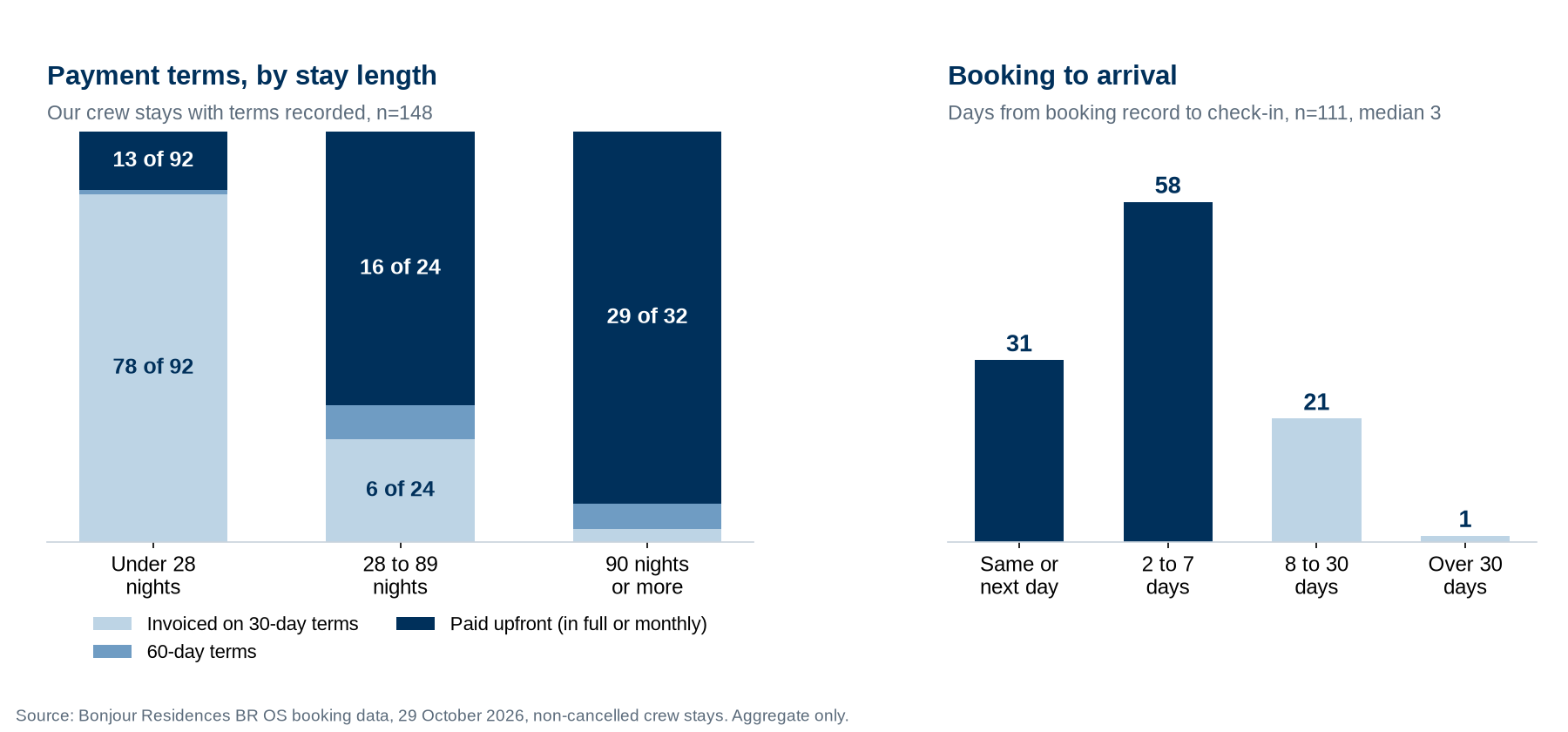
Flat owners are paid like landlords, in advance, while most contractors' accounts teams pay on 30 to 60 day terms, and the UK's Commercial Payments Bill caps payment terms at 60 days but deliberately leaves advance payments out. In Bonjour Residences booking data, 29 of 32 crew stays of 90 nights or more were paid upfront, against 13 of 92 stays under 28 nights. Bookers should agree how upfront payments get approved before the search starts, because the median gap between booking and arrival in our data is 3 days.
| 60 daysproposed UK cap on business payment terms, advance payments excluded | 29 of 32of our crew stays of 90 nights or more were paid upfront | 3 daysmedian from booking to arrival in our data (n=111) | 54%of UK construction leaders surveyed routinely fund work before the client pays |
The flat is right: four bedrooms, parking, ten minutes from site. The owner wants the first month paid before handing over the keys on Monday. Your accounts team pays suppliers at 60 days, and only once they are set up on the system. By Wednesday the flat has gone to someone else.
Our argument: this is not a negotiation problem. Hotels and large operators often take a card or invoice on terms. Flat owners are landlords, and landlords are paid in advance. The longer the crew stays, the more the booking looks like rent. A booker who only finds this out once the right flat turns up has already lost it.
Won't the new UK late payment law sort this out?
No, and it was written that way on purpose. The Commercial Payments Bill passed its last stage in the House of Lords on 20 October 2026 and was introduced in the Commons the next day. It caps payment terms between businesses at 60 days (30 when a public body is buying), makes late payment interest at 8% above Bank of England base rate compulsory, and bans retentions in construction contracts. The government expects most measures to take effect in late 2027 or early 2028.
Advance payments are outside the cap. In the Lords committee debate in July, the minister said that because an advance payment falls due before the supplier has performed, it is right that it is left out. So the law limits how long you can make a supplier wait after the stay. It says nothing to an owner who wants paying before it starts.
Elsewhere in Europe, the 2011 late payment directive already sets 60 days as the default between businesses, longer only if expressly agreed. The EU Court of Justice ruled in February 2025 that a longer term set by the paying company on its own does not count as agreed. In Germany, the civil code makes rent on a flat due at the start of each month, by the third working day at the latest. Monthly in advance is the legal default there.
What do our crew bookings show?
Payment terms follow the length of the stay. Of 210 crew stays in our booking system (cancelled stays excluded), 148 have payment terms recorded. Short stays work like a hotel bill: 78 of 92 stays under 28 nights were invoiced on 30-day terms. Long stays work like rent: 29 of 32 stays of 90 nights or more were paid upfront, 18 of them month by month. All 26 rolling stays with terms recorded are paid upfront.
The bigger issue is timing. Of 111 stays where the booking record was created before arrival, 89 were created within a week of check-in, and the median was 3 days. A new supplier set-up followed by a 30 or 60 day payment run cannot fit inside that window.
Why is everyone's cash tighter right now?
Because payment is getting slower across construction. In a Construction News survey of more than 100 industry leaders published on 12 October 2026, 42% said payment times had got worse over the past year, and 54% routinely or frequently fund delivery costs before the client pays. In France, INSEE's October survey of building firms showed the balance of opinion on payment delays at its worst since July 2015. Contractors who are waiting longer for their own money hold on to cash harder, and an owner asking for a month upfront meets more resistance.

How do the rules line up?
| What the rule says | What it means for a crew booking | |
|---|---|---|
| UK, Commercial Payments Bill | Business payment terms capped at 60 days (30 for public bodies); advance payments left out on purpose | Your own suppliers get paid faster. A flat owner can still ask for money before the keys |
| EU, Directive 2011/7/EU | 60 calendar days unless expressly agreed and not grossly unfair to the supplier | Your standard 60 to 90 day terms are not binding on an owner who never agreed to them |
| Germany, section 556b BGB | Rent is due at the start of each period, at the latest by the third working day | Monthly in advance is the legal default for a flat, not a special demand |
| Your accounts payable | New supplier set-up, purchase order, then the next payment run | Often longer than the 3 days between booking and arrival |
None of this means flats are the wrong choice. For a long crew stay they usually are the right market: our clients have saved 20-30% by using the correct market for the length of stay. But the saving only counts if the money can move as fast as the flat does.
What should bookers do differently?
- Sort payment out before the search starts. Agree with finance that crew accommodation can be paid upfront, up to a set amount, without a new approval each time.
- Plan for monthly in advance on anything over a month. Budget the cash for month one before arrival and each later month at its start, not on 60-day terms.
- Have one supplier already set up. One company that pays owners and invoices you on one account removes the supplier set-up step from every booking.
- Get the purchase order and reference in place before you book, so the first invoice is not rejected. See why accounts payable rejects crew accommodation invoices.
- Treat the deposit separately. It is a second upfront payment on long stays, and it comes back slowly: why the deposit has not come back.
Related: who carries the currency risk and how far ahead crews are booked.
FAQ
Can a flat owner insist on payment before the crew arrives?
Yes, if that is what you agree. Rent is normally paid in advance, and the UK's proposed 60-day cap leaves advance payments out.
Does the Commercial Payments Bill apply to crew accommodation?
It applies to business-to-business contracts once in force, expected late 2027 or early 2028. It limits how long you can take to pay after the stay, not whether an owner can ask for money upfront.
How do contractors pay for long crew stays?
In our data, mostly monthly in advance: 29 of 32 stays of 90 nights or more were paid upfront.
- UK Parliament, Commercial Payments Bill [HL], bill stages (Lords third reading 20 October 2026, Commons first reading 21 October 2026), bills.parliament.uk, read 29 October 2026; Commercial Payments Bill as brought from the Lords, Bill 166, new section 2B.
- Commercial Payments Bill: overview, GOV.UK, 19 May 2026, read 29 October 2026.
- Hansard, House of Lords, Commercial Payments Bill [HL], Committee stage, 21 July 2026 (advance payments excluded from the payment terms provision).
- UK Parliament, Written question 33379, answer of 9 October 2026 (most measures in force late 2027 or early 2028).
- Late Payment of Commercial Debts (Interest) Act 1998, section 11 (advance payments), legislation.gov.uk.
- Directive 2011/7/EU on combating late payment in commercial transactions, Article 3(5), EUR-Lex; Court of Justice of the EU, Case C-677/22, judgment of 6 February 2025.
- Bürgerliches Gesetzbuch, section 556b(1), gesetze-im-internet.de.
- Construction News, CN survey highlights sector's finance woes, 12 October 2026.
- INSEE, business survey in the building industry, October 2026, as reported by Batinfo, 22 October 2026.
- Bonjour Residences, BR OS booking data, 29 October 2026 (210 non-cancelled crew stays; 148 with payment terms recorded; 111 with a booking record created before check-in). Anonymised aggregate, no client names or rates.

Contact us today to discuss your next project