Why does accounts payable keep rejecting our crew accommodation invoices?
Crew accommodation invoices are usually rejected for a missing purchase order or buyer reference, and e-invoicing in Belgium, France and, from 2029, the UK turns that from a polite email into an automatic bounce. In Bonjour Residences data, only 38% of crew stays had a client reference on file, and long stays, which generate the most invoices, had one least often. Bookers should fix the reference, the paying entity and the invoicing rhythm at booking, not when the first invoice comes back.
| 38%of our crew stays had a client PO or reference on file (77 of 201) | 1 in 3of our crew stays ran longer than 30 nights, so more than one invoice (62 of 201) | 20m+e-invoices exchanged in France in the first five weeks of its reform (to 4 October) | 2029the year all UK VAT invoices must be e-invoices |
The crew is housed, the stay went well, and three weeks later the host chases payment. Accounts payable bounced the invoice: no purchase order number. Then it bounces again because it is addressed to the wrong company. Nobody on site thinks this is their problem, so it lands on the booker.
Our argument: crew accommodation invoices are rejected because of decisions made at booking, and e-invoicing is about to make those decisions unforgiving.
Why are crew accommodation invoices rejected so often?
Because crew accommodation is bought the opposite way to everything else on a project. Materials and subcontracts go through procurement first. Beds are booked in a hurry, often days before arrival, by someone on site, and the paperwork follows later.
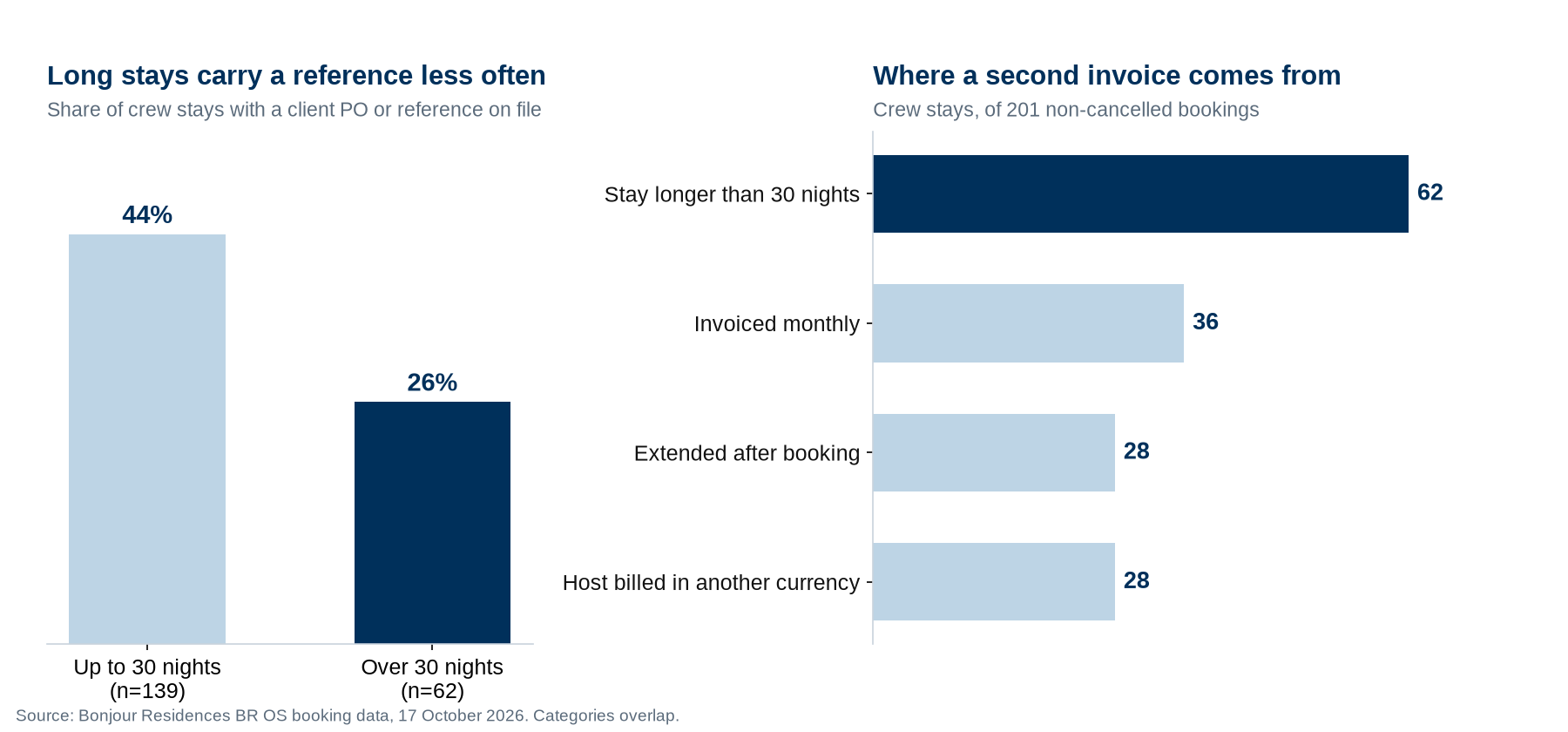
Our own data shows the gap. Across 201 crew stays we arranged this year (cancelled bookings excluded), only 77, or 38%, had a client purchase order or reference on file. And the stays that create the most invoices had one least often: 44% of stays up to 30 nights carried a reference (n=139), against 26% of stays over 30 nights (n=62).
Why do long stays make it worse?
A one-week hotel stay produces one invoice. A three-month crew stay produces many. 62 of our 201 stays ran longer than 30 nights, 36 were invoiced monthly, and 28 were extended after booking, each extension adding a new invoice. In 28 stays the host billed in a different currency from the client invoice. Every extra invoice is another chance to hit a PO that has expired, run out of value or never existed.
What is e-invoicing changing?
Under paper and PDF, a missing reference meant an email and a delay. Under structured e-invoicing, it can mean a machine rejection.
- Belgium: since 1 January 2026, invoices in scope of the obligation must be structured electronic invoices, sent in practice over the Peppol network.
- France: since 1 September 2026, every VAT-registered business must be able to receive e-invoices, and large and mid-sized companies must issue them. By 4 October, 75% of businesses filing VAT had chosen a reception platform and more than 20 million invoices worth over EUR 70 billion had been exchanged, the government said on 9 October. Smaller firms must issue from September 2027. French rules already require the purchase order number on the invoice when the buyer has issued one.
- UK: the government will require all VAT invoices to be e-invoices from 2029, with an implementation roadmap promised at the Budget.
The Peppol standard behind much of this is blunt. Its rule R003 reads: "A buyer reference or purchase order reference MUST be provided." An accommodation provider who does not know your reference cannot send a valid invoice at all.
| What accounts payable checks | Why crew invoices fail it | Fix it at booking |
|---|---|---|
| PO number or buyer reference | The stay was booked by phone from site before a PO existed | Raise the PO before arrival, or agree a project code the supplier can quote |
| Paying entity and VAT number | Booked under the parent, paid by the local subsidiary, or the reverse | Name the legal entity that pays on the booking itself |
| Period and headcount | The invoice covers dates or names nobody approved | Agree the invoicing period (monthly, by phase) and who signs it off |
| Extensions | A new invoice arrives against a closed or exhausted PO | Ask for the PO to cover the likely extension, or a new reference per extension |
| Format and channel | A PDF sent by email to a buyer that only accepts structured e-invoices | Give the supplier your e-invoicing address or Peppol ID up front |

What should bookers do differently?
- Treat the PO as part of the booking. No reference, no confirmation. If the PO will come later, agree a project or site code the supplier can quote today.
- Name the paying entity and its VAT number on the booking, especially when the crew works for a subsidiary in another country.
- Size the PO for the realistic stay, not the first month. Long stays get extended; a PO that covers only the first period guarantees a rejection later.
- Agree the invoicing rhythm up front: monthly, by phase or at the end, and who approves each one.
- Send your e-invoicing details with the booking, not after the first bounce.
- Use one supplier for multi-country crews, so one set of references and one invoice format cover every site instead of a different host per country.
Related: one invoice, one contact for temporary worker accommodation, how to stop chasing receipts when the crew moves country and what happens to the accommodation when the project slips.
FAQ
Is a purchase order number legally required on an invoice?
It depends on the country. In France, the invoice must show the purchase order number when the buyer has issued one. Under Peppol e-invoicing, a buyer reference or purchase order reference is mandatory.
Who should give the accommodation provider the PO number?
The booker, at booking. The host cannot invent it, and site teams rarely have it.
What happens to extensions when the PO runs out?
The extension invoice is usually rejected until a new or increased PO is raised. Ask for one before the extension starts.
- Peppol BIS Billing 3.0, rule PEPPOL-EN16931-R003, OpenPeppol, May 2026 release, read 17 October 2026.
- FPS Finance Belgium, e-invoicing FAQ: general questions on the B2B obligation, einvoice.belgium.be, read 17 October 2026.
- French government, Facturation électronique : le premier comité dresse le bilan du déploiement, communiqué of 9 October 2026 (via SensPo), and Batinfo/AFP, 12 October 2026.
- Service Public Entreprendre, Mentions obligatoires sur une facture (F31808), and La facturation électronique est effective depuis le 1er septembre 2026, read 17 October 2026.
- HM Treasury and HMRC, Promoting electronic invoicing across UK businesses and the public sector: consultation response, GOV.UK, read 17 October 2026.
- Bonjour Residences, BR OS booking data, 17 October 2026 (201 non-cancelled bookings; client reference on file for 77). Anonymised aggregate, no client names or rates.

Contact us today to discuss your next project