Our crew accommodation is billed in euros but our budget is in pounds: who carries the currency risk?
On a crew stay abroad, the currency on the invoice decides who carries the exchange rate risk, and on a rolling stay it re-prices every month: sterling has moved 2.7% against the euro in four weeks, and the Norwegian krone 14.5% across the year. In Bonjour Residences booking data, 32 of 47 European crew stays booked by UK companies were billed in euros or kroner, and half of all our European crew nights were in countries outside the euro (5,517 of 11,032). Bookers should choose the invoice currency at quote stage, ask when the exchange rate is fixed, and budget a buffer for floating currencies.
| 2.7%how far sterling moved against the euro in four weeks to 23 October 2026 | 32 of 47of our European crew stays booked by UK companies were billed in euros or kroner | 50%of our European crew nights were in countries outside the euro (5,517 of 11,032) | 14.5%gap between the Norwegian krone's 12-month high and low against the euro |
The quote was approved in pounds. The invoices arrive in euros, every month, for a crew in Slovakia whose stay keeps rolling on. Nobody in the site team ever decided who should carry the exchange rate. It got decided anyway, by whoever chose the currency on the first invoice.
Our argument: the currency on a crew accommodation invoice is a booking decision, not an accounts detail. On a rolling stay, every invoice is converted again at that month's rate, so a currency move becomes a price change that nobody negotiated.
Why does this matter right now?
Because the rates are moving. On 23 October 2026, Reuters reported sterling at a 17-month high against the euro, on track for a fourth straight weekly rise, with the euro at 83.70 pence after touching its lowest since May 2025. The ECB reference rate moved from 0.86045 pounds per euro on 25 September to 0.83728 on 23 October. For a UK contractor paying in euros, that is a 2.7% cut on every invoice in four weeks.
It runs both ways. Last November the same euro cost 0.8846 pounds, about 5% more than today. A Reuters poll of economists expects the Bank of England to raise rates in November, and the ECB meets on 29 October. Nobody booking a six-month stay knows which way the next move goes.
Further north the moves are bigger. The Norwegian krone is at its strongest against the euro since 2022, NRK reported on 20 October, and its gap between 12-month high and low is 14.5%. The Hungarian forint's is 13.4%.
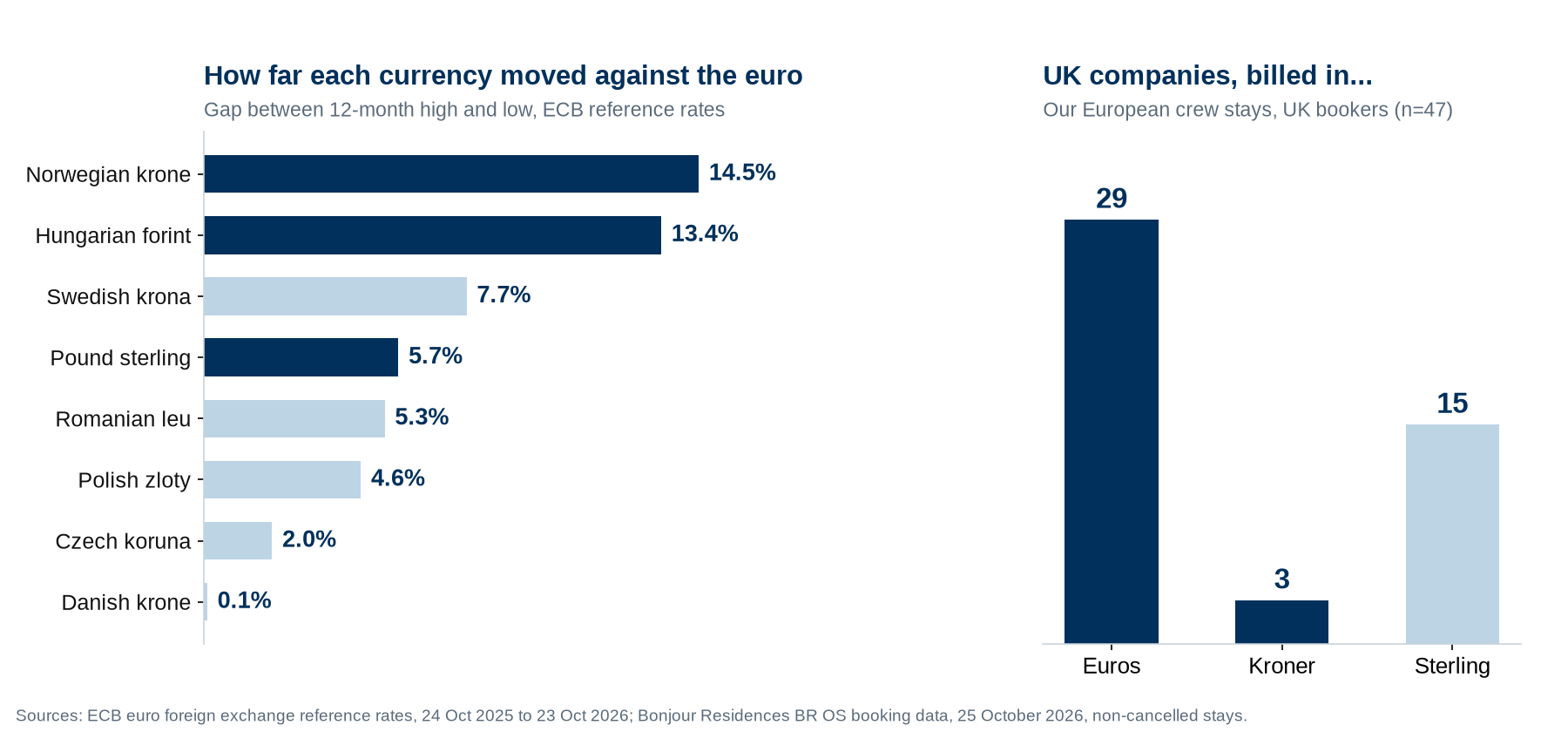
How often is a crew stay billed in a foreign currency?
More often than budgets assume. Of 47 crew stays in Europe booked by UK-based companies in our booking system (cancelled stays excluded), 29 were billed in euros and 3 in Danish kroner. Only 15 were billed in sterling. The euro stays were spread across Slovakia, Germany, Italy, France and Spain.
The other side of the map matters too. Of 192 crew stays in Europe, 61 were in countries outside the euro: the UK, Denmark, Czechia, Poland and Romania. They held 5,517 of 11,032 nights, half of the total. So even a euro budget is not safe from currency risk.
And the owner's currency is not always the local one. In Poland and Czechia, the owner priced in euros on 15 of 21 stays. A booker who expects a zloty or koruna invoice can be wrong in either direction.
| Currency | How it behaves against the euro | 12-month high to low | What it means for the booker |
|---|---|---|---|
| Euro (21 countries, Bulgaria since 1 Jan 2026) | Single currency | None | No risk for euro budgets; full risk for sterling budgets |
| Danish krone | Pegged to the euro (ERM II, central rate 7.46038) | 0.1% | A kroner price is close to a euro price |
| Czech koruna | Floats | 2.0% | Suppliers often quote in euros anyway |
| Polish zloty | Floats | 4.6% | Ask which currency the owner really prices in |
| Pound sterling | Floats | 5.7% | Fix the invoice currency before the first invoice |
| Swedish krona | Floats | 7.7% | Budget a buffer on long stays |
| Hungarian forint | Floats | 13.4% | Lock the rate or invoice in your own currency |
| Norwegian krone | Floats | 14.5% | Lock the rate or invoice in your own currency |
Who actually carries the risk?
Whoever is paid in the other currency. If the invoice is in euros and your budget is in pounds, you carry it. If the invoice is in pounds and the owner is paid in euros, the agency or owner carries it, and the rate they use to convert matters. In our system, 16 of 192 European stays had the owner paid in one currency and the client billed in another. On 11 of those 16, the exchange rate was fixed at booking.
Two details catch bookers out. First, the peg: the Danish krone has held its euro central rate of 7.46038 since 1999, so a kroner price behaves almost like a euro price, while the Swedish and Norwegian currencies float freely. Second, VAT. Under Article 230 of the EU VAT Directive, an invoice may be in any currency, but the VAT payable must be shown in the national currency of the member state. A euro invoice from Denmark should still show the VAT in kroner. If yours does not, ask for a corrected invoice before accounts payable sends it back.

What should bookers do differently?
- Choose the invoice currency at quote stage. Write it into the booking, not the first invoice.
- Ask when the exchange rate is fixed: at booking, at each invoice, or never. On a rolling stay, this decides whether month four costs the same as month one.
- Budget a buffer for floating currencies. On a long stay in Norway, Sweden or Hungary, the past year's swings were 7.7% to 14.5%.
- Treat kroner and euros as one risk in Denmark, and plan for the zloty, koruna, krona and forint separately.
- Check the VAT line on any invoice in a currency that is not the local one.
Our clients have saved 20-30% by using the correct market for the length of stay. A currency move can quietly hand part of that back if nobody owns it.
Related: why accounts payable rejects crew accommodation invoices, the VAT 28-day rule for contractor accommodation and what changes when the crew stays past three months.
FAQ
Can a crew accommodation invoice be in a currency other than the local one?
Yes. In the EU, invoice amounts may be in any currency, but the VAT payable must be shown in the national currency of the member state where the accommodation is.
Is a Danish kroner invoice a currency risk for a euro budget?
Very little. Denmark holds the krone close to a central rate of 7.46038 per euro under ERM II; over the past 12 months the gap between high and low was 0.1%.
Does Bulgaria still use the lev?
No. Bulgaria adopted the euro on 1 January 2026 at a fixed rate of 1.95583 lev per euro, making it the 21st euro area country.
- European Central Bank, euro foreign exchange reference rates (GBP, NOK, HUF, SEK, RON, PLN, CZK, DKK), 24 October 2025 to 23 October 2026, ECB Data Portal, read 25 October 2026.
- Reuters (via Euronext), Sterling edges up to fresh 17-month high versus euro after UK data, 23 October 2026.
- Reuters poll (via Investing.com), BoE to raise rates to 4% in November, 15 October 2026.
- NRK, Euroen har ikke vaert billigere siden 2022, 20 October 2026.
- Danmarks Nationalbank, Questions regarding fixed exchange rate policy; European Commission, Denmark and the euro, read 25 October 2026.
- European Central Bank, Bulgaria introduces the euro, press release, 1 January 2026.
- Council Directive 2006/112/EC, Article 230 (as amended by Directive 2010/45/EU), EUR-Lex, read 25 October 2026.
- Bonjour Residences, BR OS booking data, 25 October 2026 (192 non-cancelled crew stays in Europe; 47 booked by UK companies). Anonymised aggregate, no client names or rates.

Contact us today to discuss your next project