The crew is staying past three months: what paperwork kicks in?
Around day 90, a crew on a European project stops being treated as visitors: most EU countries can require residence registration after three months, Germany requires registration at the town hall from three months for people who live abroad, and non-EU crews, including UK workers, hit the Schengen limit of 90 days in any 180. In Bonjour Residences booking data, only 17% of crew stays ran past 90 nights (36 of 210), but they held 73% of all nights, and two in three of them rolled month by month. Bookers should put the day-90 date in the plan at booking and confirm the accommodation provider will sign the landlord paperwork registration needs.
| 73%of our crew nights were in stays longer than 90 nights (36 of 210 stays) | 24 of 36of those long stays rolled month by month, with no fixed end | 3 monthsafter which a crew member living abroad must register a German address | 90 / 180days: the Schengen limit for non-EU crews, counted digitally since April 2026 |
The job was booked for eight weeks. It is now week twelve, the crew is still in the same flat, and the booking rolls on every month.
That is the moment the paperwork changes. Around day 90, most European countries stop treating a crew as visitors and start treating them as residents. Registration duties start, a landlord signature becomes necessary, and for non-EU crews the right to stay can simply run out.
Our argument: the three-month line is a booking decision, not an HR detail. The length of stay decides which rules apply, so the person who books the accommodation is the one who should see the line coming.
Why is this suddenly harder to ignore?
Because the counting has gone digital. Since 10 April 2026, the EU Entry/Exit System has been fully operational at Schengen external borders, replacing passport stamps with digital records of every entry and exit by non-EU nationals on short stays. For a UK crew working in Germany or Denmark, the 90-days-in-180 limit used to be checked by hand. Now the system records the days.
Posting is going digital too. On 20 October 2026, the European Parliament approved a regulation for a single digital portal for posting declarations, which member states can choose to use. That helps the employer's notice to the labour authority. It does not replace the address registration that the worker and the accommodation have to deal with on site.
What changes at three months?
For EU crews, the EU free movement directive lets a host country require registration for stays longer than three months, with a deadline of at least three months from arrival. Countries use that option differently.
Germany is the clearest case. Anyone moving into a dwelling registers within two weeks. People who live abroad and are not registered in Germany are exempt, but only for three months; after that they register within two weeks. The landlord, or someone acting for them, must confirm the move-in in writing within the same deadline.
Belgium starts earlier: EU citizens report their presence to the commune within 10 working days of arrival, even for short stays, unless they stay in a hotel. The Netherlands draws its line at four months. Denmark, Finland and Spain use three.
| Where | The line | What the crew must do | What the accommodation must do |
|---|---|---|---|
| Germany | After 3 months (people who live abroad) | Register at the town hall within two weeks | Landlord confirms the move-in in writing (Wohnungsgeberbestätigung) |
| Belgium | From arrival, and again after 3 months | Report presence within 10 working days, unless in a hotel; register with the commune past 3 months | Provide an address the commune can check |
| Netherlands | Over 4 months | Register with the municipality within 5 days of arrival | Provide an address that can be registered |
| Denmark | Over 3 months | Apply for an EU residence document, then a CPR number | Provide a permanent address (needed for CPR) |
| Finland | Over 3 months without a break | Register right of residence with Migri | Provide the address for the application |
| Spain | Within 3 months of entry | Register in person at the foreigners' office or police | Provide the address for the certificate |
| Schengen, non-EU crews | 90 days in any 180 | Leave, or hold the national permit needed for a longer stay | Nothing, but the stay cannot outlast the right to be there |
How many crew stays cross the line?
Few stays, but most of the nights. Of 210 crew stays in our booking system with dates recorded (cancelled stays excluded), 36 ran past 90 nights. That is 17% of stays, but those 36 stays held 8,561 of 11,692 nights, or 73%. Their median length was 181 nights, and 17 of them ran past six months.
The important number is how they got there. 24 of the 36 long stays were on monthly rolling terms, and 11 had a formal extension recorded. Rolling terms suit crews, because nobody knows the end date. But a rolling stay has no moment where someone stops and says "this is now a four-month stay in Germany".
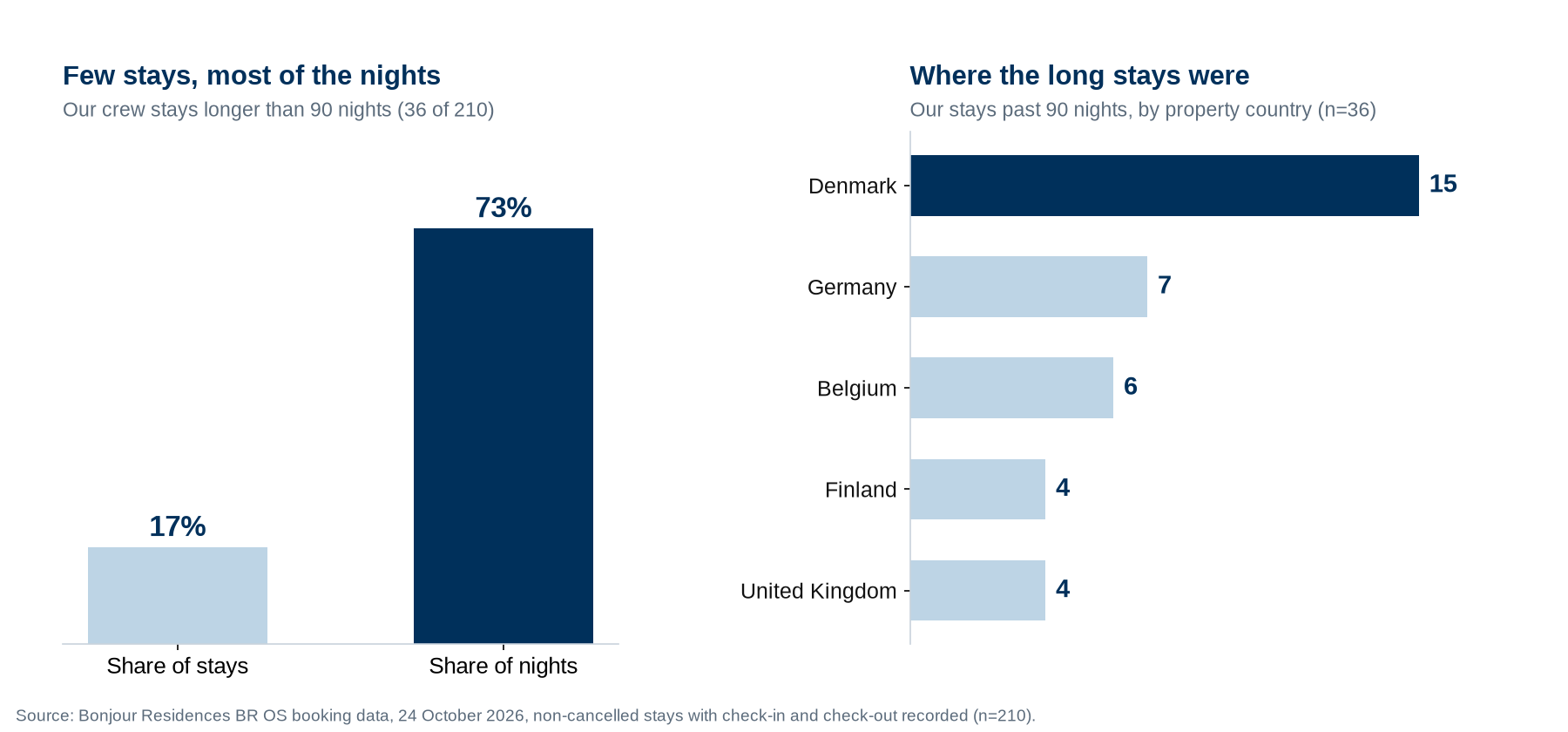
The long stays were also concentrated: 15 of the 36 were in Denmark, 7 in Germany, 6 in Belgium and 4 in Finland. All four countries can require registration after three months.
Where does the accommodation come in?
Registration is tied to an address, so it is tied to the accommodation. In Germany, registering needs the landlord's written confirmation of the move-in, and the law says only the landlord or someone acting for them can issue it. In Denmark, a CPR number needs a permanent address. If the provider will not sign, or the address cannot be registered, the crew has a problem the booker created without knowing.

What should bookers do differently?
- Put day 90 in the plan at booking. On a rolling stay, note the date each crew member passes three months, and four months in the Netherlands.
- Ask the provider in writing whether they will sign the landlord confirmation or equivalent, before the crew arrives.
- Flag non-EU crews early. For UK and other non-EU workers, count days across the whole Schengen area, not per country, and check permits before the stay passes 90 days.
- Review at month two, not month four. A short check at eight weeks catches the stays that are about to cross the line.
Our clients have saved 20-30% by using the correct market for the length of stay. A stay past three months belongs in the long-stay market, with paperwork to match.
Related: whether the accommodation needs the names of swapped workers, what happens when the project slips and how contractors house crews in Germany.
FAQ
Does a crew from abroad have to register an address in Germany?
Not for the first three months if they live abroad and are not registered in Germany. After three months they must register at the town hall within two weeks, with the landlord's written confirmation of the move-in.
Does the 90-day Schengen limit apply to UK crews?
Yes. UK nationals can stay in the Schengen area for no more than 90 days in any 180 without the relevant national permit, and since April 2026 the Entry/Exit System records entries and exits digitally.
Does staying in a hotel change anything?
In Belgium, yes: EU citizens staying in a hotel are exempt from reporting their presence for short stays. Past three months, the registration rules apply regardless.
- Bundesmeldegesetz (BMG), sections 17, 19 and 27(2), gesetze-im-internet.de, read 24 October 2026.
- Directive 2004/38/EC, Article 8, EUR-Lex, read 24 October 2026.
- IBZ (Belgian FPS Home Affairs), Registration and reporting obligation; DOFI, My Address in Belgium, read 24 October 2026.
- Rijksoverheid, Wanneer moet ik mij in de BRP laten inschrijven als ingezetene?, read 24 October 2026.
- Life in Denmark (borger.dk), Residence in Denmark for EU/EEA/Swiss citizens and When you arrive; Finnish Immigration Service (Migri), Registration of right of residence, read 24 October 2026.
- Real Decreto 240/2007, Article 7, BOE, read 24 October 2026.
- European Commission DG HOME, Entry/Exit System (EES) is fully operational, 10 April 2026; GOV.UK, EU Entry/Exit System guidance, read 24 October 2026.
- European Parliament IMCO committee, E-declaration for posting of workers, approved in plenary 20 October 2026.
- Bonjour Residences, BR OS booking data, 24 October 2026 (210 non-cancelled stays with dates; 36 longer than 90 nights). Anonymised aggregate, no client names or rates.

Contact us today to discuss your next project