Bopælspligt in Denmark: can the crew live in an ordinary Danish home?
In much of Denmark, a home used for year-round living must stay in year-round use, so a crew that lives in it for months fits the rules while short rotations and empty weeks between crews are the risk. A bill tabled on 5 November 2026 would raise the fine for repeated breaches to DKK 100,000 and let councils apply a two-people-per-room limit without the landlord's consent from 1 January 2027. Bonjour Residences data shows 15 of 17 Danish crew stays were booked for 180 nights or more, so Bonjour Residences advises bookers to plan Danish homes for long, steady crews and to use other options for short rotations.
| DKK 100,000proposed maximum fine for repeated breaches of bopælspligt, up from DKK 20,000 | 2 per roomlimit councils could apply to private rentals without the landlord from 1 January 2027 | 15 of 17of our crew stays in Denmark were booked for 180 nights or more | 12 of 188of our crew stays in the rest of Europe were that long |
On 5 November 2026, Denmark's housing minister tabled bill L 85, with its first reading in the Folketing on 19 November. It raises the fine for repeated breaches of bopælspligt, the duty to keep a year-round home in year-round use, from DKK 20,000 to up to DKK 100,000. It also lets councils apply a limit of two people per room to private rentals without the landlord's consent. Both would apply from 1 January 2027.
For bookers, this is not a tourism story. Our argument: in Denmark, what makes an ordinary home legal for a crew is how the crew uses it. A crew that lives there for months fits the rules. Short rotations, and empty weeks between them, are where the fines land.
What is bopælspligt?
It is a set of rules in the Danish housing act, lov om boligforhold. They apply in regulated municipalities, and in others whose council opts in. A home that has been used for year-round living in the last five years must stay in that use. It may not be taken into summer use or similar temporary use without the council's consent, a flat may not be let as single rooms without consent, and if a home stands empty for more than six weeks the owner must report it. The council can then assign a tenant.
Copenhagen spells out what year-round use means in practice: registration in the CPR and/or more than 180 overnight stays a year by a household. Its guidance also says a home may not be used for occasional living or for business purposes.
Why does this hit short crew rotations?
Because a flat that changes occupants every two weeks, or sits empty between crews, does not look like anyone's home. The duty sits with the owner, and the council can report the owner to the police. Councils can cross-match the CPR with the building register and ask utilities for a home's consumption. If a home is let but nobody lives there, the council can terminate the lease unless the tenant is only away for a while, for example on a business trip.
Some landlords already rule it out. One large Danish residential landlord states on its application page that a company cannot rent its flats as overnight lodging for staff, and that they cannot be let as a "håndværkerlejlighed", a tradespeople's flat.
How do the common setups compare?
| Crew setup in a Danish home | Bopælspligt risk | Why |
|---|---|---|
| Same crew lives there for months | Low | Looks like year-round living; Copenhagen's test is registration and/or more than 180 nights a year |
| Crews rotate every few weeks | Higher | Can look like occasional or temporary use, which the rules forbid in year-round homes |
| Home stands empty between crews | Owner must act | Vacancy over 6 weeks must be reported, and the council can assign a tenant |
| Flat let room by room to individual workers | Needs consent | A year-round flat may not be let as single rooms without the council |
| More than 2 people per room | Breach where the limit applies | Two per room limit; the 2025 employee housing law sets the same unless 20 m² per person |
| Hotel, or a home not used year-round in the last 5 years | Rules normally do not apply | Bopælspligt covers homes in year-round use; check the local plan |
The council decides each case. The table shows where the risk sits, not legal advice.
What does the two-per-room change mean for crews?
Today, the limit of two people per room only applies to a private rental if both the council and the landlord have opted in. L 85 removes the landlord's opt-in. The ministry cites nine adults in one flat in Copenhagen's western suburbs, and counts about 1,700 rental homes with more than two adults per room registered.
For housing an employer provides, a stricter line already exists. Since 1 July 2025, the law on employee accommodation allows no more than two people per room unless each has at least 20 m², as we covered in our piece on summer houses in winter.
What does our data show?
Danish crew stays look nothing like the rest of Europe. Of our 17 non-cancelled crew stays in Denmark, all on Zealand and spread over about a dozen towns, 15 were booked for 180 nights or more, and 12 were rolling bookings. Across 188 stays in the rest of Europe, only 12 were that long and 110 were 14 nights or less.
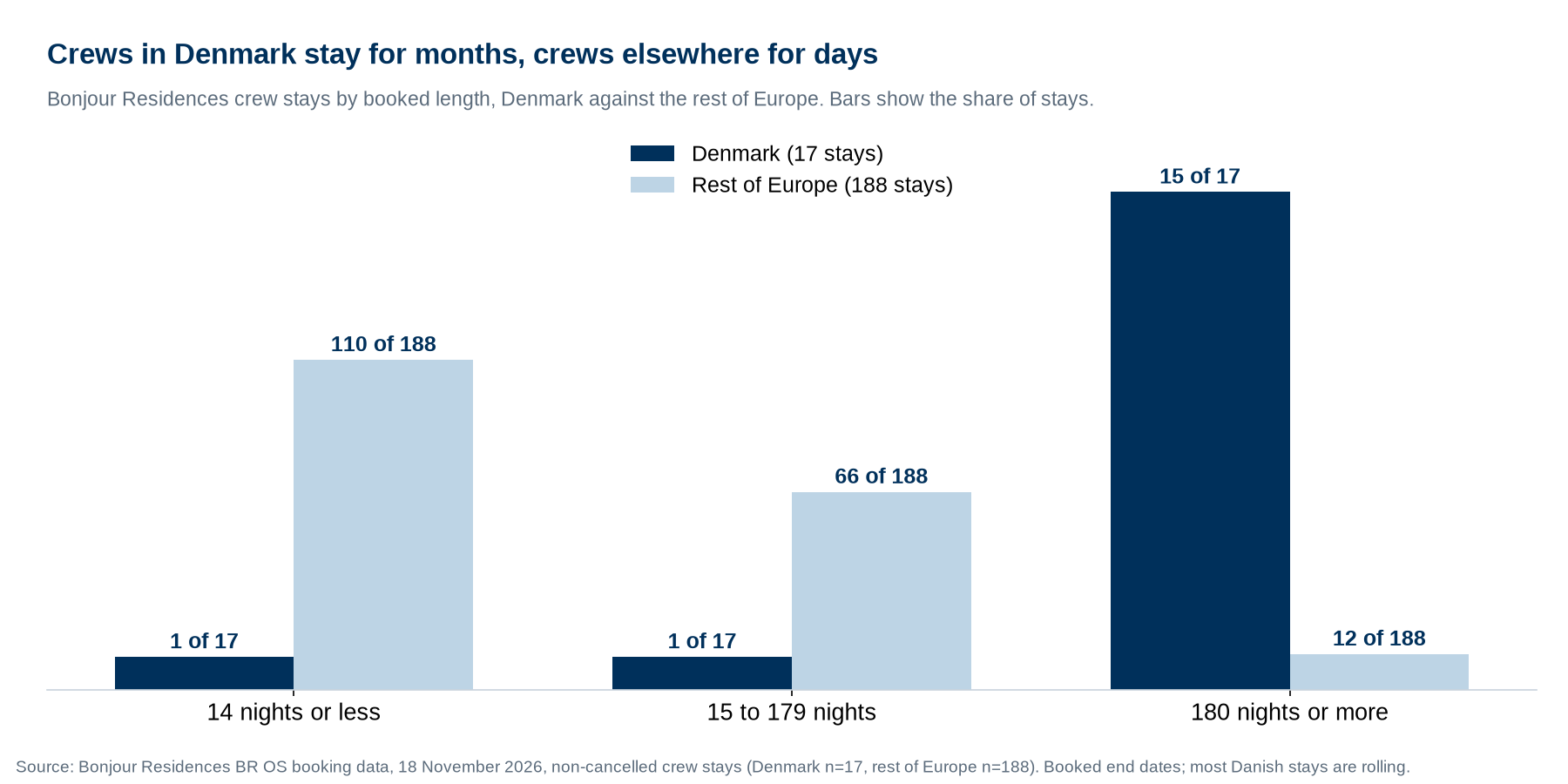
That length is what makes ordinary Danish homes work for crews. On 15 of the 17 stays, the booking had at least one bedroom per recorded guest, counting a crew split across two homes together. Small numbers: a pattern, not a benchmark.
What should bookers do differently?
- Book Danish homes for the core crew. A steady team living there for months is the use the rules expect.
- House short rotations elsewhere. For crews that change every few weeks, use hotels, hostels or homes the owner confirms are outside bopælspligt.
- Avoid empty weeks. If the crew leaves for Christmas or between phases, keep the booking lived in or agree the gap with the owner, as in planning crew rotation.
- Ask the owner three questions. Is the home subject to bopælspligt? Has the council opted in to the two-per-room limit? Will the owner let it to a company for named workers?
- Count heads per room now. From January, two per room may apply to private rentals in more councils. For bigger crews, split the crew across homes.
FAQ
Does bopælspligt apply everywhere in Denmark?
No. It applies in regulated municipalities and in others whose council has opted in, and only to homes used for year-round living in the last five years. Ask the council or the owner for the specific address.
Can the owner let the home to the crew under the 70-day holiday rule?
That rule lets owners rent out their own year-round home to holiday guests for up to 30 days a year, or 70 through a platform that reports to the tax authority, which some councils raise to 100. It is built for the owner's own home and holiday guests, not for a crew on a job.
Who pays the fine?
The owner carries the duty to keep the home in year-round use. The bill's notes expect fines of around DKK 10,000 for a first breach, DKK 20,000 for a second and up to DKK 100,000 for repeats. For a booker, the real cost is losing the home mid-job.
- Børne-, Ældre- og Boligministeriet, Forslag til lov om ændring af lov om boligforhold (L 85), tabled 5 November 2026, with explanatory notes, retsinformation.dk, read 18 November 2026.
- Børne-, Ældre- og Boligministeriet, Snyd med bopælspligt skal koste op til 100.000 kroner, press release, 18 September 2026.
- Folketinget, L 85 2026-27 case page: first reading scheduled 19 November 2026.
- Lov om boligforhold, lov nr. 342 af 22. marts 2022 as amended, sections 1 to 14, retsinformation.dk, read 18 November 2026.
- Københavns Kommune, Regler for bopælspligt i København, read 18 November 2026.
- Plan- og Landdistriktsstyrelsen, Egen fulde helårsbolig til feriegæster (30, 70 and 100 day limits), read 18 November 2026.
- Lov om indkvartering af ansatte, lov nr. 1445 af 10. december 2024, in force 1 July 2025, retsinformation.dk.
- Bonjour Residences, BR OS booking data, 18 November 2026 (Denmark n=17, rest of Europe n=188 non-cancelled crew stays). Anonymised aggregate, no client names or rates.

Contact us today to discuss your next project