Can we swap workers in the crew accommodation mid-stay?
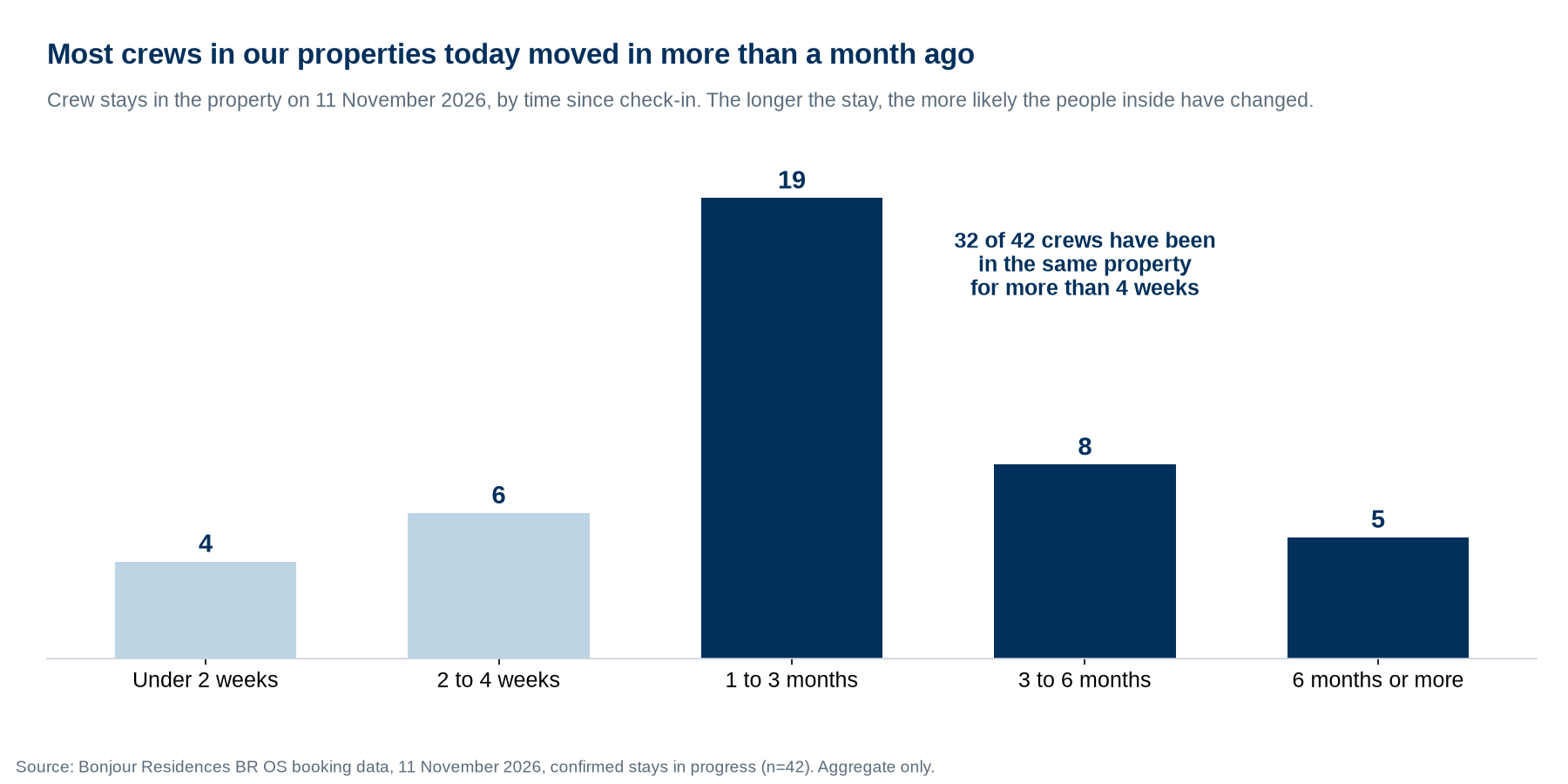
Swapping one worker for another rarely needs a new booking, but in several European countries it is a new event in law: the posting declaration must be updated, and in Spain and Italy the host must register the new guest within 24 hours. Bonjour Residences data shows that 32 of the 42 crews in our properties on 11 November 2026 had been there for more than four weeks. Bonjour Residences advises bookers to send names, dates and ID for every swap before the travel is booked.
| 32 of 42crews in our properties on 11 November had been there more than four weeks | 24 hoursfor the host to register a new guest in Spain and Italy | 558 to 93European Parliament vote on 20 October for one EU posting declaration portal | 16 of 31of our bookings with a guest list held fewer names than the headcount |
On 20 October, the European Parliament approved a regulation for a single EU portal for posting declarations, by 558 votes to 93. The Council still has to adopt it, and no date has been set for the portal to go live. Countries can choose whether to join. The duties behind it stay the same: the employer declares who is posted, where and when.
That matters for crew accommodation because crews do not stay the same. A fitter goes home after six weeks and a replacement flies in. A supervisor swaps with the night lead. Our argument: the booking is for a property, but the rules follow people. When one worker swaps for another, the flat does not change, but the paperwork does. Bookers should treat every swap as a new arrival.
Can you swap workers without changing the booking?
Usually, yes. Owners mostly care about how many people sleep in the flat, not who they are. On our bookings a swap does not need a new booking, a new contract or a new deposit. The headcount, the dates and the house rules stay the same.
The catch is the handover night. If the new worker arrives before the old one leaves, the flat can go over its maximum number of guests for a night. That is the same problem as a partner staying over, and owners treat it the same way.
What does the law treat as a change?
In Germany, the customs authority says the employer must file a change notice without delay when workers other than those originally declared are employed, or when the site moves. Separately, foreign guests in commercial lodging must sign a registration form on the day they arrive and show a valid ID. German nationals have been exempt since January 2025. So when a Polish employer swaps one posted fitter for another, that is two new events: a change notice and a new form.
In the Netherlands, the Ministry of Social Affairs says the notification must be updated when the job changes, for example when an extra worker is posted or the work runs longer. The Dutch client is told each time. In France, the employer must modify the SIPSI posting declaration when the dates change, and the labour administration says to update it as soon as a change of worker is known. The French declaration also lists the crew's housing address, as we covered in client liability for subcontractor housing.
The host has its own duties. In Spain, every guest is reported to the police platform within 24 hours of the start of the stay, and the Interior Ministry says any change to the data means a new report. In Italy, the host registers each guest in Alloggiati Web within 24 hours of arrival.
How do the rules compare?
| Country | What counts as a change | Who acts | When |
|---|---|---|---|
| Germany | Other workers than those declared; a foreign guest arriving in commercial lodging | Employer (customs portal); guest signs the registration form | Without delay; on the day of arrival |
| Netherlands | An extra worker posted, or the job runs longer | Employer updates the notification; the Dutch client is told | When the change happens |
| France | New dates or a different worker | Employer, in SIPSI | As soon as the change is known |
| Spain | Any change to the guest data | Host, in SES.Hospedajes | Within 24 hours |
| Italy | A new guest arrives | Host, in Alloggiati Web | Within 24 hours of arrival |
Why does this matter more on long stays?
Because the longer a crew stays, the more likely the people inside have changed. On 11 November, 42 crews were living in properties we booked. 32 had been there for more than four weeks, 13 for more than three months and 5 for more than six. The median was 56 days. 33 of the 42 stays are rolling, with no fixed end date.
Our records also show how easily names drift from reality. On 31 of our newer bookings with both a guest list and a headcount, 16 lists held fewer names than people. A list written at booking is often out of date by week six. Residence registration also runs per person, not per booking: in Germany, someone living abroad must register once they stay more than three months. We covered that in stays over three months.
What about keys, cleaning and invoices?
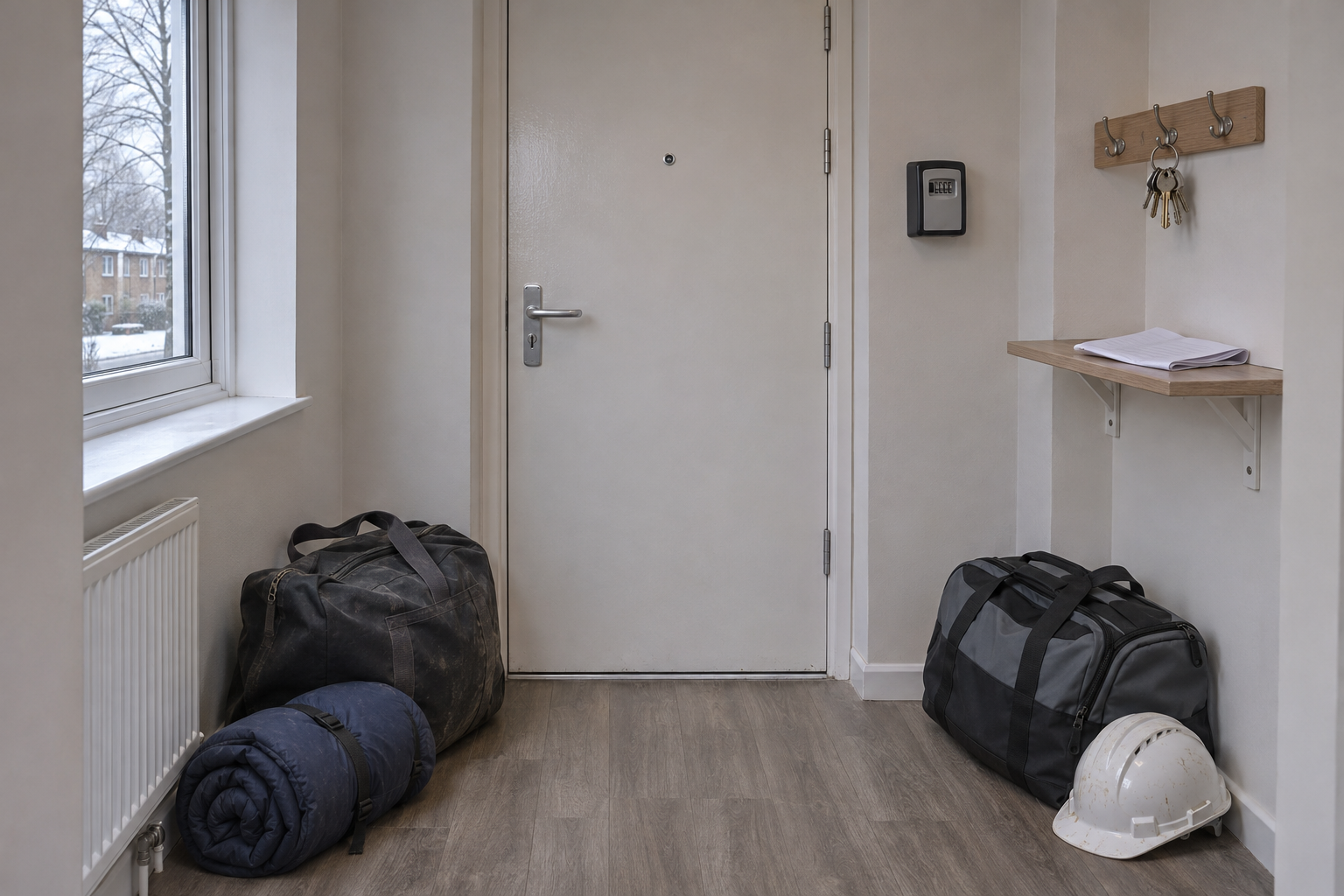
A swap is also a handover. The leaving worker has keys, sometimes a parking permit, and knows the house rules. The new one has none of that. On long stays, ask the owner to change the key safe code after a swap. A quick clean and a photo of the room between crews saves a dispute about who broke what, as in our move-in inventory checklist. Keep the same booking and client reference, so that the invoice still matches the purchase order.
What should bookers do differently?
- Send the swap before the travel is booked. Name, arrival and departure date, and nationality where the host must register guests.
- Send ID for the new arrival. In Spain and Italy the host has 24 hours to register the guest. Late ID means a late report.
- Update the posting declaration the same day. In Germany, the Netherlands and France a new worker is a change to report, not a detail.
- Avoid overlap nights. If the new worker arrives first, check the flat's maximum guests or book one night elsewhere.
- Plan the handover. Who leaves the keys, who briefs the new arrival on the house rules and the way to site.
- Keep one booking. A swap is not a new stay. The same reference keeps invoices and receipts in line.
On our bookings, when a client message says a worker will not arrive and someone else is coming instead, our system flags it as a change, and we pass the new name to the owner. Tell us early and the property is ready for the person who actually turns up.
FAQ
Do we need a new booking when one worker replaces another?
Usually not. The property, dates and headcount stay the same. Send the new name and arrival date so the host can register the guest and hand over the keys.
Does a crew swap change the posting declaration?
In Germany, the Netherlands and France, yes. Employing a different worker than the one declared means a change notice or an updated declaration.
How fast must the host register a new guest?
In Spain and Italy within 24 hours. In Germany, foreign guests in commercial lodging sign the registration form on the day they arrive.
- European Parliament, Legislative Observatory, 2024/0301(COD) Public interface connected to the Internal Market Information System for the declaration of posting of workers, decision by Parliament 20 October 2026 (558 to 93, 18 abstentions), awaiting Council; KPMG, GMS Flash Alert 2026-264, 22 October 2026.
- Generalzolldirektion (German customs), Meldung von Aenderungen bei Entsendung (MiLoG s16, AEntG s18), zoll.de, read 11 November 2026.
- BayernPortal, Beherbergungsstaette; Anmeldung (Bundesmeldegesetz s29, special registration form for foreign guests), read 11 November 2026.
- Ministerie van Sociale Zaken en Werkgelegenheid, Posted Workers, Kan ik een melding bijwerken in het geval van tussentijdse wijzigingen?, postedworkers.nl, read 11 November 2026.
- Code du travail, art. R1263-7 (SIPSI modification), code.travail.gouv.fr, read 11 November 2026; DIRECCTE, Questions et reponses sur le detachement (change of worker), via IHK.
- Real Decreto 933/2021, arts. 4 and 5, BOE; Ministerio del Interior, Preguntas frecuentes hospedajes, question 26, 10 August 2026.
- Questura di Catanzaro, Alloggiati Web (art. 109 TULPS), read 21 October 2026.
- Bonjour Residences, BR OS booking data, 11 November 2026 (42 confirmed stays in progress; 215 non-cancelled stays; 31 newer bookings with guest list and headcount). Anonymised aggregate, no client names or rates.

Contact us today to discuss your next project