Can a worker's partner stay over in the crew accommodation?
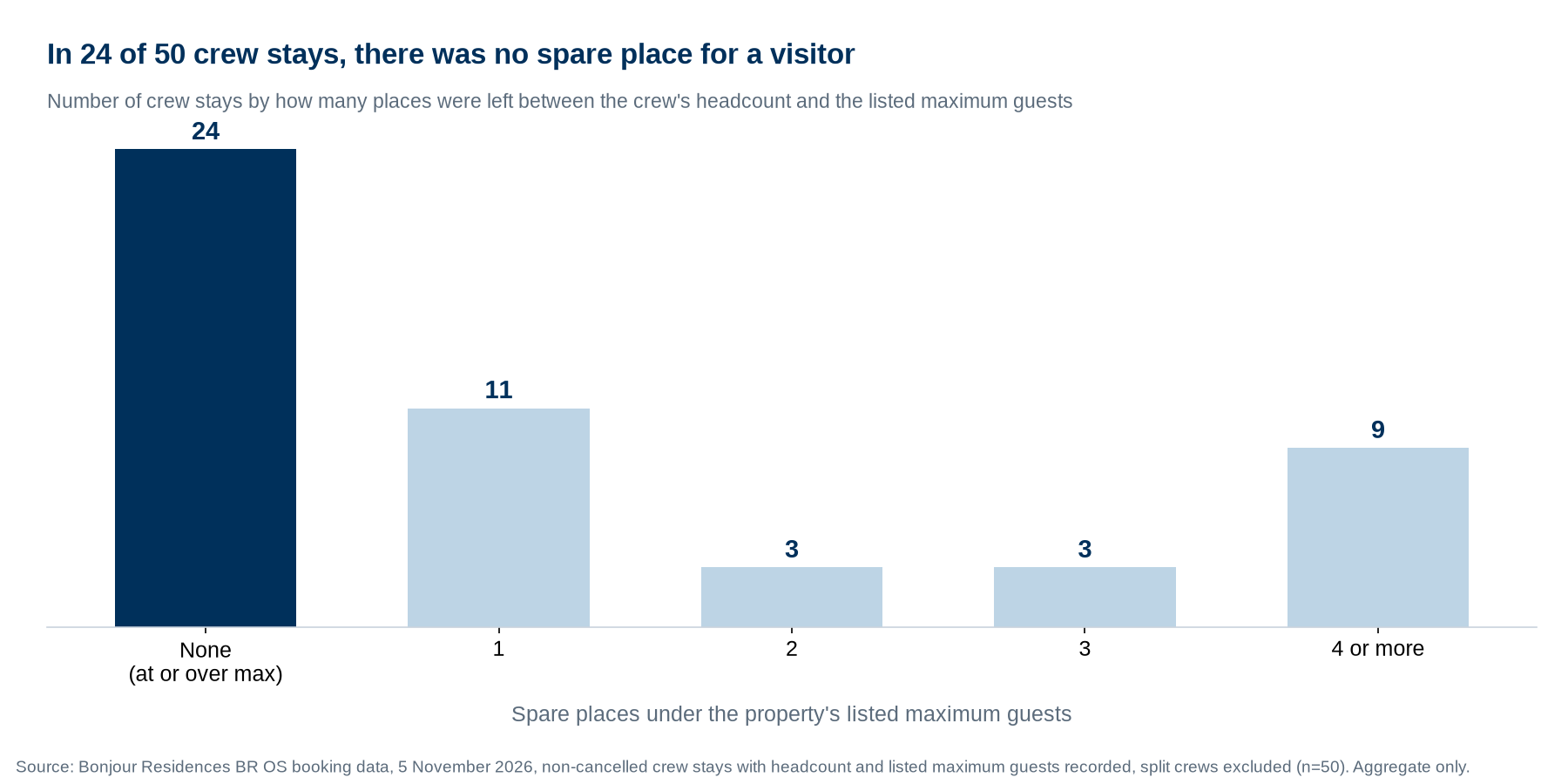
Usually yes for an occasional night, but only if the booking allows it: in Spain and Italy the host must report every guest to the police within 24 hours, in Germany foreign guests sign a registration form, and many flats are already full to their listed maximum. Bonjour Residences data shows that in 24 of 50 crew stays the crew already filled every listed place, so a visitor means an extra occupant the owner never agreed to. Bonjour Residences advises bookers to put a visitor rule in the brief before arrival, especially for stays that run over Christmas.
| 24 of 50of our crew stays had no spare place under the listed maximum guests | 25of our confirmed crew stays are booked to run through Christmas 2026 | 24 hoursfor a host in Spain or Italy to report each guest to the police | 2 per roommost an employer may house per bedroom in Denmark, unless there are 20 m2 per person |
It is the third week of a six-month job. On Thursday, a site manager gets a message from one of the crew: his partner is flying in on Friday, can she stay the weekend? Nobody in the office has a rule for this. The booking says four guests. The flat sleeps four. And in some countries, the host has 24 hours to give her name to the police.
Our argument: a partner staying over is not a private matter between the worker and the flat. To the owner, the law and the invoice, it is an extra guest. Bookers who set a visitor rule in the brief, before the crew arrives, avoid the Friday-night phone call and the dispute that follows it.
Why does this come up now?
Because Christmas is seven weeks away. Of our confirmed crew stays, 25 are booked to run through 24 to 27 December, 17 of them rolling stays counted to their booked end date. When the work pauses but the flat stays booked, families visit. Our piece on keeping or releasing the flat over Christmas covers the cost side.
And enforcement is active. On 20 October, the Polizia di Stato in Trapani reported checks on accommodation businesses that led to six owners or managers being referred to prosecutors for not reporting their guests as article 109 of Italy's public security law requires: within 24 hours of arrival, or 6 hours for stays under 24 hours. In Spain, the guest registration duty under Royal Decree 933/2021 remains in force in its original 2021 text.
Does a visitor have to be registered?
In several countries, yes, if the crew is in a flat run as an accommodation business. Spain's Royal Decree 933/2021 says the entry form must be signed by every person over 14 who uses the accommodation, and the host must report the data to the Interior Ministry's SES.HOSPEDAJES system immediately and within 24 hours at most. Italy requires the same report to the police for all guests. In Germany, section 29 of the Federal Registration Act requires foreign guests to sign a registration form on arrival, with a travelling foreign spouse or partner listed by number. Since 1 January 2025 the duty no longer applies to German nationals.
So a partner who turns up unannounced puts the host in breach, which is why hosts react badly. See also guest names after a crew swap.
Does a visitor count towards the occupancy limit?
It depends on how long they stay. In England, the government's HMO licensing guidance says room size and occupancy conditions are not breached by visitors sleeping over on an occasional basis, but a tenant who moves a friend in permanently breaks the agreement. In Denmark, housing an employer provides to staff may hold no more than two people per bedroom unless there are 20 m2 or more per person. A weekend is a visit. A partner who stays for the whole Christmas break starts to look like an extra resident.
What does our booking data show?
We looked at 50 non-cancelled crew stays where our records hold both the crew's headcount and the property's listed maximum guests, leaving out crews split across several flats. In 24 of the 50, the crew already filled or exceeded the listed maximum. Of the 26 with room to spare, the median was 2 places. In 7 of the 50, there were more people than bedrooms, so the crew was already sharing rooms. One owner's house rules in our records go further: visitors need notice and prior approval, and any increase in occupancy means a review of the monthly price.
What are the rules in each country?
| Country and type of stay | What catches an overnight partner | What the booker should do |
|---|---|---|
| England, licensed shared house (HMO) | Government guidance: occasional overnight visitors are not occupiers, but someone who moves in is | Agree a limit on nights, so a visit does not become a move-in |
| Spain, tourist-licensed flat | Every guest over 14 signs the entry form; the host reports to SES.HOSPEDAJES within 24 hours | Send the visitor's ID details to the host before arrival |
| Italy, any accommodation business | The host reports each guest's identity to the police within 24 hours, or 6 hours for stays under 24 hours | Send ID details before arrival; expect an ID check |
| Germany, accommodation business | Foreign guests sign a registration form on arrival; a travelling spouse or partner is listed by number | Tell the host the extra person so the form is right |
| Denmark, housing the employer provides | No more than 2 people per bedroom unless there are 20 m2 or more per person | Count the visitor in your headcount if the stay is not occasional |
A private long-term tenancy can differ, so read the agreement. A visitor can also add a tourist tax line, since many local taxes are charged per person per night.
What should bookers do differently?
- Write a visitor rule into the brief. Say whether visitors may stay over, for how many nights, and who approves it. Then ask the owner the same question at booking stage.
- Collect ID details in advance. In Spain and Italy the host must report each guest within 24 hours, so send the visitor's details before they travel.
- Check spare beds against the listed maximum. If the crew already fills it, a visitor means a sofa, a breach of the house rules or a second flat.
- Agree who pays for extras. Extra cleaning, tourist tax and any damage follow the booking, so the booker's company is on the hook unless the rule says otherwise.
- Plan Christmas early. If families will visit over the break, ask now. Seven weeks out, there is still time to add a room.
FAQ
Can a worker's partner stay in crew accommodation?
Often yes for an occasional night, if the owner agrees and the flat has a spare place under its listed maximum. Ask before the visit, not after.
Does a visitor need to show ID?
In Spain and Italy, a flat run as an accommodation business must register and report every guest, so expect an ID request. In Germany, foreign guests sign a registration form on arrival.
Can the owner charge more for a visitor?
Yes, if the booking or house rules say so. Some owners charge per extra person or review the price when occupancy rises.
- Real Decreto 933/2021, de 26 de octubre, articles 4 and 5 (entry form signed by every person over 14; report within 24 hours), BOE consolidated text, read 5 November 2026.
- Polizia di Stato, Questura di Trapani, monitoring of accommodation businesses (article 109 TULPS: guest reports within 6 or 24 hours), 20 October 2026.
- Bundesmeldegesetz, section 29 (registration of foreign guests in accommodation businesses), gesetze-im-internet.de; Hotelverband Deutschland (IHA), Das neue Hotelmelderecht ab 1. Januar 2025, read 5 November 2026.
- Ministry of Housing, Communities and Local Government, Houses in Multiple Occupation and residential property licensing reform: guidance for local housing authorities, 2018 (occasional overnight visitors).
- Lov om indkvartering af ansatte, Act no. 1445 of 10 December 2024 (in force 1 July 2025), Retsinformation (two people per bedroom unless 20 m2 per person).
- Bonjour Residences, BR OS booking data, 5 November 2026 (50 non-cancelled crew stays with headcount and listed maximum guests, split crews excluded; 25 confirmed stays booked through 24 to 27 December 2026, rolling stays counted to their booked end date). Anonymised aggregate, no client names or rates.

Contact us today to discuss your next project