The crew damaged the flat: who pays?
When a construction crew damages a rented flat, the company that signed the booking usually pays the owner first, whoever caused it. Whether that cost can be passed on is decided before arrival: by the booking terms, by dated photos of the flat's condition at check-in, and by the worker's written agreement to any deduction. In Bonjour Residences booking data, only 30 of 127 crew stays with the field recorded carried a deposit, so the evidence matters more than the deposit.
| 60%of short-let hosts had guest damage in the past year (Hospitable, Sep 2026) | 66%of those hosts paid for the repairs themselves | 24%of our crew stays carried a deposit (30 of 127) | 52/60of our bookings got condition photos from the owner before arrival |
Every booker of crew accommodation gets this email eventually: a photo of a broken door, a stained mattress or a burnt worktop, and an invoice. The instinct is to ask who on the crew did it. The answer that decides the money comes earlier: who signed, what was recorded at check-in, and what the worker agreed to before arriving.
Why are owners pushing harder on damage now?
Because they are paying for it themselves. In research published on 2 September 2026, Hospitable found that 60% of short-let hosts and property managers had guest damage in the past 12 months, 36% more than once, and that two thirds of those affected paid for the repairs themselves because their insurance or booking channel would not cover it. On 18 September insurer Schofields reported that 80% of 100 UK holiday let owners named guest damage as their top frustration, above cleaning and maintenance.
Owners who carry that cost respond in three ways: a bigger deposit, a higher price, or a polite no to crews. For bookers, the cheapest of the three is to show up with a clear process.
So who actually pays?
The company that signed. The owner's contract is with the booker, not with the welder who cracked the shower tray. The owner invoices or keeps the deposit, and the booker pays, regardless of whether the culprit is known. Passing the cost on to a worker is a separate step under employment law, and in most countries it is narrow.
In the UK, section 13 of the Employment Rights Act 1996 bars any deduction from wages unless a written contract term or the worker's prior written consent allows it. Consent given after the damage is too late. For posted workers, the rules on what can be taken from pay are tighter still, as we set out in Can you deduct crew accommodation from posted workers' pay?
Is the deposit there to cover it?
Often there is no deposit at all. Of the 127 crew stays in our data with the deposit field recorded, only 30 carried one. Where it was asked, the median deposit was about two weeks' worth of the nightly price (n=30). The law keeps deposits small too. In France, the owner of a furnished flat let on a bail mobilité cannot ask for any deposit. In England, the deposit on an ordinary tenancy is capped at five weeks' rent where annual rent is under GBP 50,000. In the Netherlands it is capped at two months' basic rent for contracts from 1 July 2023, it must be returned within 14 days, and normal wear cannot be charged against it.
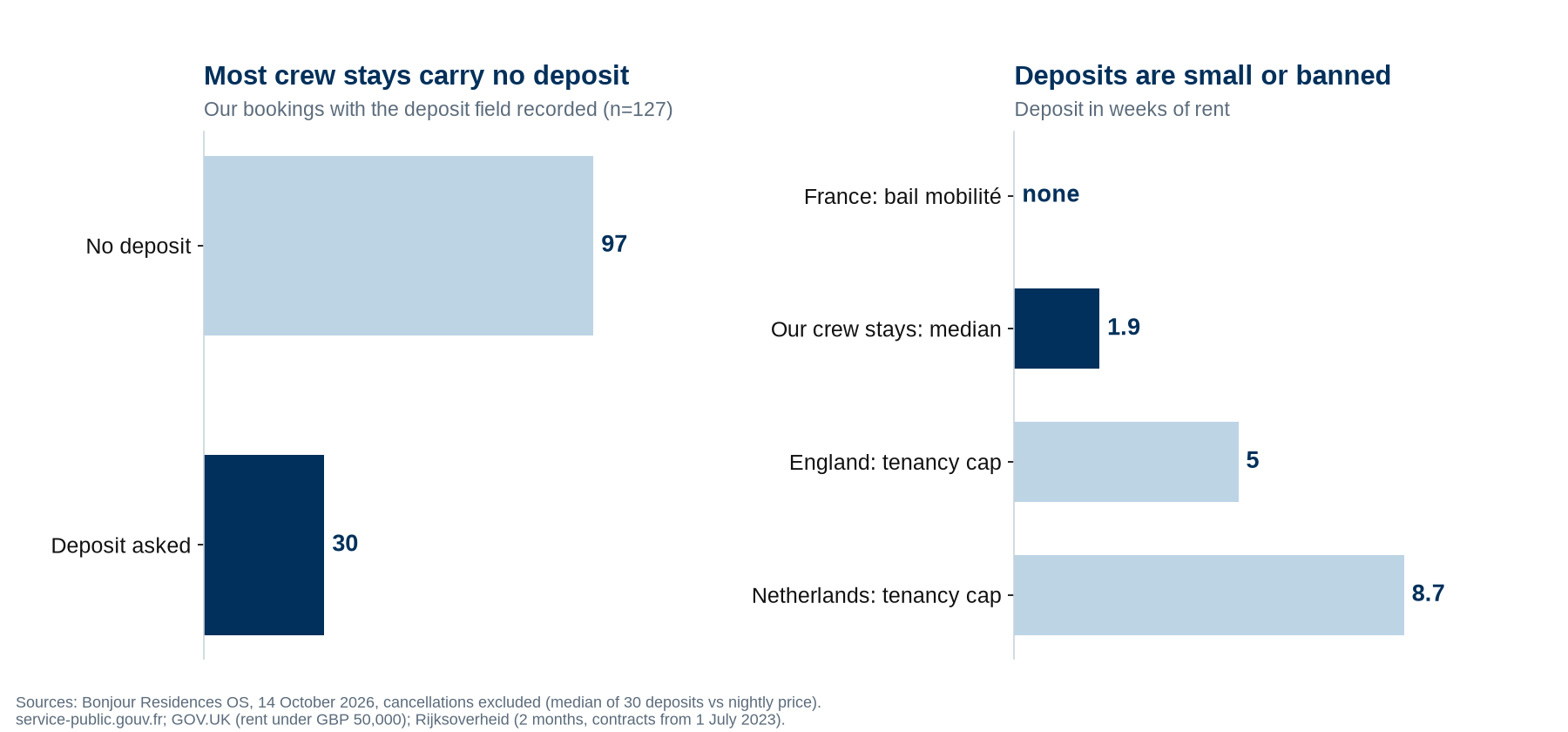
So a damage dispute is rarely settled by the deposit. It is settled by evidence: what condition the flat was in on the day the crew arrived.
What decides the argument?
Dated photos. Before arrival we ask the owner for a photo or video report of the flat's condition, and it came back on 52 of the 60 bookings where we asked (87%). That report is what separates a crack that was already there from one the crew caused. Without it, the booker pays for both.
| What happened | Who usually pays first | Can it be passed to the worker? |
|---|---|---|
| Normal wear: scuffed paint, worn carpet after weeks of use | The owner. It is the cost of letting | No. It is not damage |
| Accident: broken window, burnt worktop | The company that signed, from the deposit or by invoice | Only with a written term or prior written consent |
| Deliberate damage or a party | The company that signed, then the owner may go further | Possibly, with written consent, and only for that person |
| Damage that was there before arrival | Whoever cannot prove the date, usually the booker | No |
| Extra cleaning, missing items, lost keys | The company that signed, as set out in the booking terms | Only if agreed in writing in advance |

What should bookers do differently?
- Get the condition record before the crew arrives: dated photos or video from the owner, room by room, including meters and keys.
- Have the crew lead add their own photos within the first hour and send them the same day. Anything not reported then is presumed new.
- Agree the damage terms at booking: deposit or no deposit, how a claim is evidenced, and the deadline for raising it after check-out.
- Put written consent in place before mobilisation if you intend to recover deliberate damage from a worker. Asking afterwards does not work.
- Separate wear from damage. A crew living in a flat for three months will wear it. Do not let a long stay be invoiced as damage.
- Name one person on the crew as the contact for the flat. Owners relax when they know who to call, and they stop asking for bigger deposits.
Related: When does a crew outgrow hotel rooms?, Our project slipped 6 weeks: what happens to the crew's accommodation? and Does our crew accommodation count as a short term rental?
FAQ
Can I deduct the cost of damage from a worker's wages?
In the UK only if a written contract term or the worker's prior written consent allows it (Employment Rights Act 1996, section 13). Other countries have their own limits, and posted workers are protected by minimum pay rules, so check before mobilisation, not after the invoice.
Does the owner have to prove the crew caused the damage?
In practice the dispute turns on evidence of the condition at check-in. Dated photos or video from both the owner and the crew are the strongest protection for the booker.
Can the owner charge for normal wear and tear?
Normal wear is a cost of letting, not damage. In the Netherlands the government states that normal wear cannot be deducted from the deposit, and most booking terms follow the same principle.
- Hospitable research, reported by 10 Minutes News for Hoteliers, Two-thirds of short-term rental operators hit by guest damage paid for repairs themselves, 2 September 2026.
- Insurance Business UK, Holiday let owners cite guest damage as top stress (Schofields survey of 100 owners), 18 September 2026.
- legislation.gov.uk, Employment Rights Act 1996, section 13 (Right not to suffer unauthorised deductions), read 14 October 2026.
- Service-Public.fr (French government), Quelles sont les règles d'un bail mobilité ?, read 14 October 2026.
- GOV.UK, Fees you can charge as part of a tenancy (England), updated 2026, read 14 October 2026.
- Rijksoverheid, Mag mijn verhuurder een waarborgsom vragen als ik een woning wil huren?, read 14 October 2026.
- Bonjour Residences OS, aggregate booking data, 14 October 2026 (201 stays, cancellations excluded; deposit field recorded on 127; pre-arrival condition report requested on 60).

Contact us today to discuss your next project