The crew won't fit in one flat: should we split them across two?
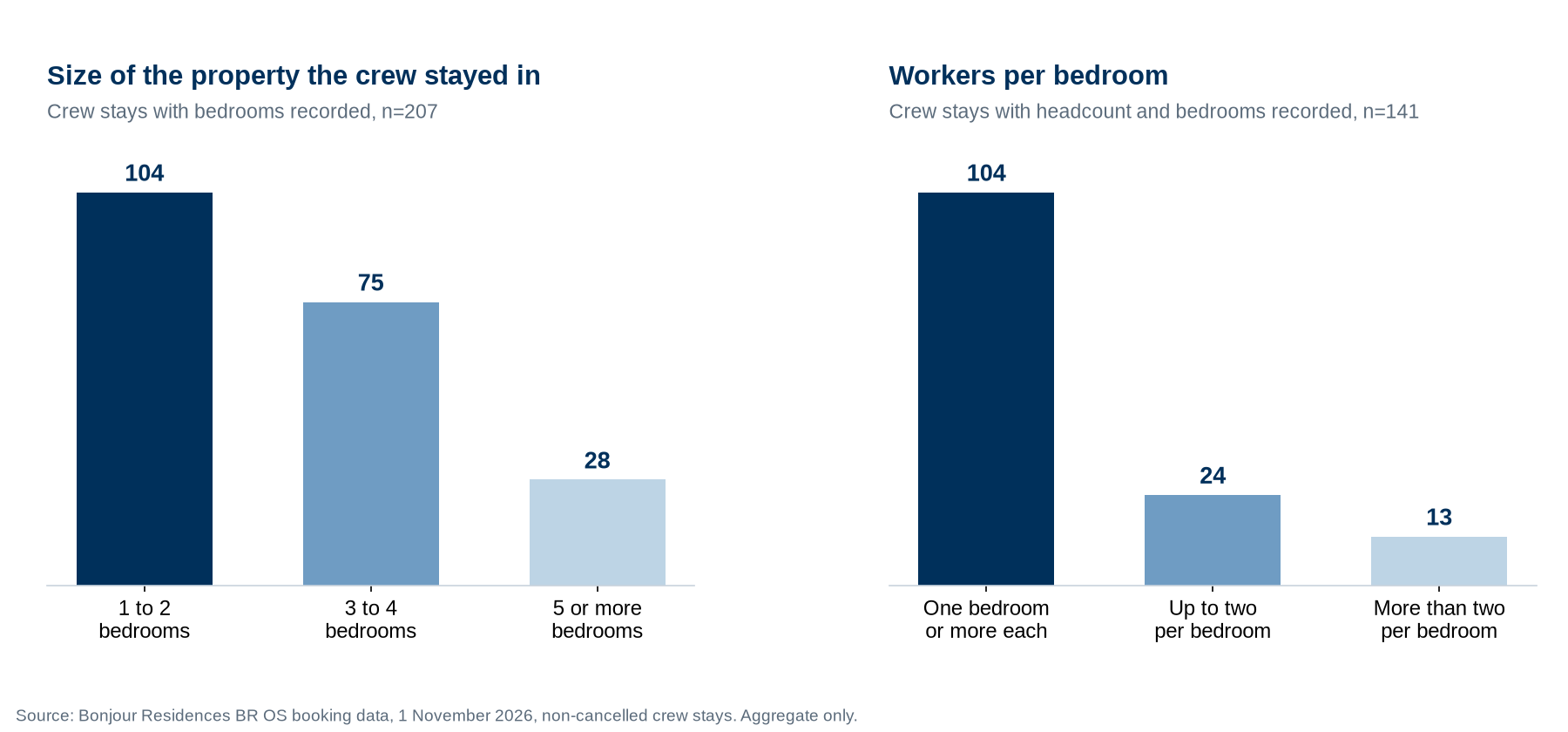
For a crew of five or more, two or three ordinary flats are often easier to secure than one big house, because large houses are scarce and a crowded house runs into licensing, space rules and neighbour complaints. In Bonjour Residences booking data, only 28 of 207 crew stays were in properties with five or more bedrooms, and 104 of 141 stays gave every worker their own bedroom. Splitting works when the flats sit close together and run under one booking reference, one contact and one invoice.
| 28 of 207of our crew stays were in a property with five or more bedrooms | 104 of 141of our crew stays gave every worker their own bedroom | 10 of 158of our crew bookings ran across two to four flats at the same time | 15 m²per resident on new Dutch worker housing locations from 1 October 2026 |
The crew is eight people for six months. The obvious brief is one big house: one address, one set of keys, everyone together. Then the search starts and the big houses are either gone, too far from site, or the owner goes quiet when they hear "eight workers".
Our argument: for any crew of five or more, plan for two or three ordinary flats close together from the start, and treat the one big house as a bonus if it turns up. The single house looks simpler on paper. In practice it is the harder thing to find, the more likely to break a rule, and the one that hurts most when it falls through.
Why is one big house so hard to find?
Because the stock is not there. In our booking data, only 28 of 207 crew stays were in properties with five or more bedrooms. The bulk sat in one and two bedroom flats (104 stays) and three and four bedroom homes (75). Big houses exist, but they are the first thing every contractor in town asks for, and they are often family homes whose owners prefer one family.
The crew also expects a room each. In 104 of the 141 stays where we hold both the headcount and the number of bedrooms, every worker had their own bedroom. Only 13 had more than two people per bedroom. So a crew of eight needs eight bedrooms, and that usually means two four bedroom flats rather than one eight bedroom house.
Does packing more workers into one house break any rules?
It can, and the rules are getting tighter. In England, a property is a large house in multiple occupation needing a licence when it is rented to five or more people forming more than one household, who share a kitchen or bathroom, and at least one pays rent or has it paid by their employer. Councils can add their own licensing on top. We covered the detail in worker accommodation standards in the UK.
In the Netherlands, the SNF standard used for labour migrant housing changed on 1 October 2026. New locations, and all locations of newly registered companies, need at least 15 m² of living space per resident, and a bedroom may in principle be used by one person only, two if the residents themselves want to share. In Germany, the technical rule for workers' accommodation (ASR A4.4) sets at least 8 m² of usable space per resident for up to six people in a sleeping area, a bed and lockable cupboard each, and no more than two beds stacked. Lower Saxony goes further for workers' housing: at least 10 m² of living space per person, and the municipality can order an overcrowded property to be cleared.
What about the neighbours?
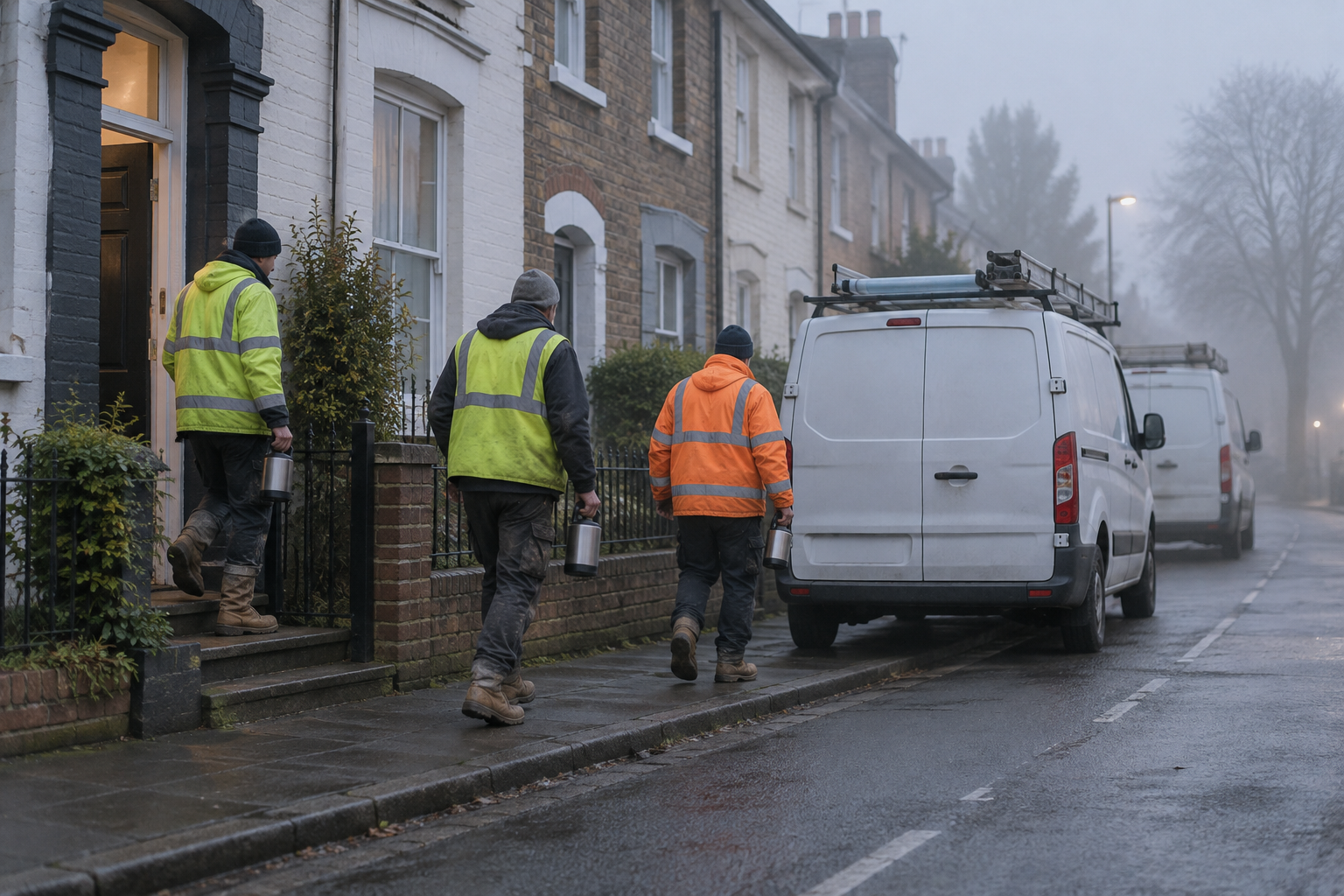
This is where big crew houses usually fail. On 19 October, Die Rheinpfalz reported that so-called Monteurwohnungen in Wörth am Rhein regularly draw complaints from neighbours about noise, rubbish and full car parks, and the town is looking to the district for help. Eight workers, four vans and a 5:30 start on one door is visible. Split across two doors, the same crew barely registers. Parking alone is reason enough, as we set out in where will the crew park the vans.
Isn't a split crew harder to run?
Only if each flat is booked as a separate job. In our data, 10 of 158 crew bookings ended up in two to four flats at the same time, 37 stays in total. The ones that run well share three things: the flats are within walking distance of each other, they sit under one booking reference with one contact, and they are invoiced together so accounts sees one line per period, not four invoices from four owners.
A split also solves problems a single house creates. Day and night shifts can sleep in different flats, which matters more than most bookers expect (see day shift and night shift in the same flat). And if one owner pulls out, half the crew moves, not all of it.
One house or several flats: how do they compare?
| One big house for the whole crew | Two or three flats close together | |
|---|---|---|
| Finding it | Rare: few homes have five or more bedrooms, and they go first | Far more stock at three and four bedrooms |
| Rules | England: five or more people from more than one household can make it a licensable large HMO. Germany and the Netherlands set space per person | Smaller households, usually under the thresholds |
| Neighbours | Several vans and early starts on one door draw complaints | Spread across two doors, less visible |
| Sleep and shifts | One kitchen and one bathroom queue for everyone | Day and night shifts can live apart |
| Running it | One address, one set of keys | Several addresses, keys and owners unless one agent runs them |
| If it falls through | The whole crew is homeless at once | Part of the crew is affected, the rest stay put |
What should bookers do differently?
- Brief by bedrooms, not by house. Ask for "eight bedrooms within ten minutes' walk of each other", not "one house for eight".
- Ask about licensing early. For five or more workers in one house in England, ask the owner whether the property is licensed. In Germany and the Netherlands, check floor space per person.
- Keep it to one booking. One reference, one contact, one invoice per period, and every flat's guest names on file (see swapping workers mid-stay).
- Split by shift or role. Supervisors or night workers in one flat, the rest in another.
- Plan the vans. Two flats usually means two parking problems. Check both before you book.
FAQ
How many workers can share one house?
It depends on the country. In England, five or more people from more than one household sharing facilities can make it a licensable large HMO. Germany and the Netherlands set minimum space per person.
Is it cheaper to put the whole crew in one big house?
Not always. Big houses are scarce, so they are often further from site or only free for part of the project.
Can a split crew still get one invoice?
Yes, if the flats are booked together under one reference with one agent.
- GOV.UK, House in multiple occupation licence (definition of a large HMO, England and Wales), read 1 November 2026.
- Stichting Normering Flexwonen, Verdere aanscherping huisvestingsnorm per 1 oktober 2026, normeringflexwonen.nl, 1 October 2026.
- Bundesanstalt für Arbeitsschutz und Arbeitsmedizin, Technische Regeln für Arbeitsstätten ASR A4.4 Unterkünfte, section 5, last amended GMBl 2024 p. 914 (4 November 2024).
- Niedersächsisches Ministerium für Wirtschaft, Verkehr und Bauen, Niedersächsisches Wohnraumschutzgesetz, mw.niedersachsen.de, read 1 November 2026.
- Die Rheinpfalz, Lärm, Müll, volle Parkplätze: Problem Monteurwohnungen (Wörth), 19 October 2026.
- Bonjour Residences, BR OS booking data, 1 November 2026 (213 non-cancelled crew stays; bedrooms recorded on 207, headcount and bedrooms on 141; 158 bookings). Anonymised aggregate, no client names or rates.

Contact us today to discuss your next project