Day shift and night shift in the same flat: will the crew get any sleep?
Only if the bedrooms are split by shift. A night worker who shares a bedroom with a day worker loses sleep twice a day, and Germany's technical rule for worker accommodation (ASR A4.4) requires separate sleeping areas for workers on different shifts. In Bonjour Residences booking data, half of crews of four or more shared bedrooms (33 of 66), so a crew that moves to day and night shifts usually needs more bedrooms, not more beds. Bookers should tell the accommodation provider the shift pattern before booking, not after the first week.
| Separatesleeping areas required for different shifts under Germany's ASR A4.4 | 50%of our crews of four or more shared bedrooms (33 of 66) | 2 nightsof full sleep HSE advises when switching between day and night shifts | 1 bedper resident: ASR A4.4 rules out two workers taking turns in one bed |
The programme changes. Concrete has to be poured at night, or the client wants the job running around the clock. The crew of six who all worked days are now three on days and three on nights, and they are all still in the same four-bedroom flat.
By the end of the first week, the night shift is not sleeping. The day shift wakes them coming home at 6pm, the kitchen is busy at noon, and two of them share a bedroom with someone on the other shift.
Our argument: when a crew moves to shifts, the accommodation needs a room plan, not a bed count. The number of beds stays the same. The number of bedrooms you need goes up.
Why is night work on the rise on site?
Because programmes are tight and some work can only happen when the railway or the road is closed. HS2 starts regular overnight concrete pours at Old Oak Common on 26 October 2026, working 8pm to 6am, Monday to Friday, until the end of April 2027. Rail possessions and data centre deadlines push crews into two shifts too.
The rules recognise that night work is harder on the body. The EU Working Time Directive caps normal hours for night workers at an average of eight in any 24 hours. The UK Health and Safety Executive says accidents and injuries have been found to be higher on night shifts, and advises allowing two nights of full sleep when a worker switches between day and night shifts. That sleep happens in the accommodation.
What does the rule say about shifts and bedrooms?
Germany is the clearest. Its technical rule for worker accommodation, ASR A4.4, says that where there is shift work, separate sleeping areas must be available for workers on different shifts. The same rule requires each resident to have their own bed, allows at most eight beds in one room in a building, and sets at least 6 m² of sleeping area per person for up to six residents.
The rule is written for accommodation an employer provides, and the German workplace regulation also covers shared accommodation off site that an employer arranges for workers, directly or through a third party. Outside Germany, it is still a sensible standard: a worker on nights should never sleep in a room a day worker walks into.
| Setup | Works when | Breaks when | Ask for |
|---|---|---|---|
| One shift per flat | Crews split into teams of 2 to 6 by shift | Shifts rotate and people swap teams | Two flats close together, ideally in one building |
| Shared flat, bedrooms kept by shift | Each shift has its own bedrooms and a lockable door | Rooms are shared across shifts to save a bedroom | A room plan by name and shift before arrival |
| Shared bedroom across shifts | Never for more than a night or two | Every day: one leaves as the other tries to sleep | Not this. Book the extra bedroom |
| Two workers taking turns in one bed | No good case | Always: hygiene, sleep and the German rule of one bed per resident | Not this |
| Hotel rooms | Short stays and night crews who need quiet in the day | Long stays with no kitchen for meals at odd hours | Day-time housekeeping switched off for night workers |
How often do crews share bedrooms?
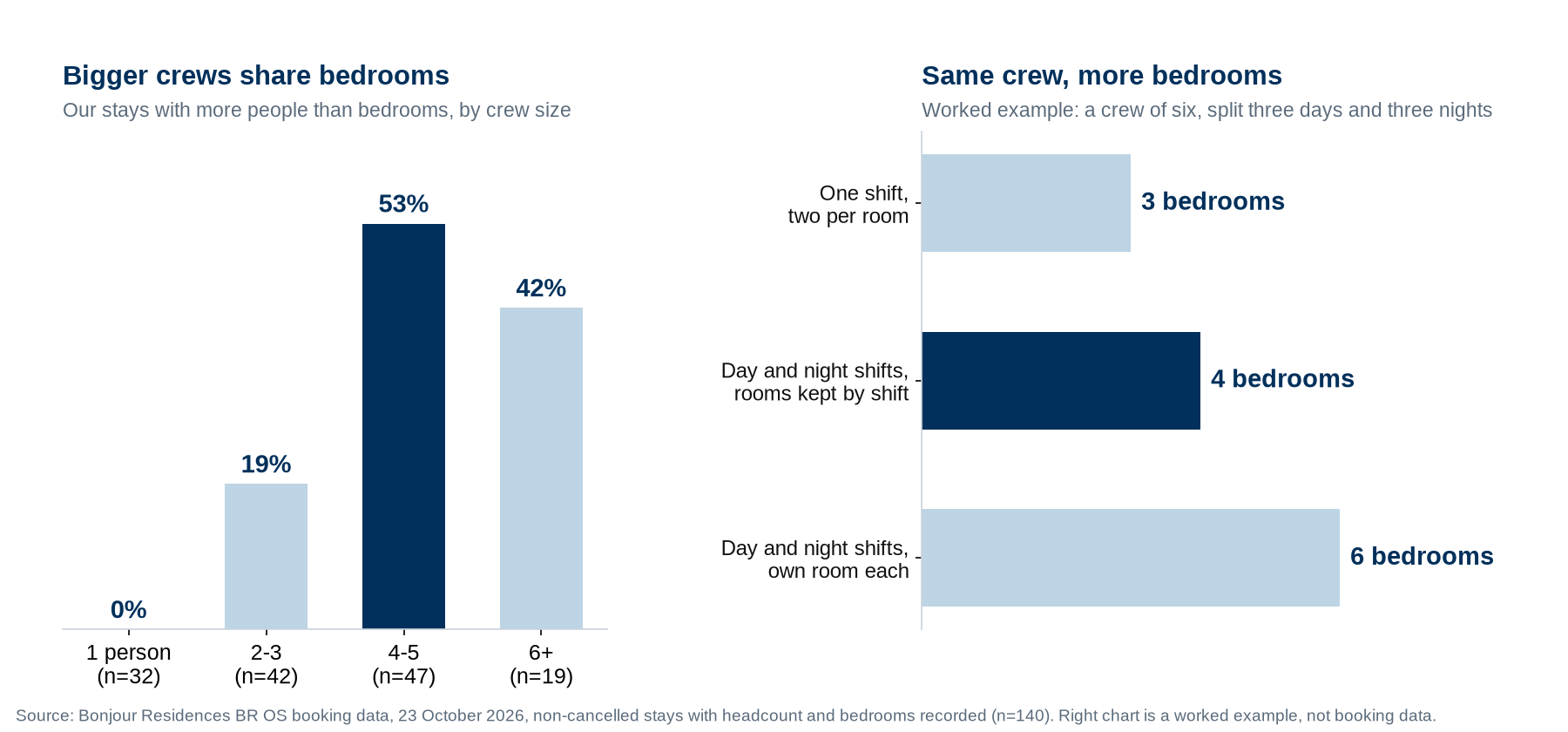
Often, and more as crews get bigger. Of 140 crew stays in our booking system with headcount and bedrooms recorded (cancelled stays excluded), 41 had more people than bedrooms. Every single-person stay had its own room. For crews of two or three it was 8 of 42 (19%). For crews of four or more it was 33 of 66 (50%).
That is fine for a crew on one shift: people who leave together and sleep together can share. It stops working the day the shift pattern splits. Take a crew of six in twin rooms. On one shift they need three bedrooms. Split three days and three nights, with rooms kept by shift, they need four, because neither group of three fits in one twin room. Give everyone their own room and it is six.
What else breaks when shifts share a flat?
The bathroom and the kitchen. In our data, 14 of 36 crews of four or more with bathrooms recorded had one bathroom. Shifts can actually help here, because the two groups shower at different times. But they also mean someone is cooking at midnight and someone is asleep at noon. Thin walls, a bedroom next to the kitchen, or no blackout curtains turn that into lost sleep.
What should bookers do differently?
- Send the shift pattern with the headcount. "Six people" and "three days, three nights" are different bookings.
- Book bedrooms by shift. Ask for a room plan with names and shifts before arrival. Never put two shifts in one bedroom.
- Consider two smaller flats. One flat per shift, close together, often beats one big house with mixed shifts.
- Ask about blackout and noise. Blackout curtains, a bedroom away from the kitchen and a quiet street matter more for nights than a garden.
- Move cleaning to fit the shift. Agree times so nobody on nights is woken by the cleaner.
Our clients have saved 20-30% by using the correct market for the length of stay. On a shift job, the right market is the one with enough bedrooms near the site.
Related: when a crew outgrows hotel rooms, whether a crew house can cope with winter wet gear and crew accommodation for data centre construction.
FAQ
Can day and night shift workers share a bedroom?
They should not. Germany's ASR A4.4 requires separate sleeping areas for workers on different shifts in worker accommodation, and the HSE notes that accidents are more frequent on night shifts, which makes daytime sleep a safety issue.
Can two shift workers share one bed in turns?
No. Under ASR A4.4 each resident must have their own bed with mattress and pillow. Taking turns in one bed also fails on hygiene and sleep.
How many bedrooms does a crew on two shifts need?
More than the same crew on one shift. A crew of six in twin rooms needs three bedrooms on one shift, but four when split three days and three nights with rooms kept by shift.
- BAuA, Technische Regeln für Arbeitsstätten ASR A4.4 Unterkünfte, sections 4(5) and 5 (edition 2010, last amended GMBl 2024), read 23 October 2026.
- Arbeitsstättenverordnung (ArbStättV), Annex 4.4 Unterkünfte, gesetze-im-internet.de, read 23 October 2026.
- Health and Safety Executive, Shift work: good practice guidelines, and Human factors: fatigue, hse.gov.uk, read 23 October 2026.
- EU-OSHA, Directive 2003/88/EC: working time, osha.europa.eu, read 23 October 2026.
- HS2 Ltd, Old Oak Common Conventional Station overnight works (work item SCP-26-2661), hs2.org.uk, read 23 October 2026.
- Bonjour Residences, BR OS booking data, 23 October 2026 (140 non-cancelled stays with headcount and bedrooms; bathrooms on 36 crews of four or more). Anonymised aggregate, no client names or rates.

Contact us today to discuss your next project