Winter on site: can the crew house dry eight sets of wet gear?
In winter, crew accommodation becomes the drying room: site welfare rules make the contractor provide somewhere to dry clothes on site, but nothing checks whether the house can cope with eight sets of wet gear, eight showers and a running washing machine. In Bonjour Residences data, 93% of stays for six or more workers had three or more people per bathroom (13 of 14), and laundry was not recorded at booking on 165 of 203 stays. With a wetter than normal autumn forecast in the UK, bookers should check bathrooms, laundry, heating and drying space before they check the bedroom count.
| 93%of our stays for 6+ workers had 3 or more people per bathroom (13 of 14) | 81%of our stays had no laundry information at booking (165 of 203) | 31%of our stays in the last year started between November and March (63 of 203) | 2xthe normal chance of a wetter October to December in the UK (Met Office outlook, via BBC Weather) |
This is set to be the wettest and windiest week of the autumn so far in the UK, with a yellow wind warning for Friday and the chance of the season's first named storm. The Met Office three-month outlook gives twice the normal chance of a wetter October to December.
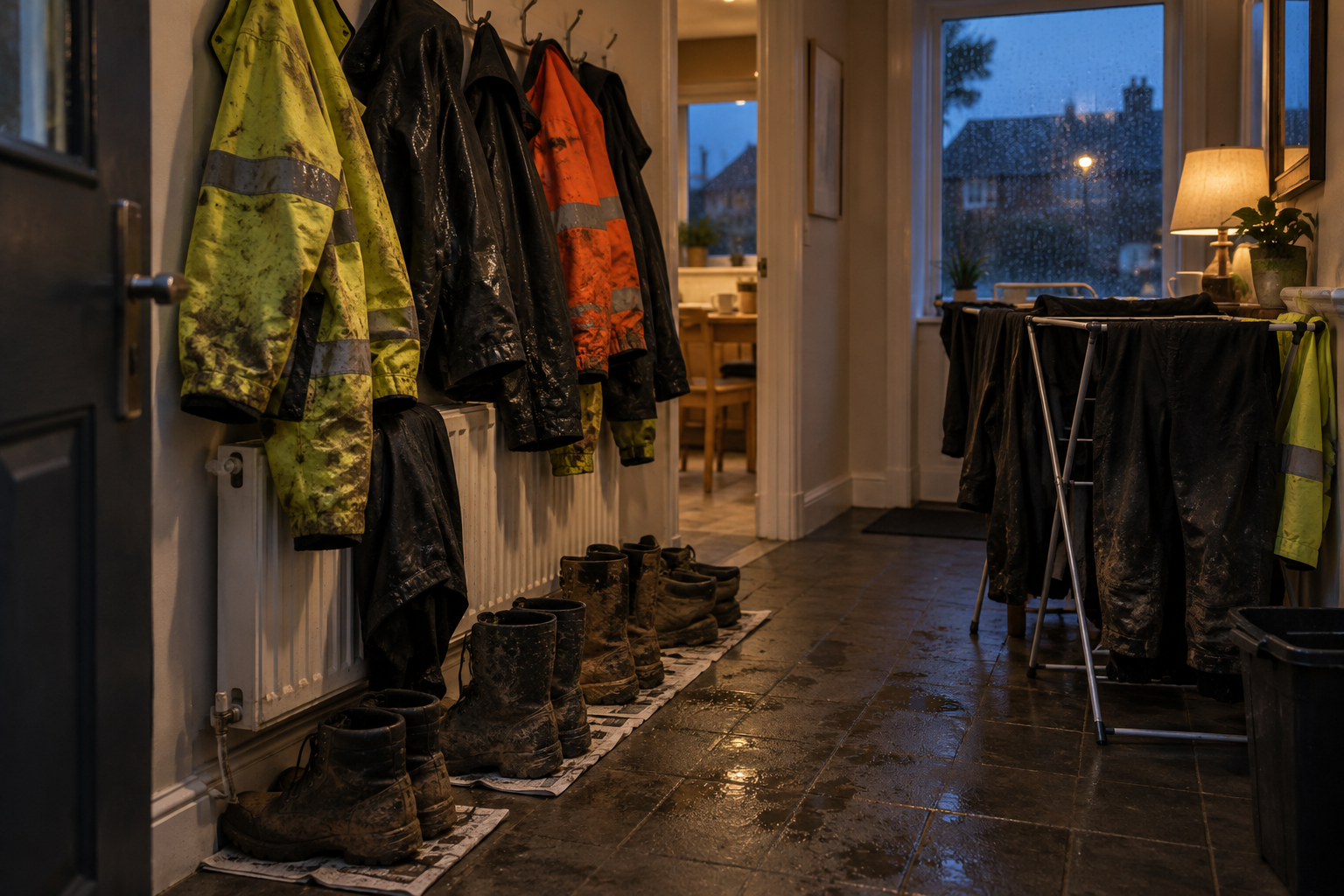
Picture the house at 6pm. Eight workers come back soaked. There is one bathroom, one washing machine and a radiator in the hall. By 7am the jackets are still damp.
Our argument: in winter the crew house becomes the drying room, but it is booked on bedrooms alone. Bookers who check bathrooms, laundry and heating first get a crew that turns up dry and on time.
Doesn't the site already dry the gear?
Partly. In Great Britain, Schedule 2 of the Construction (Design and Management) Regulations 2015 says changing rooms must include, where necessary, facilities to dry special clothing and personal clothing. In Ireland, the Health and Safety Authority says sites with more than five people at work should have enclosed accommodation for shelter and drying wet clothes.
Those rules stop at the site gate. Base layers, work trousers, socks and often boots go home with the worker, and they need washing and drying there. Nothing in the welfare rules looks at the house. That part is the booker's job.
What does our booking data show?
Winter is not a quiet season for crews. Of 203 crew stays we arranged in the last year (cancelled bookings excluded), 63 started between November and March, with a median stay of 15 nights (n=63).
Bathrooms are where big crews get squeezed. On the 74 stays where we recorded both headcount and bathrooms, the share with three or more people per bathroom rose with crew size: none for one person, 30% for two or three (8 of 27), 42% for four or five (8 of 19) and 93% for six or more (13 of 14).
Laundry is the bigger blind spot. We had laundry information on only 38 of 203 stays: 27 with a washer in the home and 11 with shared or paid laundry, such as a laundromat or token machine in the building. Cleaning tells the same story: 31 stays had an end-of-stay clean recorded and only 8 a weekly or fortnightly clean.

Who pays for the heating?
When bills are included in the price, the owner carries the energy cost, and a crew drying gear on every radiator uses a lot of it. In Great Britain, Ofgem's price cap rose 4% on 1 October to 1,723 pounds a year for a typical household, and a house of eight workers is not a typical household.
Some owners respond by limiting heating. We have seen house rules where the thermostat is set remotely and guests are asked not to change it. Ask before you book whether heating is included, whether the crew can adjust it and whether there is a dryer.
What about damp and mould?
Drying eight sets of clothes indoors in a small flat with closed windows means condensation. The UK government opened a consultation on 8 October on extending Awaab's Law, which sets legal deadlines for fixing severe damp and mould, to private renters. It says around one in 10 private rented homes already has a hazard at the most serious level. The consultation closes on 18 December, so new deadlines will not help a crew this winter. The fix is choosing a home with enough space, heat and ventilation in the first place.
| Check | Why it matters in winter | Rule of thumb | Ask the owner |
|---|---|---|---|
| Bathrooms | Everyone showers at 6am and again after a wet shift | No more than three workers per bathroom | How many bathrooms and separate WCs? |
| Washing machine and dryer | Work trousers and base layers need washing every few days | A washer in the home; a dryer for crews of four or more | Is there a washer and dryer in the home, and are they free to use? |
| Heating | Gear dried on a cold radiator is still wet in the morning | Heating included and adjustable by the crew | Is heating included, and can the crew change the thermostat? |
| Drying space | Eight jackets and eight pairs of boots need somewhere to go | A hallway, utility room or porch away from bedrooms | Where can the crew hang wet gear overnight? |
| Cleaning | Mud and condensation build up faster than in summer | A clean every one or two weeks on stays over a month | Is a mid-stay clean included or available? |
What should bookers do differently?
- Ask for bathrooms before bedrooms. Aim for no more than three workers per bathroom on any stay over a week.
- Get laundry on the booking. A washer in the home, and a dryer for crews of four or more, from November to March.
- Confirm heating in writing: included, adjustable by the crew and not capped by a remote thermostat.
- Ask where wet gear goes. A hallway, utility room or porch keeps mud and damp out of bedrooms.
- Prefer two smaller homes to one crowded flat for big crews, if the owner cannot answer these questions.
Related: when a crew outgrows hotel rooms, who pays for the empty bed when a worker goes off sick and where the crew will park the vans.
FAQ
Does the contractor have to provide drying facilities?
On site, yes where necessary. In Great Britain, CDM 2015 Schedule 2 requires changing rooms to include facilities to dry clothing where necessary. The rules do not cover the crew's accommodation.
How many workers per bathroom is reasonable?
There is no single legal number for crew homes. As a working rule, we aim for no more than three workers per bathroom on stays longer than a week.
Is heating included in crew accommodation?
Often, but not always, and some owners limit it. Ask whether heating is included and whether the crew can adjust it before you confirm.
- BBC Weather, Severe weather warning issued ahead of potential UK storm later this week, 19 October 2026.
- BBC Weather, Why hasn't the UK had any named storms yet? (reporting the Met Office three-month outlook), 17 October 2026.
- The Construction (Design and Management) Regulations 2015, Schedule 2, legislation.gov.uk, read 20 October 2026.
- Health and Safety Authority (Ireland), Welfare facilities: frequently asked questions, hsa.ie, read 20 October 2026.
- Ofgem, Energy price cap will rise by 4% from October 2026 (press release), 26 August 2026.
- Ministry of Housing, Communities and Local Government, Clampdown on dangerous homes to protect more tenants and families, gov.uk, 8 October 2026.
- Bonjour Residences, BR OS booking data, 20 October 2026 (203 non-cancelled bookings; headcount and bathrooms recorded on 74; laundry on 38). Anonymised aggregate, no client names or rates.

Contact us today to discuss your next project