Where will the crew park the vans?
For construction crews that drive to site, the van decides where the crew can stay: it needs off-street space, it carries the tools, and it must be allowed into the city it sleeps in. In Bonjour Residences data, 90% of crew stays in homes with three or more bedrooms had off-street parking, against 65% in one or two-bedroom flats, yet parking was not recorded at all on 46% of stays. With Brussels banning Euro 5 diesel vans since January 2026 and Dutch zero-emission zones closing to them in January 2027, bookers should put the vans on the booking.
| 46%of our crew stays had no parking recorded at booking (92 of 201) | 90%of our stays in 3+ bedroom homes had off-street parking (55 of 61) | 1 Jan 2027Euro 5 vans lose access to Dutch zero-emission zones | EUR 150Brussels fine for a foreign vehicle not registered for the LEZ, even if compliant |
A crew of six arrives in two vans, each carrying several thousand euros of tools. The booking is two 2-bedroom flats in the centre, close to site. On the first evening someone asks where the vans go, and nobody knows.
Our argument: for crews that drive to site, the van is the real constraint on where they can stay, and cities are tightening the rules on vans faster than bookers are adjusting.
Why does the van matter more than the bed?
Because the van is the crew's workshop. It holds the tools, it moves the crew to site at 6am, and it has to sit somewhere safe for twelve hours every night. If the accommodation cannot take it, the crew either leaves tools on the street or drives around looking for space.
Tool theft shows the cost. UK police forces recorded 76,907 tool thefts between January 2021 and December 2025, worth over GBP 25 million, and only 3.2% of cases ended with tools returned, according to Freedom of Information data published by 2580 Group in February 2026.
What does our booking data say about parking?
Across 201 crew stays we arranged this year (cancelled bookings excluded), parking was recorded on 109. On the other 92, or 46%, nobody captured it at booking. Where we do know, the pattern is clear: 90% of stays in homes with three or more bedrooms had off-street parking (n=61), against 65% in one or two-bedroom flats (n=48). A third of the smaller flats offered only street or paid parking. Every one of the 24 recorded stays with four or more crew had off-street space.
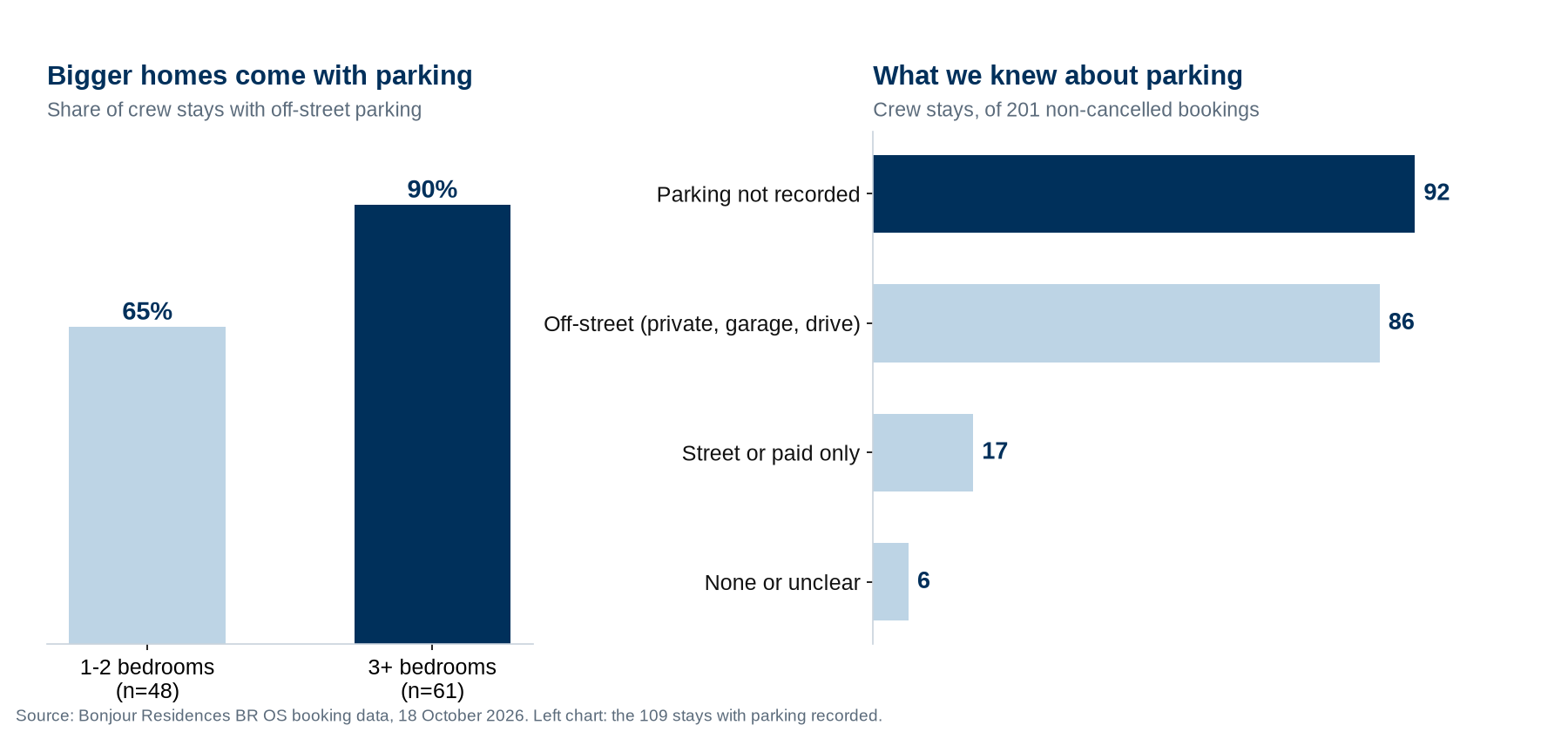
In other words, the crew-sized house usually solves the van problem on its own. The city flat usually creates it.
What are cities changing for vans?
- Brussels: since 1 January 2026, Euro 5 diesel cars and vans are banned from the low emission zone, which covers all 19 municipalities of the Region. A non-compliant vehicle without a day pass risks a EUR 350 fine, and a foreign vehicle that has not been registered faces EUR 150 even if it complies. Day passes cost EUR 35 for a van and are capped at 24 per year per plate.
- Netherlands: zero-emission zones for vans and trucks have been in force since 1 January 2025 in a growing list of cities. New vans registered since then must be emission-free to enter, Euro 5 vans lose access on 1 January 2027 and Euro 6 vans on 1 January 2028 (the government plans to extend that to 2029). The 2026 fine for a van is EUR 130. On 14 October the Dutch government told parliament it had written to 182,000 owners of Euro 5 vans warning them of the 2027 cut-off.
Both are enforced by number-plate cameras. A crew that sleeps inside a zone passes them every single day, so a non-compliant van is not a one-off risk: Brussels can fine it once every three months, up to four times a year, and in the Dutch zones a van outside the access rules needs an exemption or dispensation to enter at all.
| Where the crew sleeps | Where the vans go | What goes wrong | Check before booking |
|---|---|---|---|
| 1-2 bedroom flat in the centre | On the street, or a paid car park | Tools left overnight on the street; height barriers; residents-only permits; emission zone rules | Is there a space for each van, and does the van fit under the barrier? |
| Hotel | Hotel car park, if there is one | Spaces sized for cars, charged per night, often full | How many van spaces, and can they be reserved for the whole stay? |
| 3+ bedroom house on the edge of town | Driveway, garage or yard | Longer drive to site; check the neighbours' tolerance for early starts | Off-street space in writing, and the drive time at 6am |
| Home inside a low or zero-emission zone | Wherever, but only if the van is allowed | Fines from camera enforcement, day passes running out | Euro class of every van, and whether foreign plates must register |
What should bookers do differently?
- Count vans, not just people. Put the number of vans, their height and their Euro class on the booking request.
- Ask for off-street parking in writing, one space per van, before you confirm. "Parking available" is not an answer.
- Prefer a 3+ bedroom house on the edge of town over several flats in the centre when the crew drives. It usually brings a driveway and keeps the vans outside the zone.
- Check the emission zone for the accommodation, not only the site. The crew drives in and out of where it sleeps every day.
- Register foreign vans before arrival where the city requires it, as Brussels does.
- Agree where tools are stored overnight. If the vans must stay on the street, ask for a lockable garage or store.
Related: when a crew outgrows hotel rooms, what project managers need before mobilisation and what goes wrong when the crew lands late on a Sunday.
FAQ
Do foreign vans need to register for city emission zones?
In Brussels, yes: foreign vehicles must be registered for the low emission zone even if they meet the standard, or they risk a EUR 150 fine. Rules differ by city, so check before the crew drives in.
Can a Euro 5 van still enter Dutch zero-emission zones?
Until 1 January 2027. After that, only with an exemption or dispensation.
Is a hotel car park a good answer for crew vans?
Sometimes, but spaces are sized for cars, often charged per night and rarely guaranteed for a whole stay. Ask for reserved van spaces in writing.
- Brussels Environment, Low Emission Zone: practical page (boundaries, Euro 5 diesel ban, controls and fines) and day pass page, lez.brussels, read 18 October 2026.
- Ministry of Infrastructure and Water Management, Op weg naar ZES: access rules for vans and zero-emission zones for foreign vehicles, opwegnaarzes.nl, read 18 October 2026.
- Transport Online, 182.000 eigenaren Euro 5-bestelwagens gewaarschuwd voor toegangsverbod in 2027, 14 October 2026 (on the ninth zero-emission zone monitoring letter to the Tweede Kamer).
- Build News, Tool theft tops GBP 25m since 2021 as recovery rates remain low, 17 February 2026 (Freedom of Information data from 2580 Group).
- Bonjour Residences, BR OS booking data, 18 October 2026 (201 non-cancelled bookings; parking recorded on 109). Anonymised aggregate, no client names or rates.

Contact us today to discuss your next project