A crew member goes off sick: who pays for the empty bed?
When a crew member goes off sick or home mid-stay, the bed is almost always still paid: crew accommodation is booked per home on notice periods or non-refundable terms, so the real question is who fills it next. In Bonjour Residences data, every stay with cancellation terms recorded was non-refundable, fixed-term or needed 28 to 30 days' notice (137 of 201), and 47% of stays for four or more workers had more people than bedrooms (n=58). With sickness in construction trades high and an early flu season forecast in the UK, bookers should plan replacements into the same bed and give each worker their own room.
| 137 of 137of our stays with terms recorded were non-refundable, fixed-term or needed 28-30 days' notice | 47%of our stays for 4+ workers had more people than bedrooms (27 of 58) | 10.07%of scaffolders off sick on an average day in 2025 (AOK Rheinland/Hamburg) | Day 1UK Statutory Sick Pay is payable from the first full day of sickness since 6 April 2026 |
Week two of a six-week job. One of your eight workers wakes up with a fever, another hurts his back on site, and by Friday one of them has flown home. The site manager asks the obvious question: do we stop paying for their beds?
Usually not. Our argument: in crew accommodation the bed is paid whether anyone sleeps in it or not, so the useful question is not who pays for the empty bed but who fills it next, and how to stop one sick worker becoming three.
Why is the bed still paid?
Because crew accommodation is booked as whole homes for a set period, not as single beds by the night. A house for eight does not get cheaper when seven sleep in it, and owners price longer stays on the basis that the dates hold.
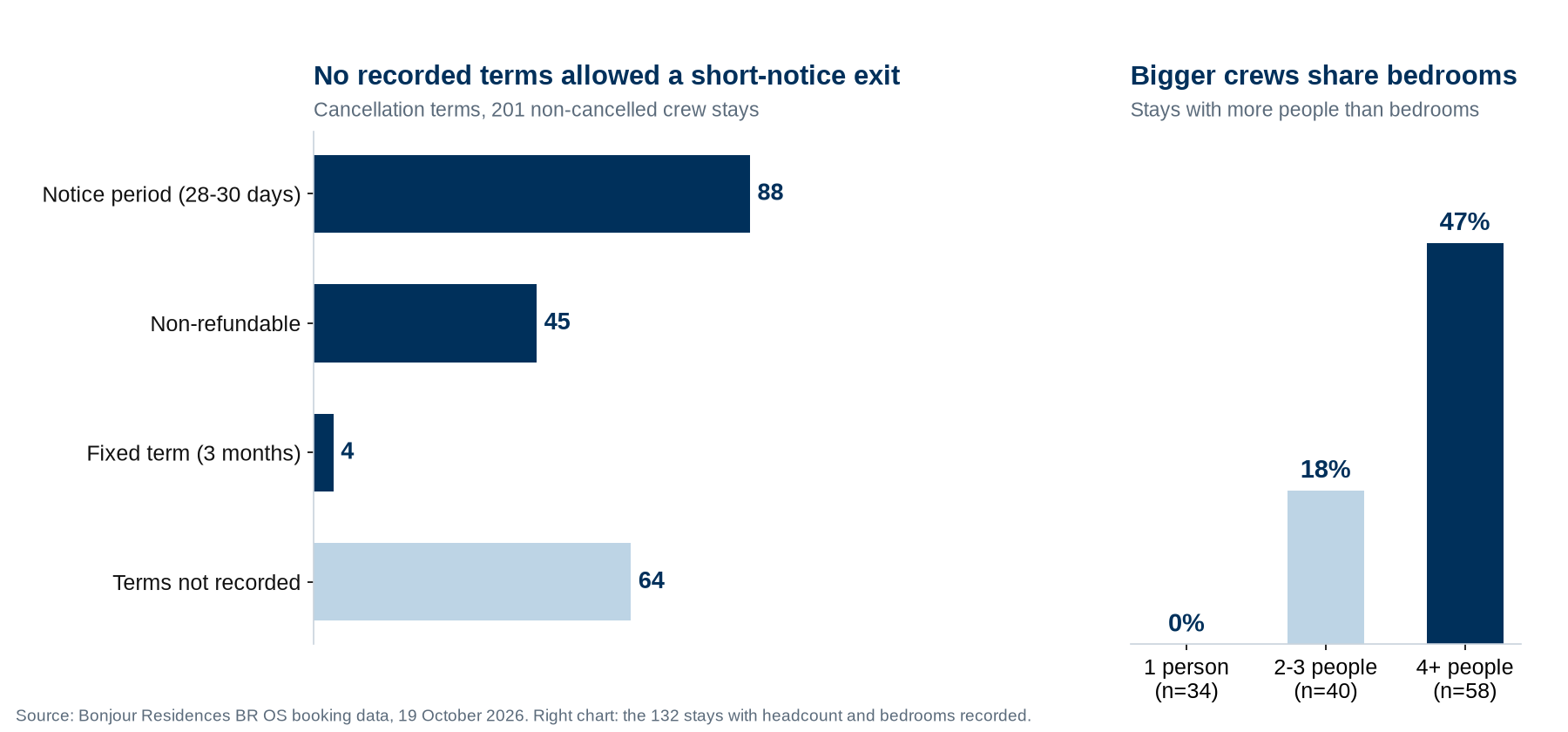
Our booking data shows how firm those terms are. Across 201 crew stays we arranged this year (cancelled bookings excluded), 137 had cancellation terms recorded. Every one of them was non-refundable (45), fixed for three months (4) or needed 28 to 30 days' notice (88). None could be cut at a few days' notice. On the other 64 the terms were not captured at booking, which is its own problem: nobody can answer the site manager's question.
So a worker who goes home on day ten of a 30-day stay leaves a bed that is paid to the end, or at least to the end of the notice period. Who carries that cost depends on the contract between the contractor and its client, but the owner rarely does.
How often does this actually happen?
More often than most bookings assume. On 1 October the German health insurer AOK Rheinland/Hamburg reported that 7.11% of the roughly 300,000 craft workers it insures were off sick on an average day in 2025. Scaffolding was highest at 10.07%, masonry next at 9.52%. Across the EU, construction had the highest rate of accidents causing at least four days off work in 2023: 2,899 per 100,000 workers, according to Eurostat.
Rough arithmetic: at a 7% sickness rate, a crew of ten on a 30-night stay loses around 20 worker-nights to illness. That is not a rare event to handle when it comes up. It is part of every long booking.
This winter may be worse. The UK Health Security Agency said on 8 October that flu activity through September was higher than in the same period in any of the past four winters, although still at baseline levels. Across the EU/EEA, ECDC reported influenza still low on 16 October. And in the UK, Statutory Sick Pay has been payable from the first full day of sickness since 6 April 2026, for all eligible employees regardless of earnings.
Why does a shared bedroom make it worse?
Because illness spreads by the room. In our data, 47% of stays for four or more workers had more people than bedrooms (27 of 58), against 18% for crews of two or three (7 of 40). The bigger the crew, the more likely two people share a room, and the more likely one fever becomes two.
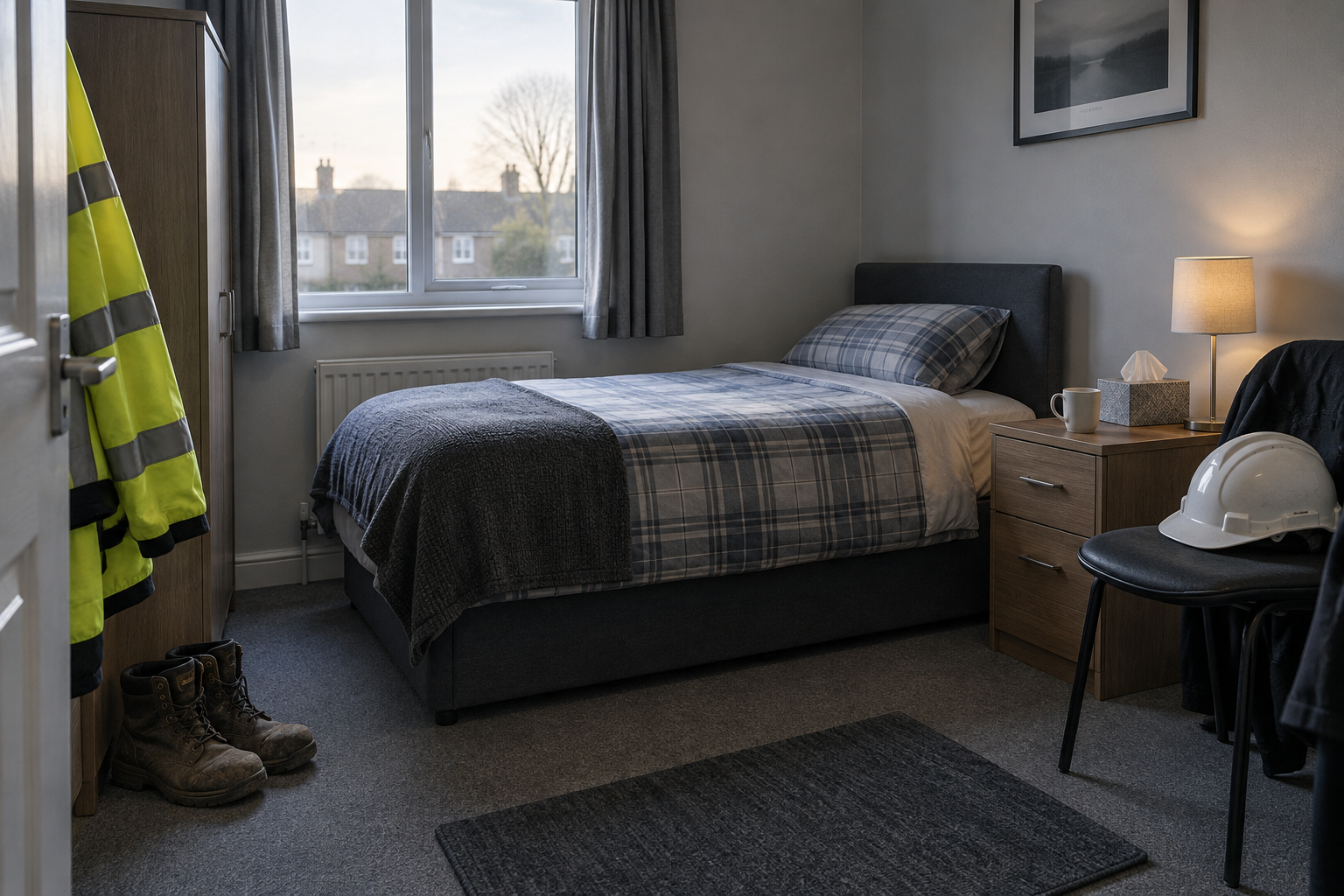
Own bedrooms also make the replacement easy. A new worker can take a single room the day after the last one leaves. Putting a stranger into a shared room with a worker who is still on site is harder to arrange.
| What happens | Is the bed still paid? | What usually works | Agree at booking |
|---|---|---|---|
| One worker is off sick for a few days | Yes, the home is booked as a whole | They recover in their own room; the stay runs on | Own bedroom per worker, and who the house can call if they get worse |
| One worker goes home for good | Yes, at least for the notice period | Send the replacement into the same bed | That names can change mid-stay without a new booking |
| Two or three leave and are not replaced | Yes, until notice runs out | Give notice and move the rest to a smaller home | The notice period in days, and whether a move counts as a new stay |
| Flu goes round a shared bedroom | Yes, and now two workers are off | Separate the sick worker if a room is free | Bedrooms equal to headcount for stays over a few weeks |
What should bookers do differently?
- Assume someone will be off sick. On any stay over a few weeks, plan for a replacement rather than a cancellation.
- Get the cancellation terms on the booking, in days, before you confirm. "Flexible" is not a term.
- Agree that names can change mid-stay. The replacement should be able to take the same bed with a new name on the guest list, not a new booking.
- Give each worker their own bedroom on longer stays, especially through winter. It costs more beds on paper and fewer days lost on site.
- Know the notice period before you shrink. If two or three workers leave for good, giving notice and moving the rest to a smaller home can be cheaper than paying for empty rooms.
- Keep one contact for the house, so a sick worker alone during the day has someone to call.
Related: what happens to the accommodation when the project slips, when a crew outgrows hotel rooms and who pays when the crew damages the flat.
FAQ
Can we cancel one worker's bed when they go home sick?
Rarely. Crew stays are usually booked per home on notice periods or non-refundable terms, so a single bed cannot be dropped. Refilling it with a replacement is normally the better route.
Can a replacement worker use the same booking?
Usually yes, if a name change is agreed at booking. Ask for it in writing.
Is UK Statutory Sick Pay paid from the first day?
Yes. Since 6 April 2026, eligible employees get Statutory Sick Pay from the first full day of sickness absence, according to HMRC guidance.
- HM Revenue and Customs, Sickness absences that start before and end on or after 6 April 2026, gov.uk, 18 March 2026.
- AOK Rheinland/Hamburg, Krankenstand im Handwerk sinkt erstmals seit Jahren (press release), 1 October 2026.
- Eurostat, Accidents at work: statistics by economic activity (2023 data), Statistics Explained, read 19 October 2026.
- UK Health Security Agency, Are we seeing an early flu season? What we know so far about this year's strains, UKHSA blog, 8 October 2026.
- European Centre for Disease Prevention and Control, Weekly respiratory virus update, week 41, 16 October 2026.
- Bonjour Residences, BR OS booking data, 19 October 2026 (201 non-cancelled bookings; cancellation terms recorded on 137; headcount and bedrooms on 132). Anonymised aggregate, no client names or rates.

Contact us today to discuss your next project