Right to rent in the UK: does the landlord have to check every crew member?
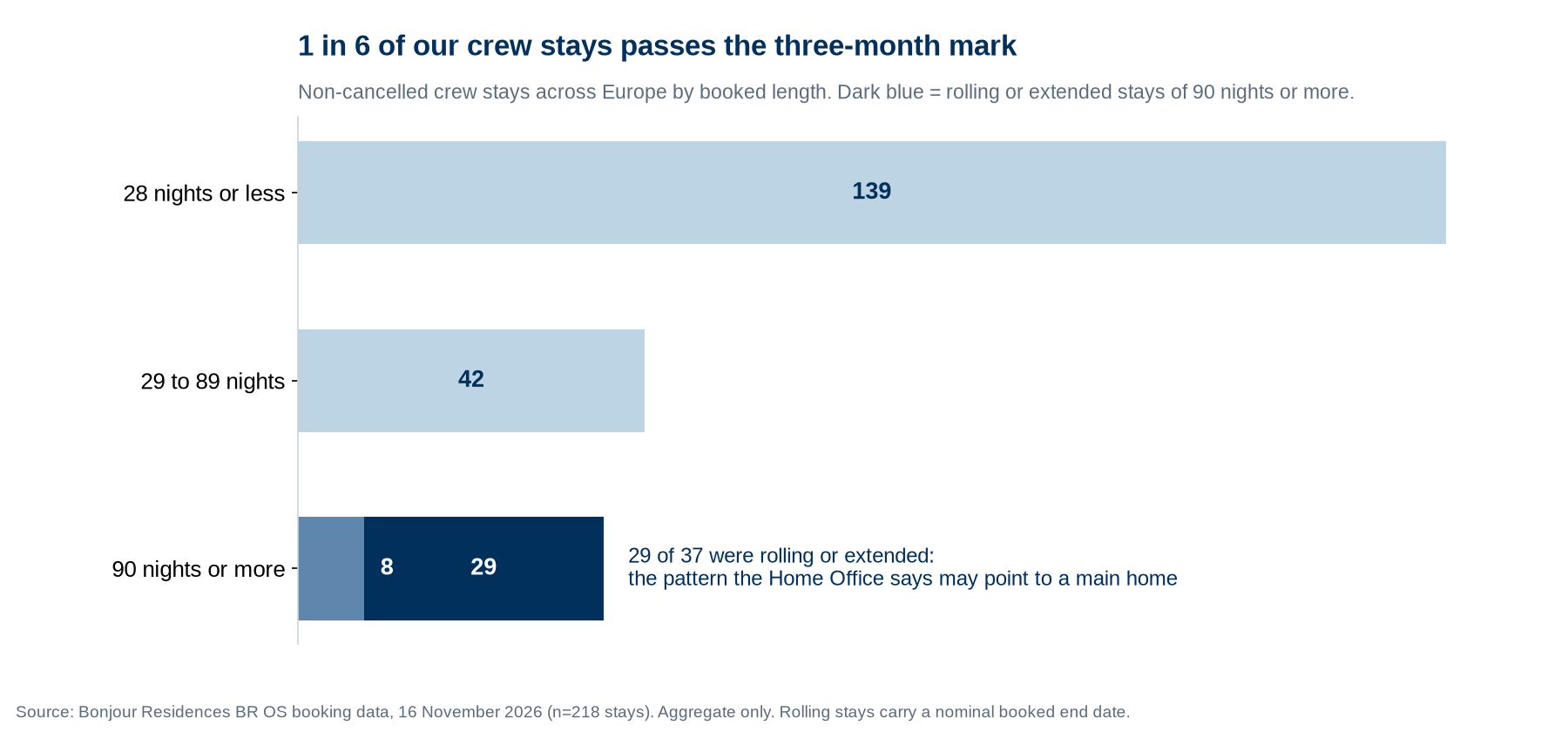
In England, a landlord must check the right to rent of every adult who uses the property as their only or main home, and the Home Office says bookings of three months or more, open-ended or repeatedly extended, may indicate exactly that. Bonjour Residences data shows 37 of 218 crew stays across Europe ran 90 nights or more, and 29 of those were rolling or extended. Bonjour Residences advises bookers on long or open-ended stays in England to agree in writing who runs the checks and to send each crew member's documents before arrival.
| 3 monthsbooking length the Home Office says may point to a main home, not a holiday stay | £10,000civil penalty per occupier without the right to rent, first breach; £20,000 for a repeat | 37 of 218of our crew stays across Europe ran 90 nights or more | 29 of 37of those long stays were rolling or extended |
On 1 October 2026, the seventh version of the Home Office right to rent code came into force in England. Digital checks now have to go through a registered provider, and anyone with an eVisa can only prove their status through the online share code service. The penalty table is unchanged: up to £10,000 per occupier for a first breach and £20,000 for a repeat.
Crews sit in a grey zone. Our argument: for a crew booking, the trigger is not the type of property but the length of the stay. A stay that runs past three months, or keeps getting extended, often is in scope, and nobody notices when it crosses the line.
Does right to rent apply to crew accommodation at all?
Only when the property is someone's only or main home. The scheme covers any tenancy, lease or licence that lets an adult occupy a property in England as their only or main home, and the check covers everyone aged 18 and over, British citizens included, even if they are not named on the agreement. Holiday accommodation is outside it: the code describes it as places let for short periods to people who keep a main home elsewhere, in a hotel, a guesthouse, a cottage or a holiday apartment.
When does a crew stay become a main home?
The code gives a guide figure: bookings of three months or more may indicate that the occupier is using the accommodation as their only or main home. It goes further for the pattern crews create. If a booking is open-ended, or was booked for a fixed period and then extended one or more times, the code says it would be advisable to run the checks. And if in doubt, landlords are told to assume the property is a main home.
So the risk does not arrive on day one. It arrives on the third extension of a job that overran.
How do the common setups compare?
| Crew booking | Right to rent checks? | Why |
|---|---|---|
| Hotel or short let, under 3 months, crew keeps a home abroad | Normally no | Treated as holiday accommodation, not an only or main home |
| Flat booked for 3 months or more | Likely yes | The Home Office says this may indicate an only or main home |
| Open-ended or extended several times | Advisable | The code tells landlords to check when the stay starts to look like a home |
| Your own employees in a flat you provide as part of the job | No, for that arrangement | Tied accommodation is excluded by Schedule 3 of the 2014 Act |
| Agency or self-employed crew paying you for the bed | Possibly, and you may be the landlord | Not employees, and whoever takes rent from an occupier carries the check |
| Property in Scotland, Wales or Northern Ireland | No | The scheme applies in England only |
The employee exclusion is narrower than it looks. Schedule 3 of the Immigration Act 2014 excludes tied accommodation, meaning accommodation an employer provides to an employee in connection with a contract of employment, with employee defined as in the Employment Rights Act 1996. Subcontractor, agency and self-employed crews are not your employees. If they pay you for the bed, for example through a deduction from pay, the code treats the person collecting rent from an occupier as the one who must check.
What does our data show?
Long crew stays are common and they are rarely booked as long stays. Across 218 non-cancelled crew stays in our records, 37 ran 90 nights or more. Of those 37, 29 were rolling bookings or had been extended. Another 9 rolling stays had not yet reached 90 nights.
Our UK numbers are small, so read them as a pattern, not a benchmark. Of 25 UK crew stays, 16 were in Scotland, where the scheme does not apply, and 9 in England. Two of the 9 English stays ran past three months, and both had been extended.

What does the landlord need from each crew member?
It depends on nationality and status. British and Irish citizens show a passport or another document from the Home Office lists. Anyone with an eVisa, including EU citizens with settled or pre-settled status, gives a right to rent share code starting with R. EU and some other nationals who entered as visitors through the eGates usually have no stamp, so the landlord needs the passport plus evidence of arrival in the UK in the last six months, such as a boarding pass or a ferry booking.
Timing matters. A check for someone with time-limited permission can be done no earlier than 28 days before the tenancy starts, and the code allows the check before move-in when the occupier is overseas arranging accommodation for work. Copies are kept for the tenancy and one year after, and some checks need repeating after 12 months.
What should bookers do differently?
- Flag the length early. If a stay in England may run past three months, say so at booking, not at the third extension.
- Agree who checks, in writing. The landlord, a letting agent who accepts responsibility in writing, or you if you collect rent from the crew.
- Collect documents before travel. Passport details, share codes and travel bookings for every adult, sent securely, at least a few days before arrival.
- Re-check at every extension. That is when a short stay starts to look like a main home, as in what changes after three months.
- Know your crew's status. Employees in tied accommodation are excluded; agency and self-employed crews are not.
- Do not assume the UK is one regime. Scotland, Wales and Northern Ireland have no right to rent scheme, but have their own rules, as in our guides to UK worker accommodation standards and council tax on crew flats.
FAQ
Do hotels have to check the right to rent of crew members?
Not normally. Hotel and short holiday stays by people who keep a home elsewhere are outside the scheme. A long or open-ended hotel stay that becomes someone's main home can fall inside it.
Does right to rent apply in Scotland?
No. The right to rent scheme applies in England only. Scotland, Wales and Northern Ireland do not require landlord immigration checks.
What is the penalty if a crew member has no right to rent?
Up to £10,000 per occupier for a first breach and £20,000 for a repeat within three years, reduced by 30% for a first breach paid within 21 days. A correct check before occupation gives the landlord a statutory excuse.
- Home Office, Code of practice for landlords and their agents: the right to rent scheme, in force 1 October 2026, gov.uk, published 30 June 2026, read 16 November 2026.
- Home Office, Landlord's guide to right to rent checks, 1 October 2026, gov.uk (assets.publishing.service.gov.uk), read 16 November 2026.
- Immigration Act 2014, sections 20 to 37 and Schedule 3 (excluded residential tenancy agreements, paragraph 10 tied accommodation), legislation.gov.uk, read 16 November 2026.
- Bonjour Residences, BR OS booking data, 16 November 2026 (218 non-cancelled crew stays across Europe; 25 UK stays, 9 in England). Anonymised aggregate, no client names or rates.

Contact us today to discuss your next project