Crew accommodation in the UK: who pays the council tax?
On most UK crew accommodation the council tax bill goes to the owner, not the crew or the booker, because a flat where nobody has their main home has no resident to bill, and shared houses with a room per worker are billed to the owner by regulation. Owners pass the cost on in the price, and since April 2025 211 of 296 councils in England have charged up to double on furnished homes with no resident, with similar powers in Scotland and Wales. Bonjour Residences advises bookers to confirm council tax is included in writing, and to ask what happens to the price when new bills arrive each April.
| 211 of 296councils in England charged a second homes premium in 2025-26 | Up to 2xcouncil tax on a furnished home with no resident, in England and in Scotland | 10 of 25of our UK crew stays ran longer than 28 nights | 150%rise one London council has warned it may need for 2027-28 |
A booker in Glasgow or Kettering signs off a three month stay for four workers. Six weeks in, the owner forwards a council tax bill and asks who is paying. Or the quote said "bills included" and nobody asked whether that covered council tax.
Our argument: on most crew accommodation in the UK, the law puts council tax on the owner, not on the crew and not on the booker. So the real question is not who pays, it is whether the owner has priced it in, at what rate, and what happens in April. Those answers are moving fast, because councils can now charge up to double on furnished homes nobody lives in, and several are warning of steep rises for 2027-28.
Who does the council actually bill?
Council tax goes to the "resident" first: someone aged 18 or over whose sole or main home is the property. A worker whose family home is in Poland, Portugal or another part of the UK is usually not resident in the crew flat, even after months on site, although the council decides on the facts. If nobody is resident, the Local Government Finance Act 1992 sends the bill to the owner.
Shared houses go the same way. Where the occupants are not one household and each has a let or licence of part of the property, regulations in both England and Scotland make the owner liable. Short lets run as a business can drop out of council tax altogether: in England a property let commercially for stays of 28 nights or less, available for at least 140 nights and actually let for at least 70 nights in the last year, is valued for business rates instead. Scotland uses the same 140 and 70 night tests.
Why should a booker care if the owner pays?
Because the owner's bill has gone up. Since April 2025 councils in England can charge a premium of up to 100% on a home that is substantially furnished and has no resident, which is exactly what a crew flat is. GOV.UK figures show 211 of 296 councils charged it in 2025-26. Scotland gave its councils the same power from April 2024, and Welsh councils can charge a premium of up to 300%.
Then there is the base bill. On 3 October the Guardian reported that Hammersmith and Fulham had warned it may need to raise its share of council tax by 150% for 2027-28 after losing more than half its government grant. Barnet has floated 32%. These are warnings, not decisions, but an owner who has let a flat to a crew on a fixed nightly price will want to pass the increase on.
What does our own UK data show?
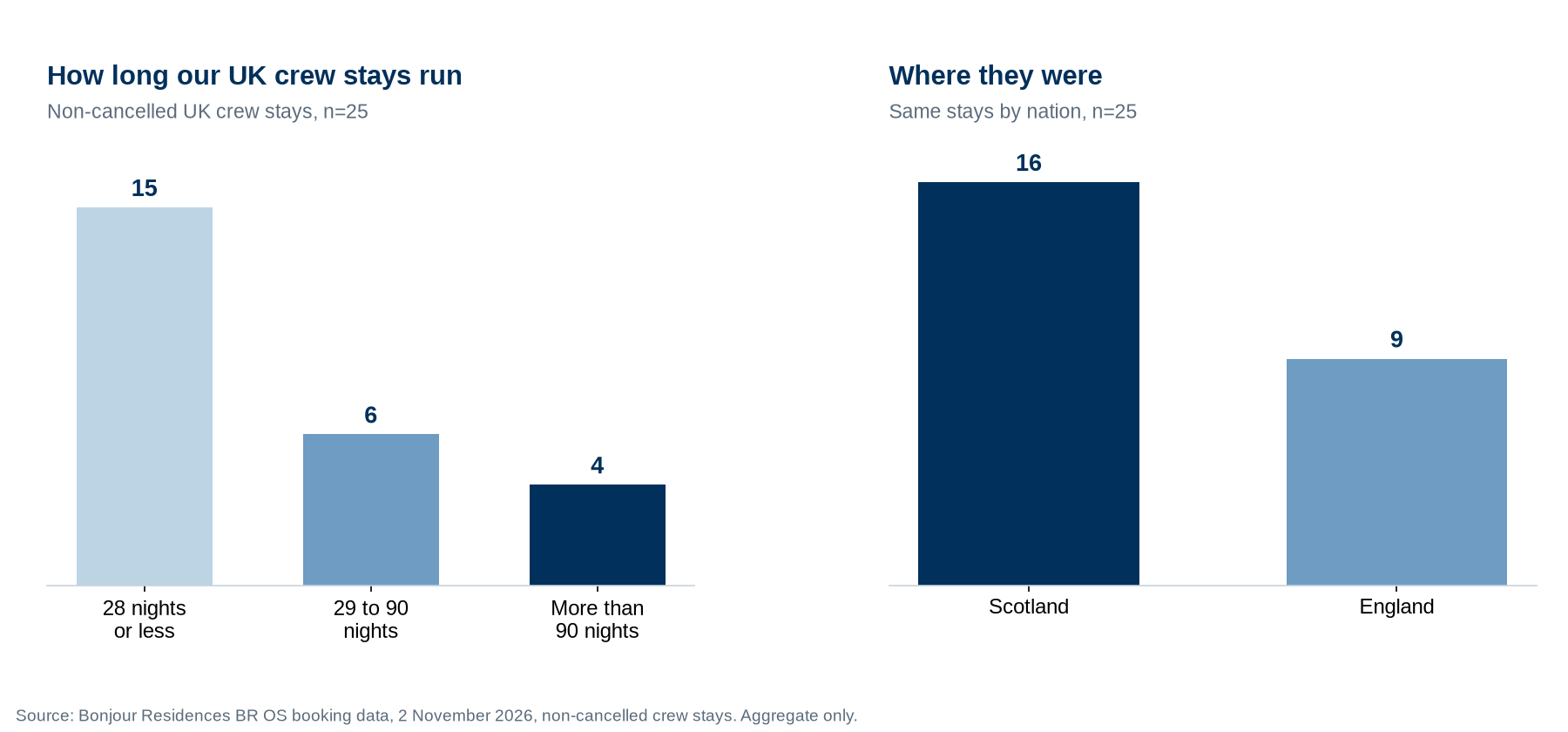
Across our 25 non-cancelled UK crew stays, the median was 21 nights. Fifteen ran 28 nights or less, six ran 29 to 90 nights and four ran more than 90. Sixteen were in Scotland and nine in England. None of our booking records shows council tax as a separate line: where it applies, it sits inside the nightly price. That is how it should be, but it means the question only comes up when something goes wrong, typically on the longer stays that cross an April billing date.
How do the setups compare?
| How the crew is housed | Who the council bills | What the booker should check |
|---|---|---|
| Flat let commercially for short stays (28 nights or less, available 140+ nights a year, let 70+) | Usually business rates, paid by the owner, not council tax | Nothing extra, as long as the price is all-inclusive |
| Whole flat for a crew whose homes are elsewhere | The owner: nobody living there has it as their main home | Is a second homes premium charged here, and is it in the price? |
| Shared house, each worker with their own room | The owner, under the rules for houses in multiple occupation | Licensing for five or more people, and an all-inclusive price |
| A worker who makes the flat their only or main home | That worker can become the person billed | Keep council tax out of workers' names |
| Company signs a long tenancy that makes it responsible for council tax | The council still bills by the rules above, the contract shifts the cost to you | Read the clause and budget for a premium and the April rise |
What should bookers do differently?
- Get "council tax included" in writing. "Bills included" often means energy and wifi only. Ask for council tax by name.
- Ask about April. For any stay that crosses 1 April, agree whether the price is fixed or can move with the new bill.
- Keep bills out of workers' names. A worker who registers the flat as their main home can end up personally liable.
- Read long tenancies closely. If the company signs a six or twelve month let that makes it responsible for council tax, check whether the council charges a second homes premium.
- Treat it like any other local charge. Council tax, like tourist tax, is a reason invoices bounce. One all-inclusive price per period avoids a rejected invoice.
For a crew of five or more in one house, the licensing rules matter as much as the tax: see should we split the crew across two flats and worker accommodation standards in the UK.
FAQ
Do contractors pay council tax on a short-term crew flat?
Usually not directly. If nobody living there has it as their main home, the council bills the owner, who normally includes it in the price.
Can a crew flat be charged double council tax?
Yes. A furnished home with no resident can attract a second homes premium of up to 100% in England and Scotland, and up to 300% in Wales, where the council has adopted it.
Does a holiday let pay council tax?
Not if it qualifies as self-catering accommodation for business rates, which in England and Scotland means available for at least 140 nights and let for at least 70 nights a year.
- Local Government Finance Act 1992, section 6 (persons liable and definition of resident, England and Wales) and section 75 (persons liable, Scotland), legislation.gov.uk, read 2 November 2026.
- The Council Tax (Liability for Owners) Regulations 1992 (SI 1992/551), Class C, and The Council Tax (Liability of Owners) (Scotland) Regulations 1992 (SI 1992/1331), legislation.gov.uk.
- GOV.UK, How Council Tax works: second homes and empty properties, read 2 November 2026.
- GOV.UK (MHCLG), Guidance on the implementation of the council tax premiums on long-term empty homes and second homes, 1 November 2024.
- GOV.UK, Local authority Council Taxbase in England 2025 (revised), 6 November 2025.
- GOV.UK, Business rates: self-catering and holiday let accommodation, read 2 November 2026. mygov.scot, Non-domestic rates: self-catering and short-term lets, read 2 November 2026.
- Scottish Government, Council tax on second homes, gov.scot, 31 March 2024. Welsh Government, Council Tax dwellings: April 2026 to March 2027, gov.wales.
- The Guardian, London Labour council warns it may raise council tax by 150%, 3 October 2026. Local Government Chronicle, Borough moots 32% council tax hike, 7 October 2026.
- Bonjour Residences, BR OS booking data, 2 November 2026 (25 non-cancelled UK crew stays). Anonymised aggregate, no client names or rates.

Contact us today to discuss your next project