Crew accommodation in Ireland: does booking the flat end the crew's country money?
In Ireland, an employer can pay site workers tax-free country money or provide their board and lodgings, but Revenue does not allow both: once the company books the accommodation, country money can no longer be paid tax-free. Bonjour Residences data shows that all 13 of our Irish crew stays were whole homes with a kitchen, and 7 ran longer than four weeks. Bonjour Residences advises bookers to agree the pay and tax model with payroll before the first night is booked.
| 159,300people working in Irish construction in Q2 2026, up more than 10% in a year | 32 kmminimum distance from base before country money can be paid tax-free | 13 of 13of our Irish crew stays were whole homes with a kitchen | 4 of 13of our Irish stays ran past 56 nights |
Irish construction is short of people and long on work. The sector employed 159,300 people in the second quarter of 2026, up more than 10% in a year, according to Arcadis on 28 October. On 11 November the Deloitte Crane Survey said Ireland will complete about 40,000 homes this year and still needs 260,000 more in four years to hit its 2030 target. That means more crews travelling to sites far from home, and more contractors deciding how to house them.
In Ireland that decision comes with a tax rule most bookers only meet at payroll. Site workers are often paid country money, a tax-free travel and subsistence payment. Revenue says it cannot be paid tax-free if the employer provides board and lodgings. Our argument: in Ireland, booking the crew's accommodation replaces country money, it does not sit on top of it. Decide which model you are using before you book, not after the first payslip.
What is country money?
Revenue lets an employer pay site-based workers tax-free travel and subsistence, known as country money in the construction industry. The site must be 32 km (20 miles) or more from the employer's base, or from the GPO for Dublin-based workers. The approved rates are 36.34 euro a day for four days or less, or 181.68 euro a week for longer.
The construction Sectoral Employment Order sets minimum pay, pension and sick pay. It does not set country money, so the amount and the conditions come from the employment contract and Revenue's rules.
When does it stop being tax-free?
Revenue lists three exclusions. Country money cannot be paid tax-free if the worker does not pay to travel to site, for example because the employer provides transport. It cannot be paid tax-free if the employer provides board and lodgings. And it cannot be paid tax-free to a worker recruited to work at one site only.
So the moment a contractor books a house for the crew, the subsistence part of country money falls away. If the crew also travels to site in a company van, the travel part goes too. Keep paying it as before and the payment becomes taxable pay, with PAYE due.
Is the accommodation itself a taxable benefit?
Usually not, if it is set up properly. Revenue's manual on travel and subsistence says that when an employer provides accommodation and meals at a temporary work location, as an alternative to tax-free subsistence or country money, no taxable benefit arises if three conditions are met. The accommodation is not the worker's main home. If the employer rents it, the rent is a reasonable cost for the location. Meals are reimbursed at no more than the actual cost.
Revenue also limits subsistence at any one location to six months, and its flat rates step down after 14 and 28 nights. Past 56 nights, the employer agrees the rate with Revenue. For Dublin, Revenue already accepts that hotels cost more than the standard overnight rate and allows vouched accommodation up to a higher cap. For workers posted to Ireland from abroad, it allows vouched rent for up to 12 months. We covered the UK and German versions of this question in meal allowance or kitchen.
How do the models compare?
| How the crew is housed | Country money tax-free? | What Revenue looks at |
|---|---|---|
| Workers find their own digs and drive their own cars | Yes, if the site is 32 km or more from base | Not recruited for that one site only; records kept for six years |
| Company books the flat, workers buy their own food | No, board and lodgings are provided | Rent reasonable for the location; not the worker's main home |
| Company books the flat and provides a van to site | No, neither the travel nor the subsistence part | Same as above; the van removes the travel cost |
| Company books the flat and covers meals | No | Meals reimbursed at no more than the actual cost |
| Worker posted to Ireland from abroad | Not the country money route | Vouched rent up to 12 months, or flat rates that step down after 14 and 28 nights |
What does our Irish data show?
All 13 of our non-cancelled Irish stays were whole homes with a kitchen, in Leixlip, Ashbourne, Dunboyne, Lusk, Cork, Limerick, Annacotty and Carlow. Ten had private parking. The median stay was 30 nights. Six were two weeks or less, but seven ran longer than four weeks and four ran past 56 nights. None ran past six months.
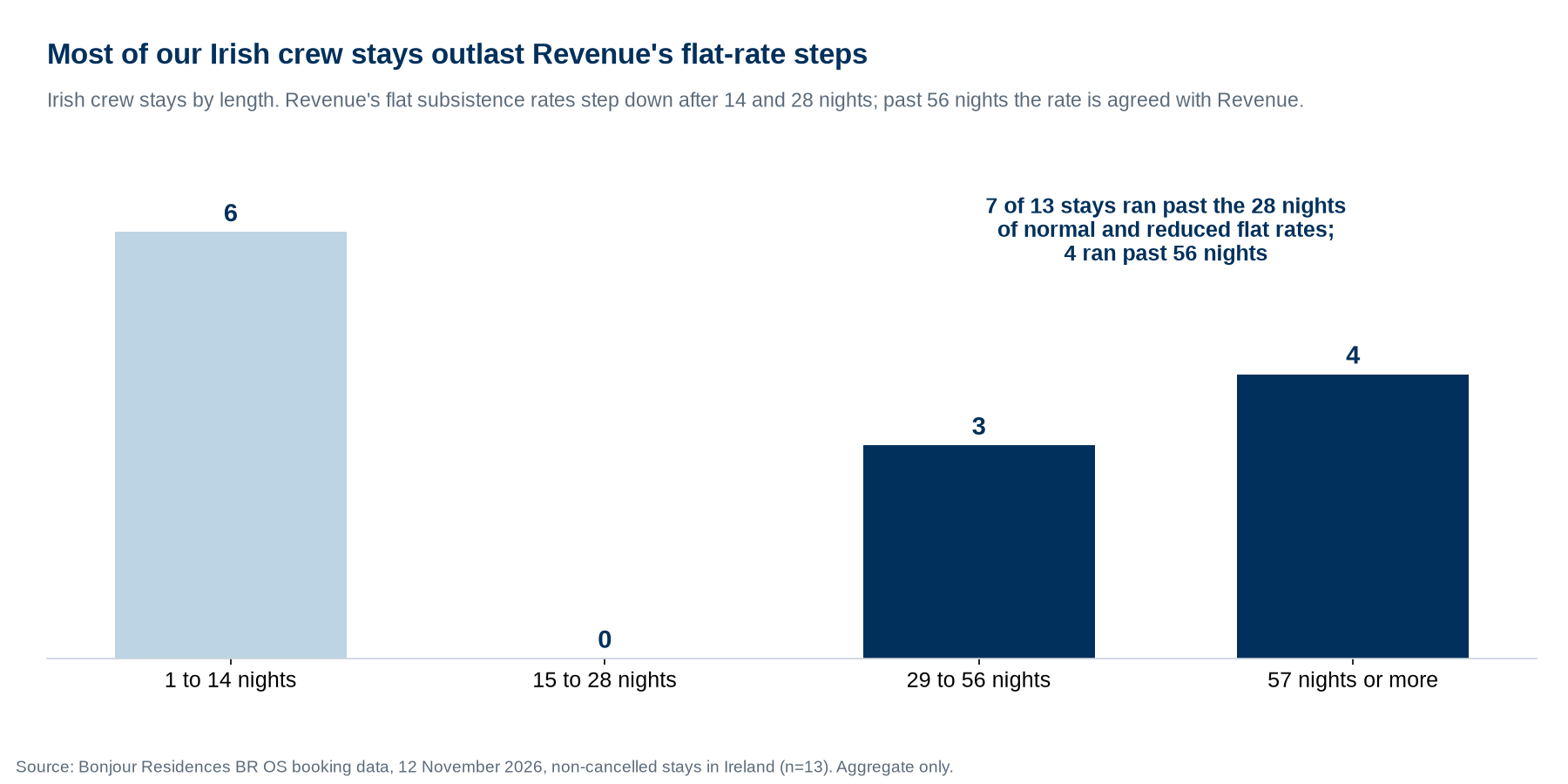
Five of the seven longer stays were extended at least once. A crew that arrives for three weeks and stays for two months moves through every step of Revenue's flat rates. That is why the model matters more than the length you book. Where the crew stays also matters: see how far crew accommodation can be from site and our earlier guide to finding worker accommodation in Ireland.
What should bookers do differently?
- Pick the model before you book. Either the crew is paid country money and finds its own bed, or the company books the accommodation. Not both, tax-free.
- Tell payroll the date the booking starts. From that night, country money for those workers is no longer tax-free.
- Check the van. If you provide transport to site, the travel part of country money also stops being tax-free.
- Keep the rent reasonable for the area. Revenue's no-benefit treatment depends on it. Keep the booking confirmation and invoices with the payroll records.
- Watch the six-month mark. Subsistence at one location is limited to six months. Plan long phases with your adviser.
- Say it in the contract. Workers who expect country money should know the accommodation replaces it. Do not take the cost back out of pay without advice, as we explained in deducting accommodation from pay.
This is general guidance, not tax advice. Your payroll adviser should confirm the treatment for your crew.
FAQ
Can we pay country money and also book the crew's accommodation?
Not tax-free. Revenue says country money cannot be paid tax-free when the employer provides board and lodgings. Any payment on top becomes taxable pay.
Is employer-booked accommodation a benefit in kind in Ireland?
Not if it is at a temporary work location, is not the worker's main home, and the rent is reasonable for the location. Meals must be reimbursed at no more than the actual cost.
Does the construction SEO require country money?
No. The Sectoral Employment Order sets minimum pay, pension and sick pay. Country money comes from the employment contract and Revenue's rules.
- Revenue, Site-based employees (country money, exclusions, eating on site), revenue.ie, published 9 June 2026, read 12 November 2026.
- Revenue, Tax and Duty Manual Part 05-01-06, Tax treatment of the reimbursement of expenses of travel and subsistence, chapters 3, 4.2, 4.7, 4.8 and 4.10, last reviewed September 2026.
- Workplace Relations Commission, Construction Sector Sectoral Employment Order (pay, sick pay and pension), workplacerelations.ie, read 12 November 2026; S.I. No. 620/2024, irishstatutebook.ie.
- Arcadis, Ireland Construction Outlook and Market Trends, 28 October 2026 (construction employment Q2 2026).
- RTE News, Ireland risks missing 2030 housing target by over 120,000 (Deloitte Crane Survey), 11 November 2026.
- Bonjour Residences, BR OS booking data, 12 November 2026 (13 non-cancelled stays in Ireland). Anonymised aggregate, no client names or rates.

Contact us today to discuss your next project