How far from site should the crew's accommodation be?
Crew accommodation should be judged by door-to-door minutes, not kilometres: on a 12-hour shift, an hour each way already reaches the 14-hour door-to-door maximum that UK rail fatigue guidance treats as exceptional. UK and German construction agreements also draw a line at about 9 miles or 10 km between the worker's lodging and the site, beyond which daily travel allowances start. Bonjour Residences data shows bookers often ask for a radius the local stock cannot meet, so it advises setting a maximum drive time tied to the shift pattern and widening the search early.
| 7 kmmedian straight-line distance from site to our crew flats (n=48) | 17 of 31flats booked further out than the 10 km or less radius the booker asked for | 14 hoursdoor-to-door maximum UK rail fatigue guidance treats as exceptional | 10 kmlodging-to-site line in Germany's construction agreement (9 miles in the UK) |
The booker gets two options for a crew of six. One flat is 4 km from the gate. The other is a bigger house 35 km away, cheaper and available now. The site manager says the crew will be fine driving. Three weeks later the crew is on 12-hour days, someone has fallen asleep at the wheel on the way back, and the cheaper house is the most expensive decision on the project.
Our argument: the right distance from site is not a number of kilometres. It is a number of minutes, and it depends on the shift. Set a maximum door-to-door time first, then search, and widen the search early rather than on day three.
Why does the commute matter more this winter?
Because working days are getting longer and the rest window is not. The EU Working Time Directive guarantees 11 consecutive hours of rest in every 24. Germany is now arguing about replacing its daily limit with a weekly average of 48 hours: Deutschlandfunk noted on 16 October that employers would then in theory be able to schedule up to 13 hours a day, and on 30 October the Augsburger Allgemeine reported that CDU/CSU politicians are pressing for the change quickly while the SPD draws red lines. Nothing has passed yet. But on many sites 10 to 12 hour days are already normal under collective agreements.
The commute comes out of the 11 hours. Germany's construction agreement states plainly that travel time to changing sites is not working time under the Working Hours Act, so the law does not count it. The crew's body does. The UK Office of Rail and Road sets out the maths: 8 hours of sleep, an hour to get up and an hour to wind down leaves an absolute maximum of 14 hours door to door, and even that, it says, is likely to lead to excessive fatigue.
Where do the agreements draw the line?
Two of Europe's main construction agreements both draw a line at about 10 km, and both measure from where the worker sleeps, not from their family home.
In the UK, the CIJC Working Rule Agreement pays a daily fare and travel allowance from 9 miles, measured from "the address at which the operative is living while employed" on the job. A worker on subsistence allowance only gets that daily allowance if they live "as near to the job as there is accommodation available". In Germany, the BRTV requires the employer to provide proper accommodation when the site is at least 75 km from the firm and the normal journey takes over 75 minutes, and pays 0.20 euro per km for trips between that accommodation and the site once they exceed 10 km.
So a flat inside the line usually saves a daily allowance as well as time. A flat well outside it adds cost every working day, unless the employer drives the crew in its own van.
What does our booking data show?
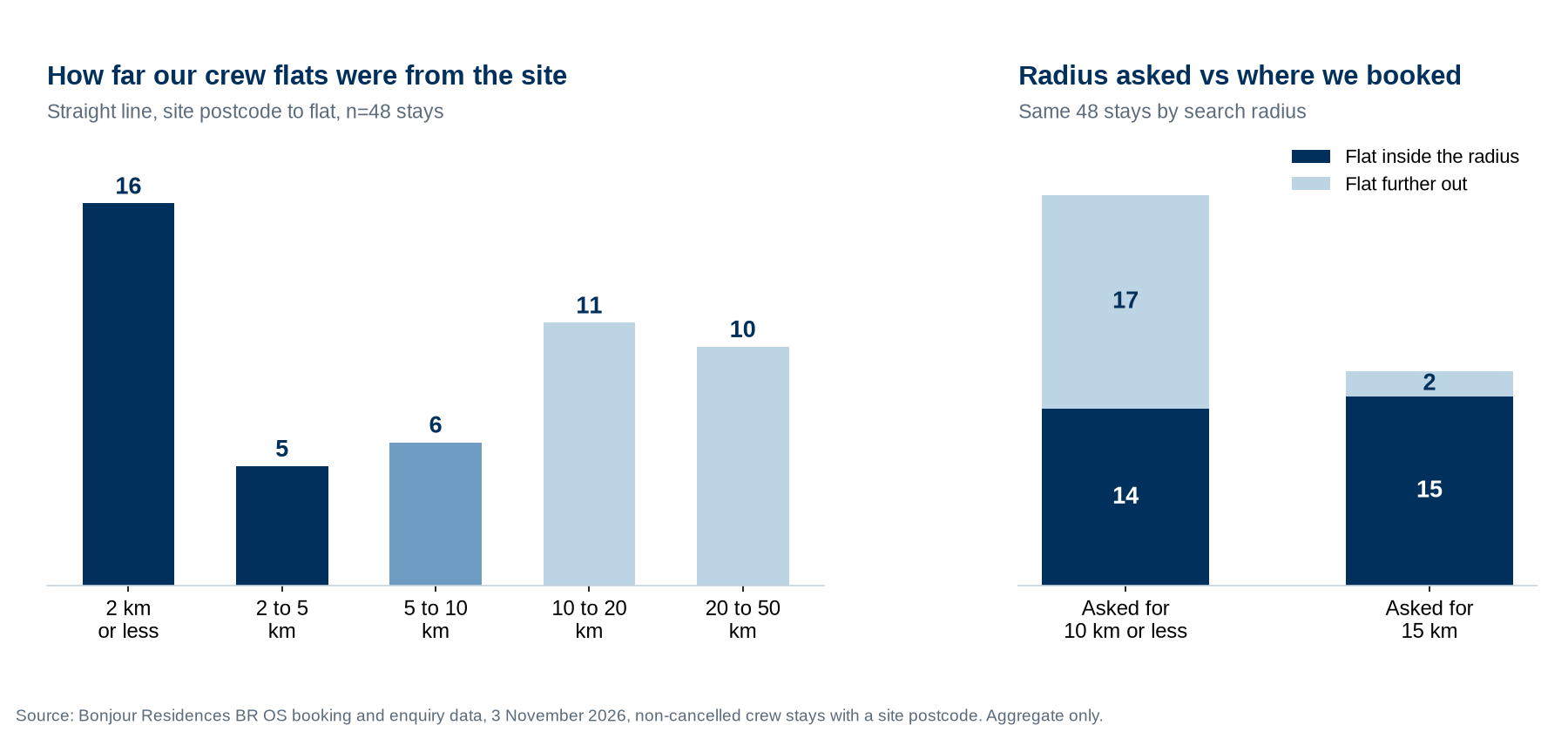
We matched 48 non-cancelled crew stays where the booker gave a site postcode with the flat we booked. The median straight-line distance was 7 km. Sixteen flats were within 2 km of the site, but 21 were more than 10 km away. Where the booker asked for a radius of 10 km or less, 17 of 31 flats ended up further out, mostly because nothing suitable was free inside it. Where they asked for 15 km, 15 of 17 fell inside. Longer stays sat further out: a median of 9.9 km for stays over 28 nights (n=18) against 6.7 km for shorter ones (n=30). And 38 of the 48 enquiries needed parking, so most of these crews were driving.
A tight radius is not wrong. But set late, it is the first thing to give, and it gives without anyone checking what the extra distance means at 6am.
How do shift length and drive time combine?
| Time on site, breaks included | 20 min each way | 45 min each way | 60 min each way |
|---|---|---|---|
| 8 hours | 8h40 door to door | 9h30 | 10h |
| 10 hours | 10h40 | 11h30 | 12h |
| 12 hours | 12h40 | 13h30 | 14h: the exceptional maximum |
Straight-line kilometres hide the real number. Twenty kilometres on a motorway can be 15 minutes. Twenty kilometres of rural road behind tractors and school buses can be 40. Check the drive at shift change, not at noon.
What should bookers do differently?
- Set the limit in minutes. As a rule of thumb, aim for 20 to 30 minutes each way on 10 to 12 hour shifts. On 8 hour days you have more room.
- Check the route at shift time. Run the route planner for 6am and 6pm on a weekday, not the straight line on the map.
- Know your allowance line. If your crew is paid under the UK Working Rule Agreement or the German BRTV, compare the cost of a closer flat with daily allowances beyond 9 miles or 10 km.
- Agree who drives. A rested driver, enough seats and somewhere to park the van. See where will the crew park the vans.
- Treat night shifts separately. The drive home after a night shift is the most dangerous one. Our piece on day and night shifts in the same flat covers the sleep side.
- Widen early, not late. If the site town is thin, agree a second ring with the site manager before the search, not after the first option falls through. See why there is no accommodation near the site.
FAQ
Is the commute from crew accommodation to site working time?
Usually not, where the crew travels to a fixed site. Germany's construction agreement says this travel time is not working time under the Working Hours Act. It still comes out of the worker's daily rest, which is why fatigue guidance counts it.
How far can a worker live from site under the UK Working Rule Agreement?
There is no maximum, but daily fare and travel allowances start at 9 miles from where the worker lives during the job, and a worker on subsistence allowance should live as near to the job as accommodation allows.
What is a safe commute after a 12-hour shift?
There is no single legal figure. UK rail fatigue guidance treats 14 hours door to door as an exceptional maximum, so on a 12-hour shift anything near an hour each way is too far.
- Directive 2003/88/EC concerning certain aspects of the organisation of working time, Article 3 (daily rest of 11 consecutive hours), Official Journal of the EU.
- Office of Rail and Road, Managing rail staff fatigue, Appendix A: Travel time, paragraphs 10.8 and 10.9, read 3 November 2026.
- Health and Safety Executive, Driving and riding safely for work: plan and manage journeys, and look after your workers' health, read 3 November 2026.
- Construction Industry Joint Council, Working Rule Agreement for the Construction Industry (revised 1 August 2025), WR.5 Daily fare and travel allowances and WR.15 Subsistence allowance. CIJC Pay Promulgation 2026, effective 20 July 2026.
- Bundesrahmentarifvertrag für das Baugewerbe (BRTV) of 28 September 2018 as amended 5 November 2021 and 10 November 2022, section 5 no. 7 and section 7, published by SOKA-BAU, read 3 November 2026.
- Deutschlandfunk, Arbeitszeitreform: Wie viele Stunden am Tag sollen wir arbeiten?, 16 October 2026.
- Augsburger Allgemeine, Union pocht auf schnelle Aufweichung des Acht-Stunden-Tags, 30 October 2026.
- Bonjour Residences, BR OS booking and enquiry data, 3 November 2026 (48 non-cancelled crew stays with a site postcode, straight-line distance site to flat; 6 geocoding errors over 100 km excluded). Anonymised aggregate, no client names or rates.

Contact us today to discuss your next project