Hotel breakfast or a kitchen: what happens to the crew's meal allowance?
The bed decides more than where the crew sleeps: in Germany, a breakfast the employer provides cuts each worker's tax-free meal allowance by EUR 5.60 a day, and the allowance stops after three months at the same site. In the UK, the Budget of 28 October 2026 plans new tax-free subsistence rates of up to GBP 75 from April 2028. Bonjour Residences data shows that 147 of 215 crew stays run longer than a week, so Bonjour Residences advises bookers to decide meals and kitchen in the same brief as the bed, and to tell payroll.
| 147 of 215of our crew stays are booked for longer than a week | EUR 5.60cut from a worker's German daily meal allowance for each breakfast the employer provides | 3 monthsafter which German tax-free meal allowances stop at the same site | GBP 75planned UK tax-free subsistence rate for travel over 24 hours, from April 2028 |
A crew of six lands in Germany for a seven-week job. The booker finds a hotel near site with breakfast included and books it. Payroll keeps paying the usual daily meal allowance in full. Nobody connects the two, until the tax adviser does: every breakfast the company paid for should have cut the tax-free allowance.
Our argument: the choice between a hotel with breakfast and a flat with a kitchen is not only about comfort or price. It changes what the crew can be paid tax-free for food. So meals belong in the accommodation brief, and payroll needs to know what was booked.
Why is this coming up now?
Because the UK has just changed the numbers. In the Budget on 28 October 2026, the government said it will reform the benchmark scale rates employers use to pay meal allowances without checking receipts. Today they are GBP 5, GBP 10 and GBP 25, and they have not moved in years. The new rates will be GBP 20 for travel over 5 hours, GBP 60 for over 10 hours and GBP 75 for over 24 hours, from 6 April 2028, through secondary legislation. The 200 or more overseas rates will be replaced by a tiered system linked to them.
Meanwhile, Germany's rules have not changed, and they are where most crews get caught.
What changes when the hotel serves breakfast?
Under section 9(4a) of Germany's Income Tax Act, a worker away from home can receive EUR 28 tax-free for each full day and EUR 14 for the arrival and departure days. If the employer, or a third party at the employer's request, provides a meal, the allowance is cut: by 20% of the full-day rate for breakfast, which is EUR 5.60, and by 40%, EUR 11.20, for each lunch or dinner.
A hotel breakfast on a room the company books and pays for counts as a meal the employer provides. Over 20 nights, that is up to EUR 112 less tax-free allowance per worker. If payroll keeps paying the full amount, the difference is taxable pay. A flat with a kitchen leaves the allowance whole, because no meal is provided. The crew shops and cooks for itself.
What happens on long stays?
In Germany, the meal allowance is limited to the first three months of longer work at the same site. After that, nothing can be paid tax-free for meals there, unless the work is interrupted for at least four weeks, which restarts the clock. On a long job, the crew is paying for its own food from taxed pay. That is when a proper kitchen, a big fridge and enough rings on the hob matter most. Our piece on stays over three months covers the other lines that crossing this point moves.
What does our booking data show?
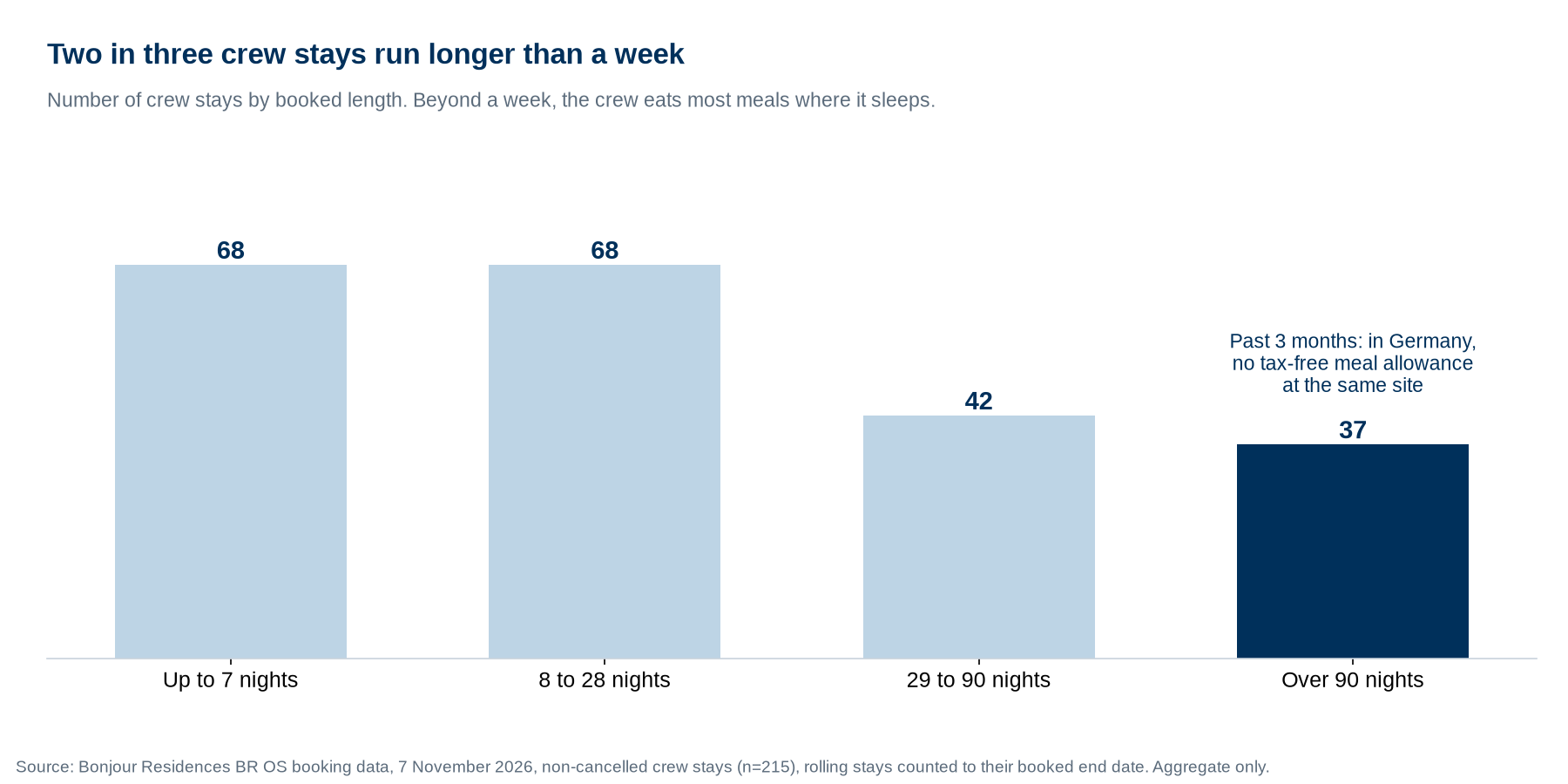
We looked at 215 non-cancelled crew stays in our records. The median booked length is 15 nights. 147 run longer than a week, 79 longer than 28 nights and 37 longer than 90 nights, with rolling stays counted to their booked end date. In Germany, 7 of our 47 stays run past 90 nights.
Where we recorded the type of property (148 stays), 129 were flats or houses and 19 were hotels or aparthotels. The hotel stays were short, with a median of 6 nights (n=19), against 20 nights for flats and houses (n=129). A kitchen was recorded on 141 of the 148, including 15 of the 19 hotel stays. In practice, crews that stay longer than a week cook. When a crew outgrows hotel rooms, the meal allowance should move with it.
How do the rules compare?
| Where the crew works | Tax-free meal allowance today | What reduces or ends it | What it means for the booking |
|---|---|---|---|
| Germany, worker on a domestic job | EUR 28 per full day away, EUR 14 on arrival and departure days | Each meal the employer provides: breakfast minus 20% (EUR 5.60), lunch or dinner minus 40% (EUR 11.20). Ends after 3 months at the same site; a break of 4 weeks restarts the clock | A breakfast-included rate shrinks the allowance. On long jobs, the kitchen does the work the allowance no longer does |
| United Kingdom | Benchmark rates: GBP 5 (5 hours), GBP 10 (10 hours), GBP 25 (15 hours and still away at 8pm), plus GBP 10 after 8pm on the lower two | Only for qualifying business travel; anything above the rate is taxable unless HMRC agreed a bespoke rate | Budget 2026 plans GBP 20, 60 and 75 from 6 April 2028. Review the subsistence policy before then |
| Posted crew in another EU country | The host country's rules on travel, board and lodging allowances apply | Depends on the host country | Check the host rules before choosing a rate with or without meals |
For posted crews, the EU Posting of Workers Directive, as amended by Directive 2018/957, applies the host country's rules on allowances for travel, board and lodging when workers travel to their regular place of work there. The European Commission's practical guide says allowances that repay real expenses are not part of pay. Our piece on deducting accommodation from posted workers' pay covers the bed side of the same rule.
What should bookers do differently?
- Put meals in the brief. Next to headcount and dates, say whether the crew gets breakfast, a kitchen or both.
- Tell payroll what you booked. In Germany, each breakfast the company pays for cuts the daily allowance. Send payroll the meal plan with the booking confirmation.
- Do not pay twice. A breakfast-included rate plus a full meal allowance means paying for the same breakfast twice, and part of it becomes taxable.
- Check the kitchen against the headcount. Six workers need more than a two-ring hob and a small fridge, especially after three months, when the German allowance stops.
- Diary April 2028. UK employers should review their subsistence policy before the new rates start, and decide whether to keep a bespoke rate.
FAQ
Does a kitchen in the flat reduce the German meal allowance?
No. The cut applies to meals the employer provides, not to cooking facilities. A worker in a flat with a kitchen keeps the full allowance for the first three months at the site.
What about German workers sent abroad?
They get country rates instead, set by the Federal Ministry of Finance. Its letter of 5 December 2025 lists the rates that apply from 1 January 2026.
Can UK employers pay more than the benchmark rates today?
Yes, but any excess is taxable unless HMRC has agreed a bespoke scale rate, or the employer repays actual receipted costs.
- Einkommensteuergesetz, section 9(4a) sentences 3, 6 to 8 (EUR 14 and EUR 28 meal allowances; three-month limit and four-week restart; cuts of 20% and 40% for meals provided), gesetze-im-internet.de and Lohnsteuer-Handbuch 2026 of the Federal Ministry of Finance, read 7 November 2026.
- Bundesministerium der Finanzen, letter of 5 December 2025 on travel costs for business trips abroad from 1 January 2026.
- HM Treasury and HMRC, Budget 2026: overview of tax legislation and rates, section 2.8 Reform of Benchmark Scale Rates and Overseas Scale Rates, GOV.UK, 28 October 2026.
- HMRC, Employment Income Manual EIM30240 (benchmark rates under the Income Tax (Approved Expenses) Regulations 2015, SI 2015/1948), GOV.UK, read 7 November 2026.
- Directive 96/71/EC as amended by Directive (EU) 2018/957, article 3(1)(i) (allowances for travel, board and lodging), legislation.gov.uk copy, read 7 November 2026; European Commission, Practical guide on posting.
- Bonjour Residences, BR OS booking data, 7 November 2026 (215 non-cancelled crew stays; property type recorded on 148; rolling stays counted to their booked end date). Anonymised aggregate, no client names or rates.

Contact us today to discuss your next project