Germany's six-month rule: what happens when the crew's flat runs longer?
Germany's draft rent law caps lets for a temporary need at six months, or eight if the need grows after move-in, and the government names assembly work as a typical case; past that line the let falls under normal tenant protection. On the Federal Court of Justice's reasoning, a flat rented by the company to house its crew is not a residential tenancy, so the risk sits mainly with lets signed in a worker's own name and with stays that simply roll on. In Bonjour Residences data, 43 of 52 crew stays in Germany ended within 28 nights, and all 3 that passed six months were rolling stays that had been extended.
| 6 monthsproposed cap on a let for a temporary need in Germany | 8 monthsthe most it can run if the need grows after move-in | 43 of 52our crew stays in Germany that ended within 28 nights | 3 of 3our German stays past six months that were rolling and extended |
Germany's rent reform is back in the news. On 21 November 2026, ZDF reported from Hamburg that furnished lets for a temporary need are to be capped at six months, and that it is still unclear when the Bundestag will vote. The government bill (Bundestag paper 21/6807) was adopted by the cabinet on 29 April 2026, had its first reading on 9 July and a public hearing in the legal affairs committee on 14 October.
The bill is aimed at furnished flats in big cities, where short lets are used to get around the rent brake. But the explanatory memo names our sector directly: a temporary need is typically found in short work stays, "for shorter projects, assembly work or trade fairs". Our argument: for crews, the six-month line is a contract question, not a housing question. Who signs the let, and how extensions are agreed, decides whether it matters.
What does the bill actually change?
German law already leaves lets "for temporary use only" outside most tenant protection, including the rent brake and protection against termination (BGB section 549(2) no. 1). What it never said was how long temporary can be. The memo lists the court decisions: seven months was too long in one Berlin case, a four-month term counted as a sign of temporary use in another. The trend, it says, is about six months.
The bill writes that down. A let for a special temporary need may run up to six months, and up to eight in total if a longer need arises after the start. The memo's example: a project finish that slips a few weeks. Go past eight months and the exemptions stop from the date of that extension. The same applies if the tenant simply stays on after the end date (BGB section 545), and a fresh short let between the same parties straight after the old one does not count as temporary either.
Two limits matter for bookers. The new rule only applies to contracts signed after it comes into force, on the first day of the fourth month after the law is published. And it has not been passed yet.
Does it apply when the company signs?
Probably not. In its judgment of 13 January 2021 (VIII ZR 66/19), the Federal Court of Justice confirmed its line: what counts is the purpose the tenant pursues. Where the tenant rents a flat to hand it to others, even for them to live in, residential tenancy law does not apply to that let. A company, the court said, cannot have its own housing need.
So a contractor that rents a flat for its fitters is, on that reasoning, outside section 549 altogether. The bigger exposure is the let signed by a worker in their own name, which is common when a subcontractor pays a housing allowance and leaves the crew to find beds. This is not legal advice: check the wording of your own contract.
| Who signs the let | Does the 6-month cap matter? | What to watch |
|---|---|---|
| The contractor (company is the tenant) | Unlikely: the Federal Court of Justice treats a flat rented to house others as a non-residential let | Owners may still apply the cap to be safe. Ask for it in writing at booking |
| The worker, in their own name | Yes: past 6 months (8 with an extension) normal tenant protection applies | Expect owners to refuse extensions near month 6 or insist on a hard end date |
| Nobody signs again: the crew just stays on | Yes for a worker's let: a silent extension past the limit counts | Agree every extension in writing before the end date |
| A new short let straight after the old one | Does not reset the clock between the same parties | Plan the full project length at the first booking |
What does our data show?
We looked at the non-cancelled crew stays we arranged, measured to the booked end date. In Germany (n=52, all in 2026) the median stay was 9.5 nights and 43 ended within 28 nights. Only 3 ran past six months, and none past eight so far. All 3 were rolling stays that had been extended along the way, which is exactly the pattern the bill's extension rules are written around. Across Europe (n=228) the median was 15 nights, 18 stays ran past six months and 11 past eight.
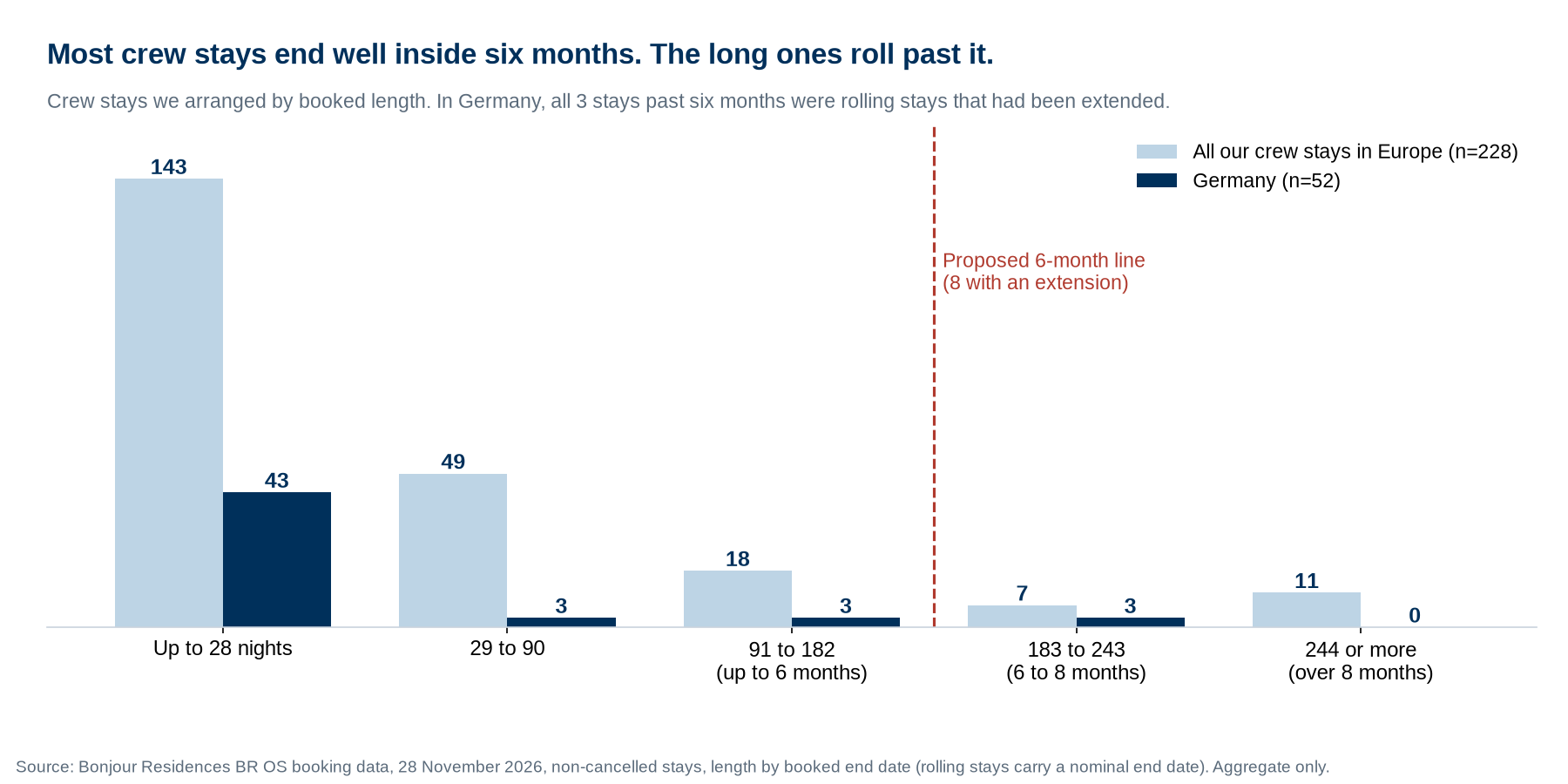
Today 7 of our crews are in German flats, 5 of them on rolling terms. Two have already passed six months and two more are between four and six. None of them started as a six-month booking. Crew stays get long by rolling, not by plan, so the risk is the extension nobody writes down.
Why would owners care?
Because a let that tips into normal tenant protection is hard to end and, in rent-brake areas, capped on price. Owners who let furnished flats to workers will read the six-month line as a hard stop. Expect more questions about who the tenant is, shorter offers, and refusals near month six. Most of our German stays are in small towns near plants and sites, where local permits are the bigger issue, as our Monteurwohnung article shows.
What should bookers do differently?
- Sign in the company's name. Book the flat as the contractor, for named workers, rather than leaving workers to sign their own lets.
- Book the real project length. If the programme says nine months, say so at the start. A chain of short lets does not reset the clock. Our article on stays over three months covers the planning.
- Put every extension in writing before the end date. Never let a crew just stay on. See what to do when the project slips.
- Agree the exit too. Notice terms on a company let are what you negotiate, so set them at booking. Our guide to ending a booking early explains the trade-offs.
- Use the right market for the length. Short stays and long stays are different markets. Our clients have saved 20-30% by using the correct market for the length of stay.

FAQ
Is the six-month limit for short-term lets in Germany law yet?
No. It is in a government bill (Bundestag paper 21/6807) that had its committee hearing on 14 October 2026. No date for the final vote had been set as of late November 2026.
Can a crew's let be extended past six months?
Under the bill, up to eight months in total if the longer need arises after the start, such as a project finish that slips. Past eight months, normal tenant protection applies from the extension.
Does the cap apply if our company rents the flat for the crew?
Probably not. The Federal Court of Justice holds that a let where the tenant hands the flat to others to live in is not a residential tenancy, and a company cannot have its own housing need.
Does the rule affect contracts we already have?
No. The transitional rule in the bill applies the new limit only to contracts signed after it comes into force.
- Federal Ministry of Justice and Consumer Protection (BMJV), government bill amending the law on residential and commercial leases (Mietrecht II), including explanatory memo, 2026; press release on cabinet adoption, 29 April 2026.
- BMJV, speech by Federal Minister Stefanie Hubig at the bill's first reading in the Bundestag, 9 July 2026.
- Bundesgerichtshof (Federal Court of Justice), judgment VIII ZR 66/19, 13 January 2021, confirming VIII ZR 282/07 of 16 July 2008.
- ZDFheute, Hohe Mieten durch moebliertes Wohnen und Co-Living (Hamburg), 21 November 2026.
- Die Immolage, report on the legal affairs committee hearing on Bundestag paper 21/6807, 17 October 2026.
- Bonjour Residences, BR OS booking data, 28 November 2026: non-cancelled crew stays, Germany n=52, Europe n=228, length by booked end date.

Contact us today to discuss your next project