Monteurwohnung in Germany: can the town close the crew's flat mid-job?
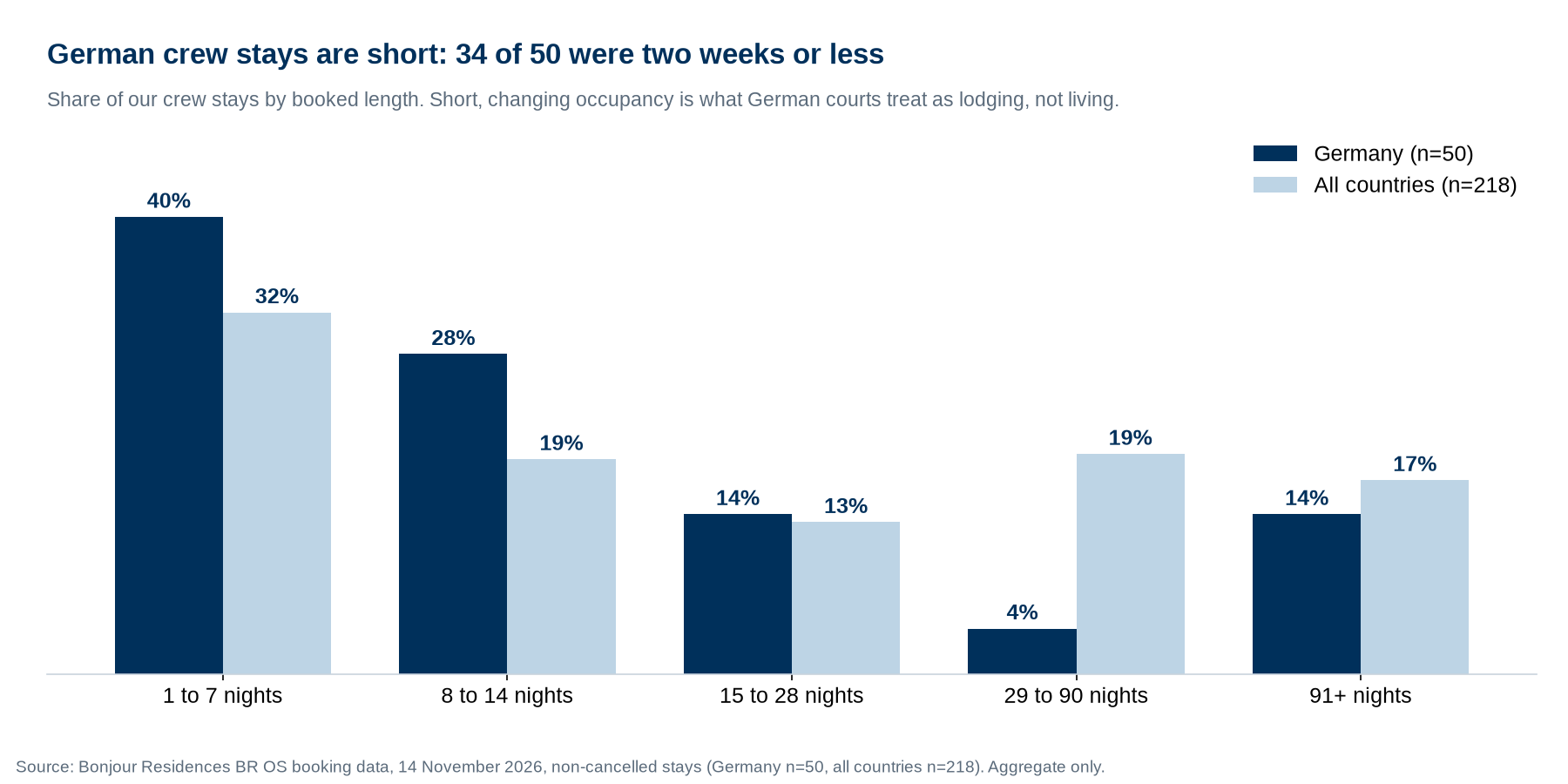
In Germany, a town can ban the use of a flat or house as a Monteurwohnung if it only has a permit as a home, and courts have upheld such bans even when the flats were simply rented to companies for their workers. Bonjour Residences data shows that 34 of 50 crew stays in Germany in 2026 were two weeks or less, the short, changing occupancy that courts treat as lodging rather than living. Bonjour Residences advises bookers to ask whether the property is permitted for lodging workers before the crew moves in.
| 34 of 50of our 2026 crew stays in Germany were two weeks or less | 41 of 50were outside Germany's four big cities where we house crews | 13workers found in a two-family house a court let the town close | 8 weeksa year of short lets before Munich's misuse ban applies |
On 11 November, Die Rheinpfalz reported from Woerth am Rhein, where school renovations are under way and new housing projects are about to start. Monteurwohnungen are in demand there, the paper wrote, but not every one is allowed. The district administration says it keeps receiving reports of homes used without the required permit, and that planning rules do not allow worker lodging everywhere. Three weeks earlier, the same paper described the neighbours' complaints: noise, rubbish and full parking spaces.
Woerth is not alone. In August, Krefeld told the Westdeutsche Zeitung that using a flat as a Monteurwohnung can be a change of use that needs a permit, and that it has approved only 30 such lodging businesses in nine years while hundreds are advertised online. Our argument: in Germany, the biggest risk to a crew flat is not the booking contract but the building's permit, and the short, rotating stays most crews need are exactly what the courts treat as lodging.
Why would a town close a flat that is rented legally?
Because renting it and using it are judged separately. In July, the administrative court in Neustadt an der Weinstrasse upheld a town's ban on using a 1960 two-family house as worker lodging. Inspectors had found 13 workers from different companies, mostly two to a room, sharing kitchens and bathrooms, with regular cleaning and bed linen changes. The owner argued the flats were simply rented to two companies.
The court disagreed. Living in a home, it said, means a household set up for the long term, where people run their own private lives. Accommodation for a temporary stay is something else. The house had a permit as a home, so lodging workers in it was a change of use without a permit, and that alone was enough to ban it.
Who gets the order, and who moves out?
The order goes to the owner, but the crew leaves. In a 2024 case about a family house let as fitters' rooms, the Bavarian administrative court said the town was right to address the owners, because the workers change constantly. On the workers' side, it noted that a fitter who must leave at once can find a room in a guesthouse or hotel. The ban was immediately enforceable. Anyone who starts an unpermitted use, the court said, must expect a ban at any time.
For a booker, that means a crew can lose its beds mid-job for a reason that was never in the booking, with no notice period and no say in the procedure.
Which rules can close a crew flat?
| Rule | Where it applies | What triggers it | What the authority can do |
|---|---|---|---|
| Building permit (change of use) | Every town | A building approved as a home is used to lodge changing workers | Ban the use, often with immediate effect; in North Rhine-Westphalia fines up to EUR 500,000 |
| Misuse ban (Zweckentfremdung) | Cities with a local statute, such as Munich | In Bavaria, more than 8 weeks a year of short lets to visitors | Require a permit; fines up to EUR 500,000 in Bavaria |
| Housing standards (Wohnraumschutz) | For example Lower Saxony | Less than 10 m2 of living space per person | Order the flat to be cleared |
The rules are not a blanket ban. In 2024, the higher administrative court of North Rhine-Westphalia held that lodging for 11 fitters can in principle be allowed in a general residential area. The point is the permit: worker lodging can be approved, but a flat approved as a home is not automatically approved for it.
What does our booking data show?
Our German stays are short and spread out. Of 50 crew stays in Germany in 2026, the median was 9.5 nights, against 14 nights across all 218 of our stays in Europe. 34 of the 50 were two weeks or less, and 31 of the 36 German properties with a recorded minimum stay accept bookings from one night.
The stays are also mostly in small towns. 41 of the 50 were outside Duesseldorf, Essen, Frankfurt and Dresden, across 31 smaller towns. City misuse bans rarely reach those places, but building permits apply in every town, and small towns are where neighbours notice a van-load of workers first. We covered the German housing standards for crews in where crews in Germany actually stay and fire safety in who checks the smoke alarms.
What should bookers do differently?
- Ask about the permit, not just the price. Is the property approved as lodging (Beherbergung) or as a home? A licensed guesthouse or approved Monteurunterkunft carries less closure risk for short rotations.
- Match the property to the stay. Week-long rotations of changing workers look like lodging. One stable crew in a whole home for months looks more like living, though no court has drawn a fixed line.
- Check the city rules. In Munich, more than 8 weeks a year of short lets needs a misuse permit. Our article on registration numbers explains what to ask the owner for.
- Do not overfill. Two to a room and shared bathrooms were part of what the Neustadt inspectors recorded. Crowding also draws the complaints that trigger inspections, so consider splitting the crew across flats.
- Put it in the contract. The owner should confirm the use is permitted and rehouse the crew at their cost if the town stops it.
- Keep a fallback. If a ban comes, it can take effect at once. Know where the crew sleeps that night.
Getting the property type right also saves money: our clients have saved 20-30% by using the correct market for the length of stay.
FAQ
Is a Monteurwohnung legal in Germany?
It can be, if the building has a permit for lodging workers. A flat approved only as a home and used for changing workers may need a change-of-use permit, and a town can ban the use without one.
Can the town make the crew leave immediately?
Yes. Courts have upheld use bans with immediate effect, addressed to the owner. The workers then have to find other accommodation.
Does it help that a company rents the flat?
Not by itself. In the Neustadt case, the owner argued the flats were rented to two companies, and the court still treated the use as worker lodging.
- Die Rheinpfalz, Monteurwohnungen: Fluch oder Segen?, 11 November 2026; Laerm, Muell, volle Parkplaetze: Problem Monteurwohnungen, 19 October 2026.
- Westdeutsche Zeitung, Monteurwohnungen in Krefeld: Bussgeld moeglich, 27 August 2026.
- Verwaltungsgericht Neustadt an der Weinstrasse, press release 7/26, Klage gegen Nutzungsuntersagung einer Monteurunterkunft erfolglos, 15 July 2026, vgnw.justiz.rlp.de.
- Bayerischer Verwaltungsgerichtshof, order of 25 March 2024, 1 CS 24.65 (use ban on a house used as worker lodging), gesetze-bayern.de, read 14 November 2026.
- Bayerischer Verwaltungsgerichtshof, order of 30 August 2024, 12 CS 24.1190 (8-week limit), gesetze-bayern.de, read 14 November 2026.
- Landeshauptstadt Muenchen, Satzung ueber das Verbot der Zweckentfremdung von Wohnraum (ZeS), s4, risi.muenchen.de.
- Bavarian Zweckentfremdungsgesetz (ZwEWG), Art. 1 and Art. 4, version from 1 April 2026, gesetze-bayern.de, read 14 November 2026.
- Bauordnung fuer das Land Nordrhein-Westfalen (BauO NRW 2018), s86(3), recht.nrw.de, read 14 November 2026.
- Oberverwaltungsgericht Nordrhein-Westfalen, order of 31 January 2024, 10 B 1456/23, as reported by urteile.news.
- Niedersaechsisches Ministerium fuer Wirtschaft, Verkehr und Bauen, Niedersaechsisches Wohnraumschutzgesetz, mw.niedersachsen.de, read 1 November 2026.
- Bonjour Residences, BR OS booking data, 14 November 2026 (50 non-cancelled crew stays in Germany, 218 in all countries). Anonymised aggregate, no client names or rates.

Contact us today to discuss your next project