Who checks the smoke alarms in the crew's accommodation?
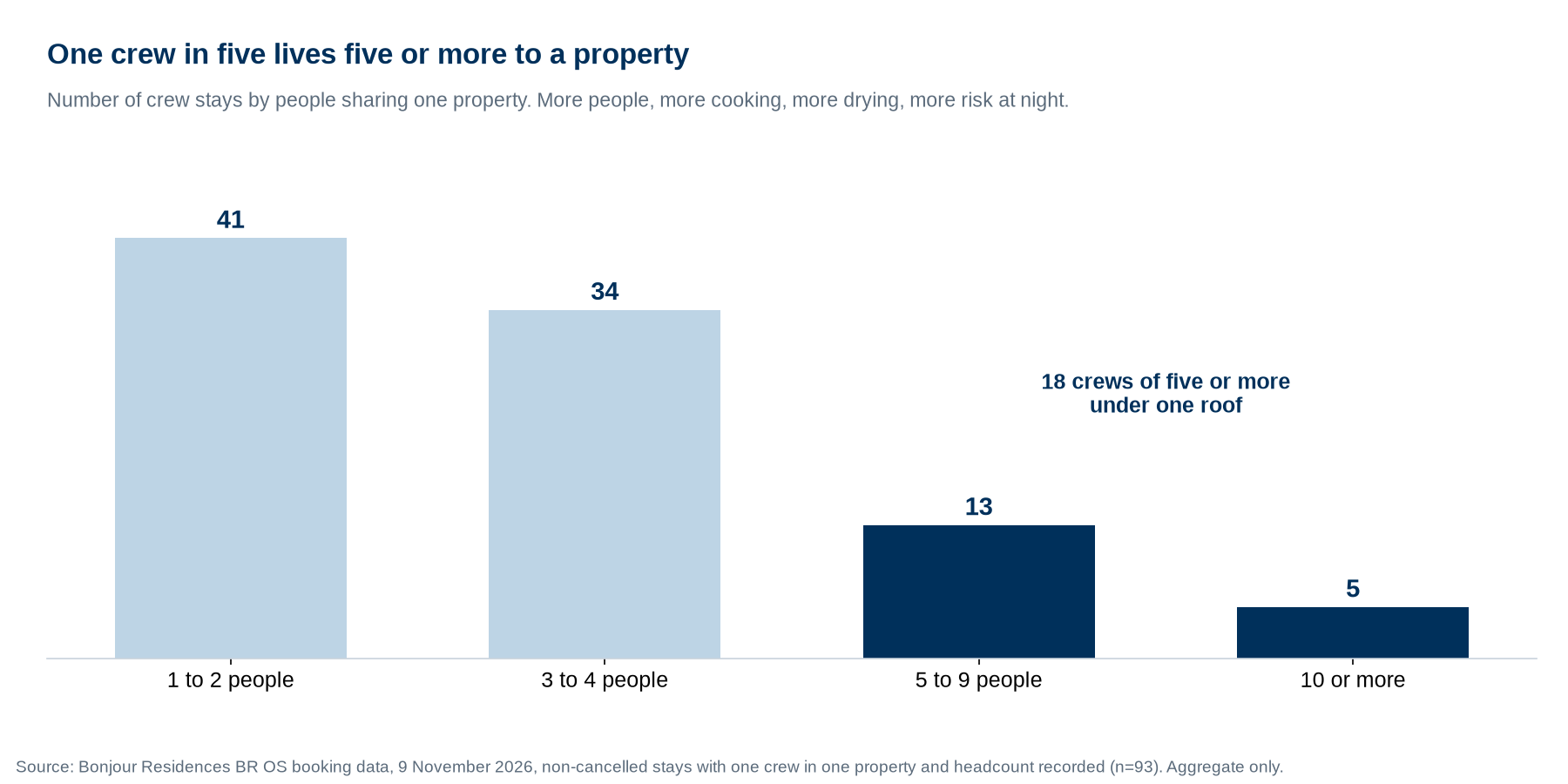
In most of Europe the owner of a rented flat must fit smoke alarms, but who keeps them working differs: in Bavaria it is the people living there, and in England a short let to paying guests also needs a fire risk assessment from the owner or agent. Bonjour Residences data shows that 18 of 93 crews lived five or more to one property. Bonjour Residences advises bookers to ask for proof of working alarms before the crew arrives, and to agree who tests them on long stays.
| 18 of 93of our crews lived five or more to one property | 10 peopleupper limit of England's fire guide for small paying-guest lets; bigger lets follow fuller guidance | 30 June 2026deadline in Poland for detectors where hotel services are provided, flats from 2030 | 42of our confirmed crew stays run into this winter, 32 of them rolling |
On the evening of 5 October, firefighters in Noordwijkerhout were called to a fire in a ground-floor unit of housing for migrant workers. Neighbours had already started on it with extinguishers. The day before, in Marylebone, London Fire Brigade sent four engines to a fire in a house in multiple occupation. Ten people got out before the crews arrived. The brigade put it down to the unsafe disposal of smoking materials.
Neither was our crew. But both were the kind of building crews live in: shared, full, and lived in at odd hours. Our argument: the booker cannot see a smoke alarm on a listing, and the law puts the alarm on the owner while leaving the testing unclear. So fire safety has to be a question in the booking, not something the crew discovers on night one.
Who is responsible for the alarms?
Almost everywhere, the owner fits them. In England, landlords must put a smoke alarm on every storey used as living accommodation and a carbon monoxide alarm in any room with a fixed combustion appliance, such as a boiler or gas fire. They must check the alarms work on the first day of the tenancy, and a council can fine up to GBP 5,000 per breach of a remedial notice.
A crew on a short let is often not a tenancy at all. The Home Office guide for small paying-guest accommodation says premises with short-term, temporary paying guests are unlikely to count as a private dwelling. Then the Regulatory Reform (Fire Safety) Order 2005 applies, and the owner, letting agent or other person in control must carry out a fire risk assessment. The guide covers lets for up to 10 people or 2 floors. Larger or more complex properties follow the national guidance for sleeping accommodation.
Germany leaves the rules to its states. In Bavaria, every bedroom and every hallway leading to living rooms needs a smoke alarm, and owners had to retrofit existing flats by the end of 2017. Keeping them working is the job of the people living there, unless the owner takes it on. Germany's consumer centres say alarms must be replaced after 10 years at the latest.
In the Netherlands, smoke alarms have been required in every home since 1 July 2022, on each storey with a living room, bedroom or kitchen, and the owner or landlord must place them. In Poland, the State Fire Service said on 30 June 2026 that places where hotel services are provided, in use before 23 December 2024, had until that day to fit autonomous detectors. Ordinary flats follow from 1 January 2030.
How do the rules compare?
| Country | What must be fitted | Who fits it | Who keeps it working |
|---|---|---|---|
| England, tenancy | Smoke alarm on every storey; carbon monoxide alarm by fixed combustion appliances | Landlord | Landlord tests on day one, repairs once told |
| England, short let | What the fire risk assessment requires | Owner, agent or person in control | The same person |
| Germany (Bavaria) | Smoke alarm in every bedroom and hallway to living rooms | Owner | Occupants, unless the owner takes it on |
| Netherlands | Smoke alarm on every storey with a living room, bedroom or kitchen | Owner or landlord | Agree it in writing |
| Poland | Detectors where hotel services are provided by 30 June 2026; flats from 2030 | Owner or operator | Owner or operator |
Why is a crew flat a different risk?
Because it is fuller and busier than the family home the rules were written for. We looked at 93 non-cancelled stays in our records where one crew lived in one property and the headcount was recorded. The median crew was 3 people. 18 crews lived five or more to one property, 5 of them ten or more, and the largest was 20. In 15 of 91 stays with the bedroom count recorded, there were more people than bedrooms.
Crews also live differently. A night shift sleeps through the day while the day shift cooks. In winter, wet gear ends up on radiators and heaters. 42 of our confirmed crew stays run into this winter, and 32 of them are rolling, with no fixed end date.
Is it only the owner's problem?
The alarm duty sits with the owner, but the crew is still your people. In France, as we covered in client liability for subcontractor housing, the client can be pulled in when a crew's housing falls short. Asking costs one email.
What should bookers do differently?
- Ask for proof before arrival. A photo of the smoke alarm on each floor and in the hallway, and of a carbon monoxide alarm next to any boiler, gas fire or stove.
- Send the real headcount. In England, ten or more paying guests takes the let beyond the small-premises guide. Ask whether the fire risk assessment covers the number of people you are sending.
- Agree who tests. In Bavaria the occupier keeps alarms working. On long stays, put a regular test in the house rules and name who does it.
- Ask how old the alarms are. Alarms older than 10 years should be replaced.
- Brief the crew on night one. The way out, no drying gear on heaters, no smoking inside, and who to call if an alarm beeps or fails.
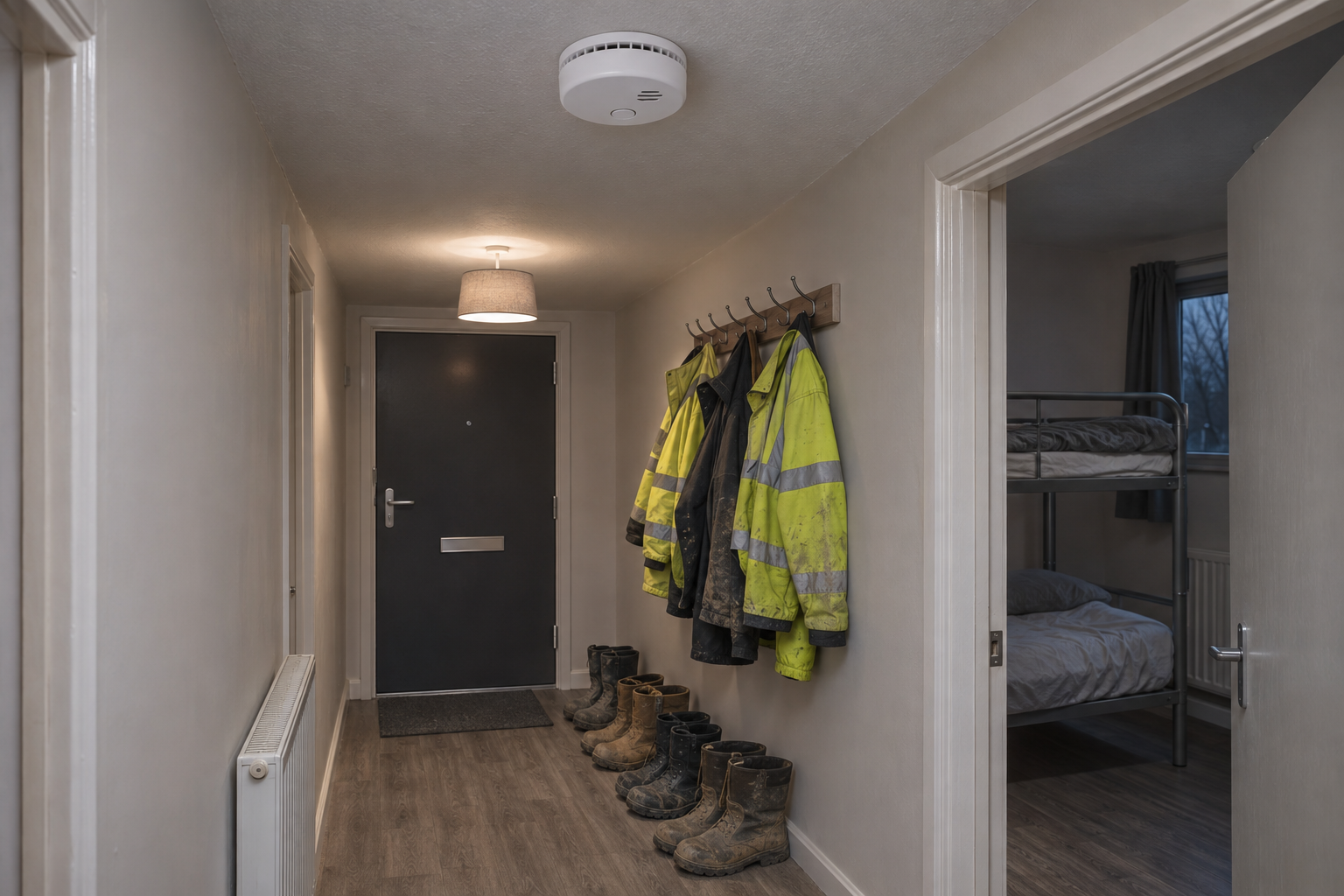
On our bookings we ask owners for a short walkthrough video or photos after the final clean, before the crew arrives. A ceiling alarm in the hallway is one of the easiest things to check in it. See also our guide to worker accommodation standards in the UK.
FAQ
Who must fit smoke alarms in a rented crew flat?
In England, Germany, the Netherlands and Poland, the owner or landlord. Who keeps them working differs: in Bavaria it is the people living there unless the owner takes it on.
Does the Fire Safety Order apply to a crew on a short let in England?
Usually. The Home Office guide says premises with short-term, temporary paying guests are unlikely to count as a private dwelling, so the person in control needs a fire risk assessment.
- 112 Duin en Bollenstreek, Brand in woonunit arbeidsmigranten in Noordwijkerhout, 5 October 2026.
- London Fire Brigade, House fire, Marylebone, incident report, 4 October 2026.
- Ministry of Housing, Communities and Local Government, Smoke and Carbon Monoxide Alarm (Amendment) Regulations 2022: guidance for landlords and tenants, GOV.UK, updated 29 July 2022.
- Home Office, A guide to making your small paying-guest-accommodation safe from fire (Regulatory Reform (Fire Safety) Order 2005), November 2024; Department for Business and Trade, Letting out a self-catering holiday home in England: rules and regulations, GOV.UK, updated 2 October 2026.
- Bayerische Bauordnung, Art. 46(4) (smoke alarms in homes), gesetze-bayern.de, read 9 November 2026; Verbraucherzentrale, Rauchmelder austauschen, 30 March 2026.
- Rijksoverheid, Hoeveel rookmelders moet ik in mijn huis hebben?, read 9 November 2026; Brandweer Nederland, Minimaal 1 werkende rookmelder op elke verdieping, 1 July 2022.
- Komenda Glowna Panstwowej Strazy Pozarnej (Polish State Fire Service), Obowiazek instalowania autonomicznych czujek dymu i czadu, gov.pl, 30 June 2026.
- Bonjour Residences, BR OS booking data, 9 November 2026 (93 non-cancelled stays with one crew in one property and headcount recorded; bedroom count on 91; 42 confirmed stays running into winter 2026 to 2027). Anonymised aggregate, no client names or rates.

Contact us today to discuss your next project