Should we build a worker village for the crew or book local accommodation?
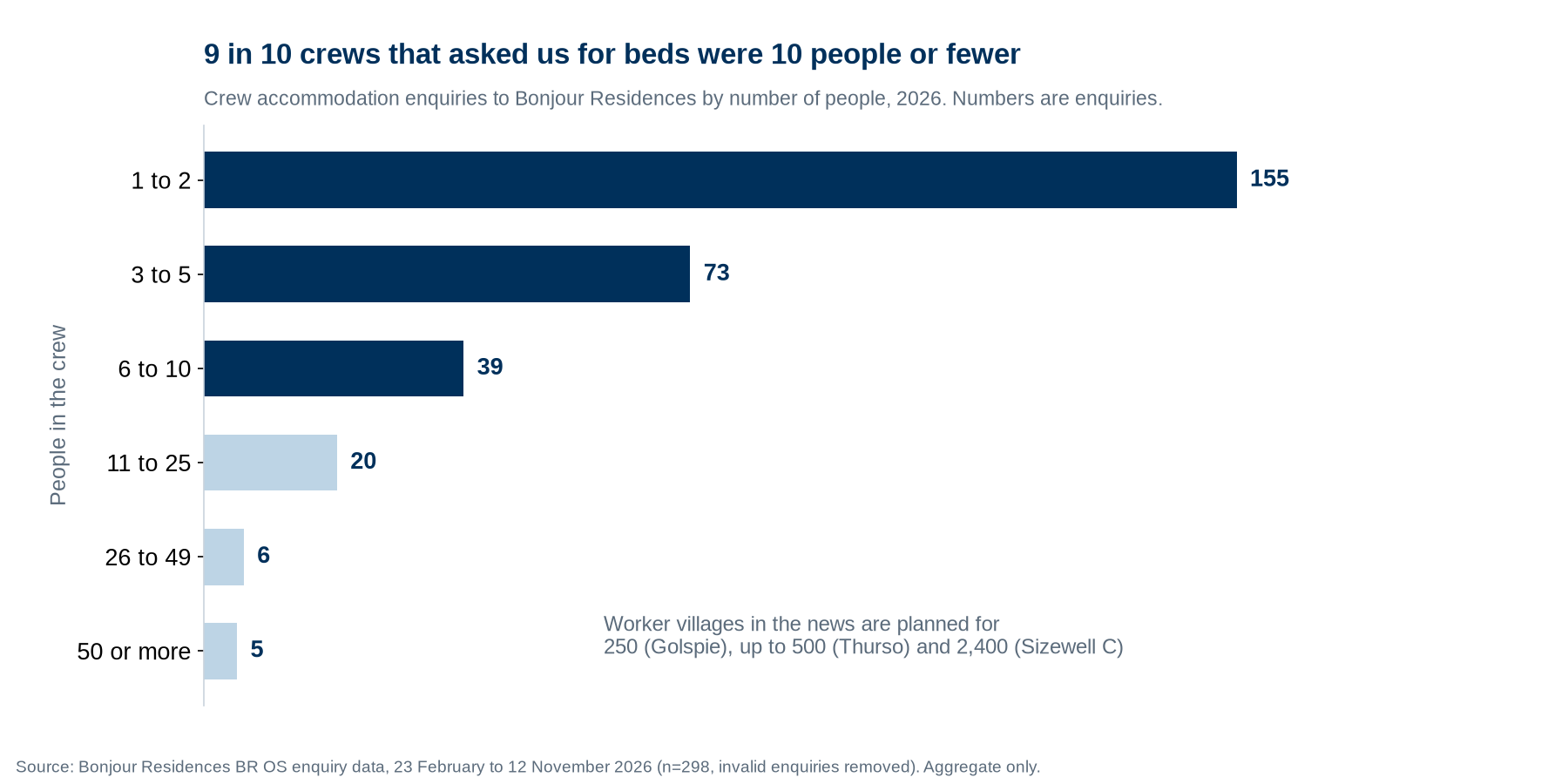
A worker village makes sense when hundreds of workers need beds for years in a place with no housing, but it needs planning consent, months of lead time and local support, and even Sizewell C plans to house only about half of its incoming peak workforce in its own campus and caravan park. In Bonjour Residences data, 267 of 298 crew accommodation enquiries in 2026 were for 10 people or fewer, and only 5 asked for 50 or more. Bonjour Residences advises bookers to plan local flats and houses as the default and to treat a village as an addition for the peak, not a replacement.
| 2people: the median crew size in 298 enquiries to us in 2026 | 5 of 298enquiries asked for beds for 50 people or more | 3,000 of 5,900incoming Sizewell C workers planned in its own campus and caravans at peak | 8 m²minimum floor space per worker in German site accommodation, containers included |
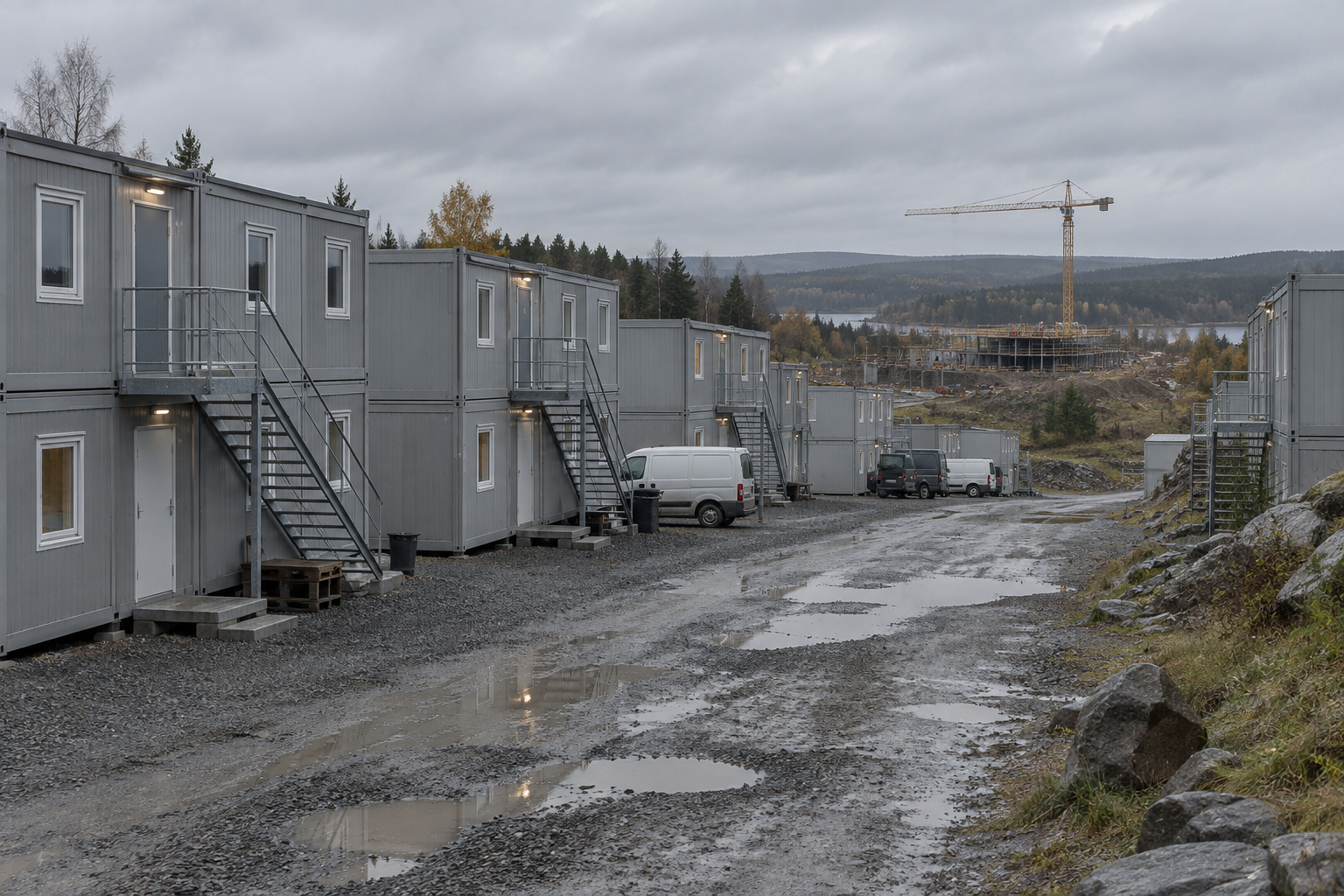
On 13 November, contractor J Murphy & Sons confirmed it has submitted plans to Highland Council for a temporary village for around 250 workers on the edge of Golspie, for five years, to build a pylon line that does not yet have consent. The same day, a distillery owner in Thurso called a second Murphy village, for up to 500 workers, "a recipe for chaos". In October, East Suffolk Council refused a plan to turn 35 holiday lodges near Beccles into year-round housing for Sizewell C workers.
Grid and nuclear projects need thousands of workers in places with little housing. Bookers on smaller projects now ask: should we build our own? Our argument: a village is a tool for hundreds of workers over years, and even then it only covers part of the crew. For almost every crew, local flats and houses are the default, and the village is an addition for the peak.
When does a worker village make sense?
When the numbers are large, the stay is long and the local stock is thin. Sizewell C expects up to 7,900 workers at peak, of whom around 5,900 would come from further afield. Its accommodation strategy plans a 2,400-bed campus on the site and a caravan park of up to 400 pitches, together housing up to 3,000 workers.
That still leaves the other half. The same strategy expects around 800 incoming workers in tourist accommodation, 1,200 in private rented homes and 880 buying a home, all within a 60-minute commute. If the biggest construction project in Britain plans to house half its incoming crew in the local market, a 20-person crew will not escape it.
What does it take to put the crew on site?
Less than most bookers think, if the beds really are on site. In England, Wales and Scotland, no caravan site licence is needed for land that is part of, or next to, a building or engineering site, if the caravans house people working on those operations. In England, planning permission is granted automatically for that use, on condition the caravans go once the works end.
A village off the site is a different matter. It needs a full planning application, and in Scotland a major one starts with a formal notice at least 12 weeks before. Murphy filed that notice for Golspie in December 2025 and the application has still to be validated.
In Germany, site containers count as worker accommodation under the workplace rule ASR A4.4. That means at least 8 m² per worker, no more than four beds in a container sleeping area, heating to at least 21 °C, separate sleeping areas per shift and a sick room once more than 50 people live there. The same rule says the employer may use local hotels and guesthouses instead, and has no duty to provide accommodation at all if it pays the workers' extra cost of finding their own.
How do the options compare?
| Option | Paperwork | Lead time | Works best for |
|---|---|---|---|
| Caravans on or next to the site (England) | No site licence or planning application needed while building works run, if only workers on those works live there | Weeks, once units and services are on site | Remote sites, shift work, short peaks |
| Worker village off the site | Full planning application, often a major development with public consultation | Golspie: about 11 months from first notice to application, decision still pending | Hundreds of workers for several years |
| Containers at a German site | Must meet ASR A4.4: 8 m² per worker, at most 4 beds per sleeping area, heating to 21 °C | Weeks to months | Remote sites, shift work, crews of dozens |
| Local flats and houses | Normal letting rules, plus local short-let rules for short stays | Days: our median is 3 days from booking to check-in | Crews of 1 to 25, stays of days to months |
What does our data show?
Most crews are far too small for a village. Between 23 February and 12 November 2026, bookers sent us 298 crew accommodation enquiries. The median was 2 people, 267 were for 10 people or fewer, and only 5 asked for 50 or more. Only 2 asked for 50 or more people for six months or longer.
Stays are short too. Of 283 enquiries with dates, the median was 24 nights, and 158 were for four weeks or less. A village that needs a year of planning cannot serve a crew that needs beds next week. When crews are bigger, we house them across several properties: 37 of our 162 booked enquiries used more than one, and the largest crew in one property was 27 people.
What should bookers do differently?
- Size the peak, not the average. A village earns its cost only if it stays full. Plan it for the steady core and house the peak locally.
- Count the lead time honestly. An off-site village needs planning consent. If the first workers arrive before the decision, you need local beds anyway.
- Use the on-site route if it fits. Caravans on or next to the site avoid a licence and a planning application, but only while works run and only for people working on them.
- Talk to the town early. Golspie, Thurso and Ellough all drew organised objections. Spreading a crew across local homes draws far less attention.
For crews between hotel rooms and a village, see when a crew outgrows hotel rooms and splitting a crew across flats. For very large builds, see data centre crew sizing.
FAQ
Do we need planning permission to put workers in caravans on a construction site?
In England, not if the caravans are on or next to the site and only house people working on those operations. The permission ends when the works end. A village elsewhere needs a full planning application.
Can German site containers be used as crew accommodation?
Yes, if they meet ASR A4.4: at least 8 m² per worker, no more than four beds per sleeping area, heating to 21 °C and the other listed facilities. Employers may also use local hotels or flats instead.
- Northern Times, Plans formally submitted for controversial Golspie workers' village, 13 November 2026.
- John O'Groat Journal, 'A recipe for chaos': distillery co-founder hits out over Thurso workers' village, 13 November 2026.
- Beccles and Bungay Journal, Ellough Sizewell C worker accommodation plan refused, 16 October 2026.
- SZC Co., The Sizewell C Project, 8.10 Accommodation Strategy, May 2020, Planning Inspectorate (EN010012), read 17 November 2026.
- Caravan Sites and Control of Development Act 1960, Schedule 1 paragraph 9, legislation.gov.uk, read 17 November 2026.
- Town and Country Planning (General Permitted Development) (England) Order 2015, Schedule 2 Part 5 Class A, legislation.gov.uk, read 17 November 2026.
- Planning etc. (Scotland) Act 2006 and Town and Country Planning (Development Management Procedure) (Scotland) Regulations 2013: pre-application notice at least 12 weeks before a major application.
- BAuA, Technische Regeln fuer Arbeitsstaetten ASR A4.4 Unterkuenfte, June 2010, last amended GMBl 2024 p. 914.
- Bonjour Residences, BR OS enquiry and booking data, 17 November 2026 (298 crew enquiries, 23 February to 12 November 2026; 162 booked enquiries). Anonymised aggregate, no client names or rates.

Contact us today to discuss your next project