The crew goes home every weekend: should we keep the accommodation or book Monday to Friday?
Booking a crew Monday to Friday saves two nights a week, but every block is a new short stay, so it never crosses the length lines that change the rules: 28 days for UK VAT on hotel stays, 30 nights for Spain's new 10% VAT on furnished flats from 1 December 2026, and 21 nights for Ireland's short-term letting register. In Bonjour Residences data, 117 of 205 crew stays started on a Sunday or Monday, and no flat was re-booked for the same crew after a weekend gap. Bonjour Residences advises keeping the accommodation through the weekend when the crew is coming back for more than about three weeks.
| 117 of 205crew stays with us started on a Sunday or Monday | 28 daysUK line after which VAT on a hotel stay falls, if the stay is continuous | 30 nightsSpain: furnished flat stays up to this length pay 10% VAT from 1 December 2026 | 21 nightsIreland: stays up to this length count as short-term lets under the new bill |
A project manager asked us this month for five blocks in January: check in Monday, check out Friday, four nights each, no weekend nights. The crew flies home on Friday. Why pay for Friday, Saturday and Sunday?
It is a fair question, and the most common rhythm we see: 117 of 205 crew stays booked through us started on a Sunday or Monday. Our argument: for a job of a week or two, book the working week. For anything longer, keep the accommodation through the weekend. Four nights a week looks like 43% fewer nights, but every block is a new short stay, and short stays sit on the wrong side of every length line in European tax and letting rules.
What changes when the crew checks out every Friday?
The length of the stay resets. Rules that reward or allow longer stays count consecutive nights in one stay, not nights per year or nights per project. A crew that does four nights a week for three months never gets past night four.
Three of those lines moved this autumn.
UK: the 28-day VAT rule
HMRC updated its hotels and holiday accommodation notice on 27 October. The rule it describes is old but often missed: when a guest stays in a hotel, inn, boarding house or similar establishment for more than 28 consecutive days, VAT from day 29 is due only on the part of the charge for facilities, at least 20% of it, not on the room itself.
The stay must be continuous. HMRC's own example: a guest who stays three weeks every month always pays VAT in full. A long-term resident who leaves for an occasional weekend, or who pays a retaining fee, keeps the stay going. A Monday-to-Friday booking never gets there. Our 28-day VAT guide covers the detail.
Spain: 10% VAT on stays of 30 nights or less
From 1 December 2026, Royal Decree-law 29/2026 removes the VAT exemption from furnished flats let for 30 nights or less, unless the flat is the landlord's own home. Those lets now pay 10% VAT. A weekly block is always under 30 nights. A three-month stay is not caught by this rule. Our Spain rental decree article covers the wider changes.
Ireland: 21 nights and the register
Ireland's Short-Term Letting and Tourism Bill 2026 passed the Dáil on 11 November and was down for its final Seanad stages on 18 November. It treats stays of up to 21 consecutive nights as short-term lets, which must be registered. Every four-night block is one. A crew staying for months is outside that definition, which widens the choice to homes that are not on any short-let register. More in our Ireland guide.
How do the rules compare?
| Country | Length line | Four nights a week, every week | One continuous stay |
|---|---|---|---|
| UK (hotels, inns, boarding houses and similar) | 28 consecutive days | Never reaches day 29: full VAT on every block | From day 29, VAT only on the facilities part, at least 20% of the charge; an occasional weekend away or a retaining fee keeps the stay continuous |
| Spain (furnished flats) | 30 nights, from 1 December 2026 | Every block is a stay of 30 nights or less: 10% VAT | Over 30 nights: outside the new 10% rule |
| Ireland (short-term letting bill) | 21 consecutive nights | Every block is a short-term let: the property must be on the register | Over 21 nights: not a short-term let under the bill |
The same logic runs through short-let registration across the EU since May 2026. A flat let by the week is a short-term rental and needs a registration number where the city requires one.
What does our data show?
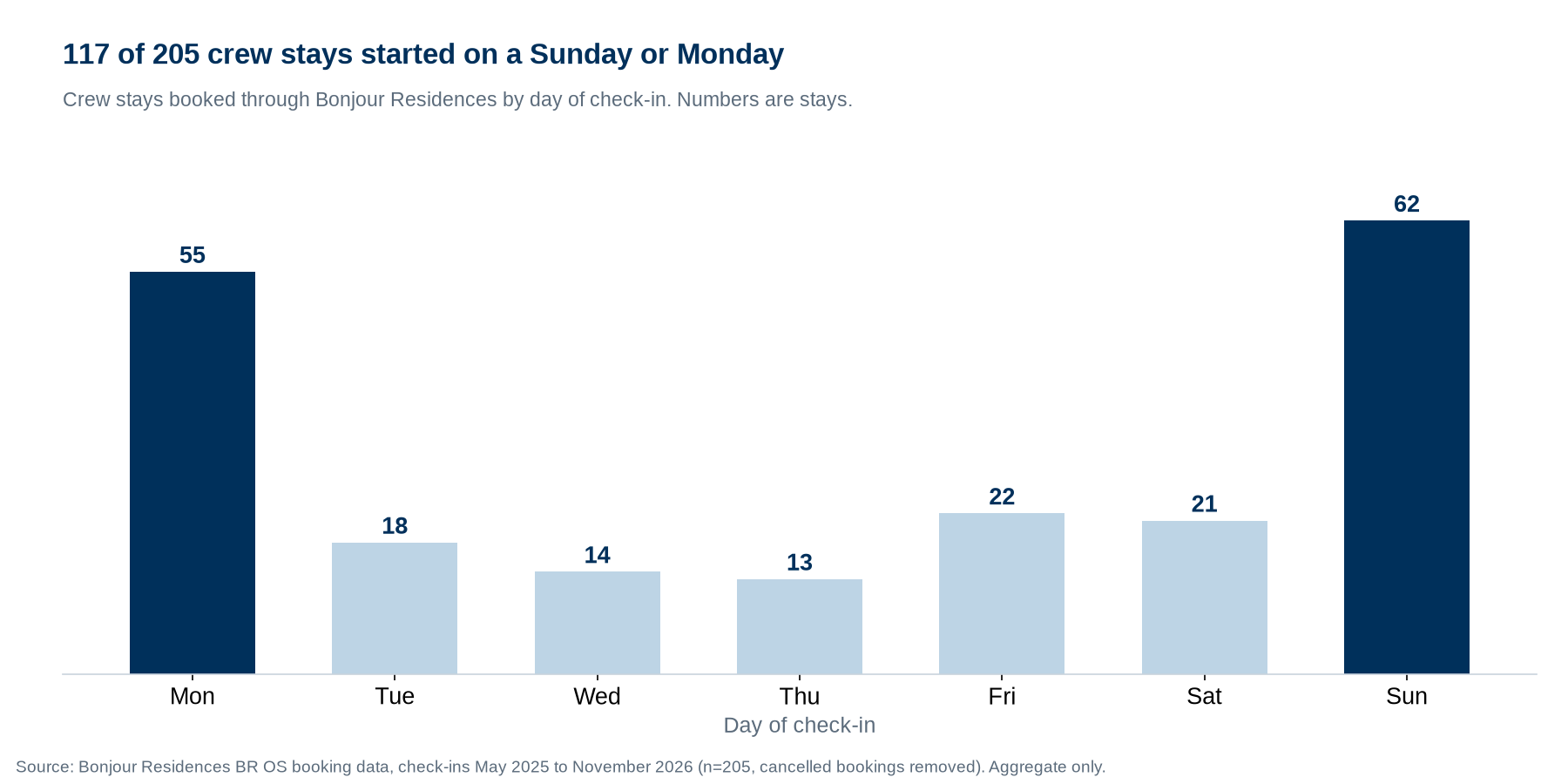
Crews arrive at the start of the week. Of 205 stays, 62 checked in on a Sunday and 55 on a Monday. Of the 68 stays of a week or less, 26 had no Friday or Saturday night at all: short, working-week jobs.
What we did not find is the weekly pattern repeated. Not once was the same flat re-booked for the same crew after a weekend gap. The 72 stays of four weeks or more ran through the weekends, and 33 of them were rolling monthly bookings that simply continued.
There are practical reasons too. A flat kept through the weekend keeps the tools, the drying work gear and the same beds. Nobody has to check in again on Monday morning, and there is no weekly change-over clean. A Monday-to-Friday flat goes back on the market every Friday, and in a busy town it may not come back.
When is Monday to Friday the right call?
When the job is one or two weeks, or when the crew changes from week to week. In those cases you never reach the length lines anyway, so pay only for the nights you use.
What should bookers do differently?
- Count the weeks, not the nights. If the same crew comes back for more than about three weeks, price one continuous stay next to weekly blocks, with VAT and local taxes included in both.
- Ask about the weekend. Ask the owner what keeping the flat over the weekend costs, or whether a retaining fee works. In UK hotels, a retaining fee also keeps the 28-day count running.
- Check the length lines in each country. 21 nights in Ireland, 28 days for UK hotel VAT, 30 nights for Spanish VAT from 1 December.
- Book the market for the length. Our clients have saved 20-30% by using the correct market for the length of stay. A crew that stays for months belongs in the mid-term market, not in weekly short lets.
If crews swap between weeks, our crew rotation guide covers how to change names without breaking the booking.
FAQ
Does the 28-day VAT rule stop if the crew goes home for a weekend?
Not if they are long-term residents leaving for an occasional weekend, or if a retaining fee is paid while they are away. HMRC says the time away is then ignored. A guest who stays three weeks every month pays full VAT every time.
Will Spanish crew stays pay VAT from December?
Furnished flat lets of 30 nights or less, other than the landlord's own home, pay 10% VAT from 1 December 2026. Longer stays are not caught by this change.
Is it cheaper to book only weeknights?
For one or two weeks, usually yes. For a longer job, compare total cost including VAT, tourist tax and change-over cleaning, and check whether the same flat will still be free on Monday.
- HM Revenue and Customs, Hotels and holiday accommodation (VAT Notice 709/3), section 3 Long stay guests, gov.uk, last updated 27 October 2026, read 19 November 2026.
- Agencia Tributaria, Novedades de normativa 2026: Real Decreto-ley 29/2026, de 6 de octubre (articles 20.Uno.23 e' and 91.Uno.2.2 LIVA), sede.agenciatributaria.gob.es, read 19 November 2026.
- Houses of the Oireachtas, Short-Term Letting and Tourism Bill 2026 (No. 101 of 2026): passed by Dáil Éireann 11 November 2026; Seanad Committee and Remaining Stages scheduled 18 November 2026.
- European Commission, New rules bring increased transparency to the short-term rentals sector, 20 May 2026 (Regulation (EU) 2024/1028).
- Bonjour Residences, BR OS booking and enquiry data, 19 November 2026 (205 non-cancelled crew stays, check-ins May 2025 to November 2026). Anonymised aggregate, no client names or rates.

Contact us today to discuss your next project