Grand déplacement in France: should the crew's allowance pay for the accommodation?
In France, a worker on grand déplacement can be paid a flat lodging and breakfast allowance free of social contributions up to EUR 56.80 a night outside Paris and its inner suburbs in 2026, cut by 15% from the fourth month, while lodging paid at real cost on receipts has no cap. Near big sites such as Flamanville and Penly, a flat allowance pushes the search for beds onto the crew and has led workers into caravans and tents. Bonjour Residences advises bookers to book and pay the crew's accommodation directly and to pay only the meal allowance on top.
| EUR 56.80lodging and breakfast cap a night outside Paris, 92, 93 and 94 in 2026, first 3 months | -15%cut to every allowance cap from the first day of the fourth month | 3,800people on the Flamanville site during reactor outages, against 2,500 normally | 172 of 209of our crew stays were booked for three months or less |
On 3 November 2026, actu.fr reported that up to 3,800 people were working at the Flamanville nuclear site during reactor outages, against 2,500 in normal times. One local figure described contractors who wanted to spend 100 euros a week on a worker's bed, and crews who ended up in mobile homes on an old stadium. A week earlier, a deputy mayor of Dieppe told a housing conference that the town is planning for more than 10,000 workers on the Penly EPR2 build, and named Flamanville as the example to avoid: workers who tried not to spend their travel allowances and lived in old caravans and tents, in camps of 500 to 700 people.
Our argument: in France, paying the crew a flat grand déplacement allowance and leaving the bed to them is a payroll answer to an accommodation problem. Near big sites, the company should book and pay the beds itself and keep the allowance for meals.
What does the grand déplacement allowance cover?
URSSAF treats a worker as on grand déplacement when the site is at least 50 km from home and public transport cannot cover the trip in under 1 hour 30. The employer can then cover meals and lodging either at real cost on receipts or with flat allowances that are free of social contributions up to set limits.
For 2026 the limits are EUR 21.40 per meal and EUR 56.80 a night for lodging and breakfast, or EUR 76.60 in Paris, Hauts-de-Seine, Seine-Saint-Denis and Val-de-Marne. From the first day of the fourth month, every limit drops by 15%, to EUR 48.30 a night outside Paris. From the 25th month it drops by 30%. Real costs repaid on receipts have no limit, as long as the company can show the job forced the cost.
Why is the flat allowance a problem for bookers?
Because it moves the search for a bed from the company to the worker. Every euro not spent on the bed stays in the worker's pocket. That is exactly the behaviour Dieppe described at Flamanville.
It is also not automatic. In a ruling of 10 April 2025 (no. 23-10.593), the Cour de cassation repeated that the employer must show the flat allowance compensates extra lodging costs before the exemption applies. In that case the firm signed the leases, deducted the rent from pay and paid the allowance, and the court accepted it because the workers really bore the cost. If the company books and pays the flat and recovers nothing, the crew has no lodging cost for a lodging allowance to cover.
And the employer stays responsible for the bed. Prévention BTP, the construction safety body, says the employer must make sure accommodation is available, clean, heated and aired, with a shower, washbasin and toilet. When collective housing is undignified, the client can be told to step in, as we covered in client liability for subcontractor housing in France.
How do the options compare?
| How the company covers lodging | What URSSAF looks at | What it means for the booker |
|---|---|---|
| Flat grand déplacement allowance, crew finds its own bed | Lodging and breakfast cap EUR 56.80 a night (EUR 76.60 in Paris, 92, 93, 94); the company must show the crew really pays extra lodging | Crew hunts for beds; any excess over the cap counts as pay |
| Real costs repaid on receipts | No cap, if the company proves the cost is forced by the job and keeps the receipts | Admin per worker; the crew still books and pays first |
| Company books and pays the property | Crew bears no lodging cost, so there is no lodging allowance to justify; meal allowance still possible | One invoice in the company's name, a known address and a known standard |
Sources: URSSAF frais professionnels pages and Cour de cassation, read on 22 November 2026. Collective agreements and company agreements can set higher allowances; the caps only decide what is free of contributions.
What does our booking data show?
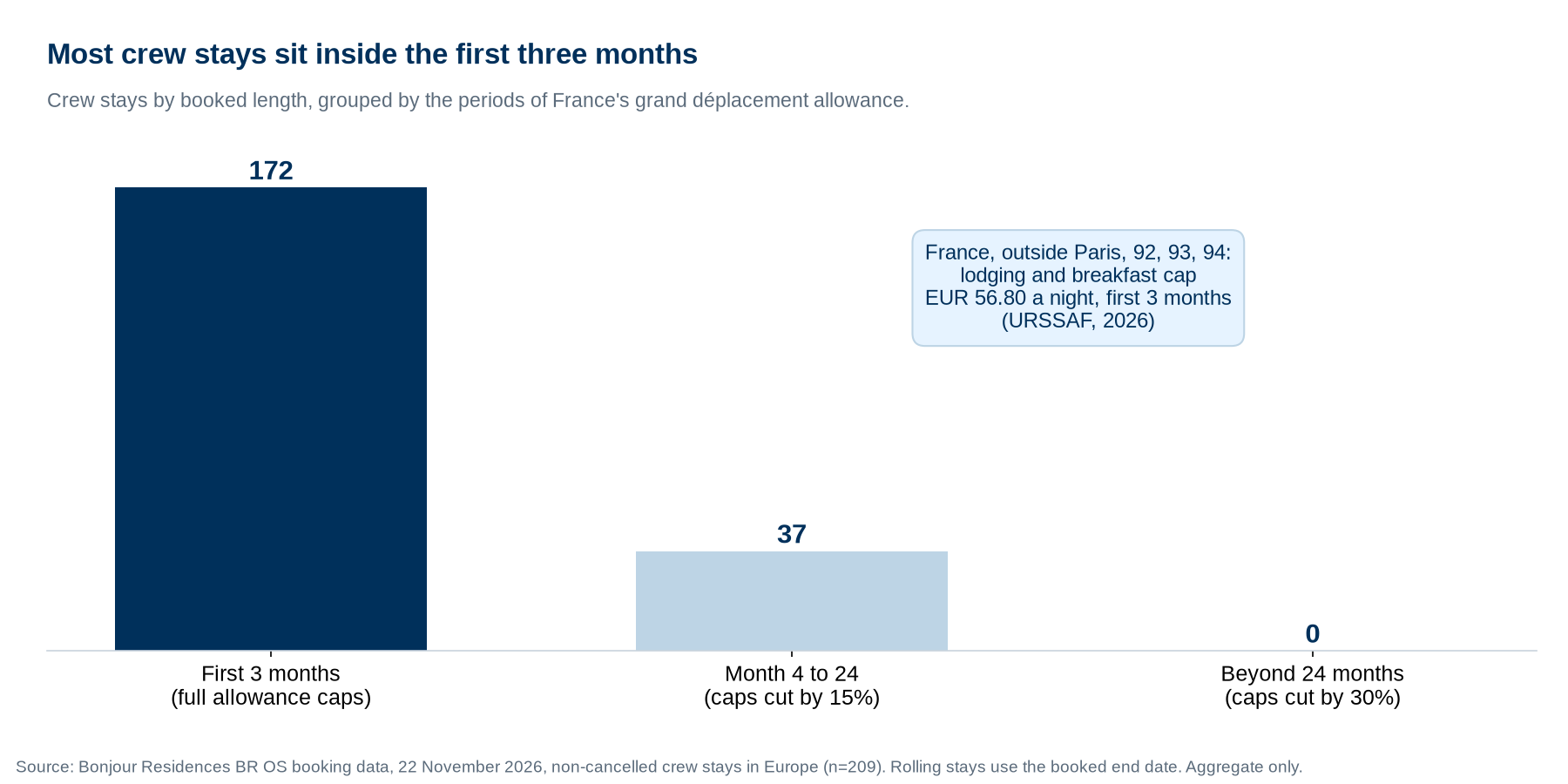
Across 209 non-cancelled crew stays in Europe with check-ins from May 2025 to November 2026, 172 were booked for three months or less, the period with the full allowance caps. 37 ran into months four to 24, and 24 of those were rolling bookings with no fixed end, the point where the caps drop and, as we found in stays over three months, the booking often runs longer than planned.
Our French stays are a small sample, 12 bookings in 9 towns, all outside the Paris area, so the EUR 56.80 cap is the relevant one. 11 of the 12 were 16 nights or fewer. Where the booking company's country was recorded, 6 of 12, it was a UK firm. Small numbers: a pattern, not a benchmark.
That last point matters. Crews posted to France by a foreign employer usually stay in their home social security system, so the URSSAF caps are a French payroll question. Posting rules still apply: under the EU posting directive, allowances specific to the posting count as pay unless they repay travel, board or lodging actually spent, as we explained in deducting accommodation from posted workers' pay.

What should bookers do differently?
- Book and pay the beds for any crew near a big site. One invoice in the company's name is real cost with no cap and a known standard.
- Pay the meal allowance, not the lodging allowance, on top. If the crew bears no lodging cost, a lodging allowance has nothing to compensate.
- Book early around nuclear outages and major works. Flamanville, Penly and the Lyon to Turin works in the Maurienne, with 3,378 workers on 30 September 2026, all compete for the same beds.
- Plan the fourth month. If you keep flat allowances, the caps drop by 15% then, so budget for it or switch to direct booking.
- Keep the paper trail. Mission order, site address, dates and invoices for each worker, ready for an URSSAF check or a SIPSI declaration.
Our clients have saved 20-30% by using the correct market for the length of stay.
FAQ
Is the grand déplacement allowance compulsory?
The URSSAF limits are not amounts the employer must pay; they are the ceiling free of social contributions. What the worker is owed comes from the collective agreement and the employment contract.
Can the company pay both the hotel and a lodging allowance?
That is risky. The exemption needs proof that the allowance compensates extra lodging costs the worker really bears. If the company pays the property and recovers nothing, that proof is hard to give.
- URSSAF, Les frais professionnels: grand déplacement, montants pour 2026, read 22 November 2026.
- Cour de cassation, 2e chambre civile, 10 April 2025, no. 23-10.593 (courdecassation.fr), read 22 November 2026.
- Prévention BTP (OPPBTP), Comment organiser l'hébergement des salariés en déplacement, updated 25 September 2026.
- actu.fr, Réserver un hôtel dans le Cotentin: un casse-tête pour certaines entreprises, 3 November 2026.
- Cadre de Ville, À Dieppe, des logements transformables en réponse à l'afflux de travailleurs du chantier EPR2, 27 October 2026.
- Nos Alpes, Turin-Lyon: où trouver des logements pour les travailleurs dans le Val de Suse et en Maurienne, 3 November 2026.
- Directive (EU) 2018/957 amending Directive 96/71/EC, article 3(7) (EUR-Lex).
- Bonjour Residences, BR OS booking data, 22 November 2026 (n=209 non-cancelled stays in Europe, n=12 in France). Anonymised aggregate, no client names or rates.

Contact us today to discuss your next project