Should you book crew accommodation before the contract is signed?
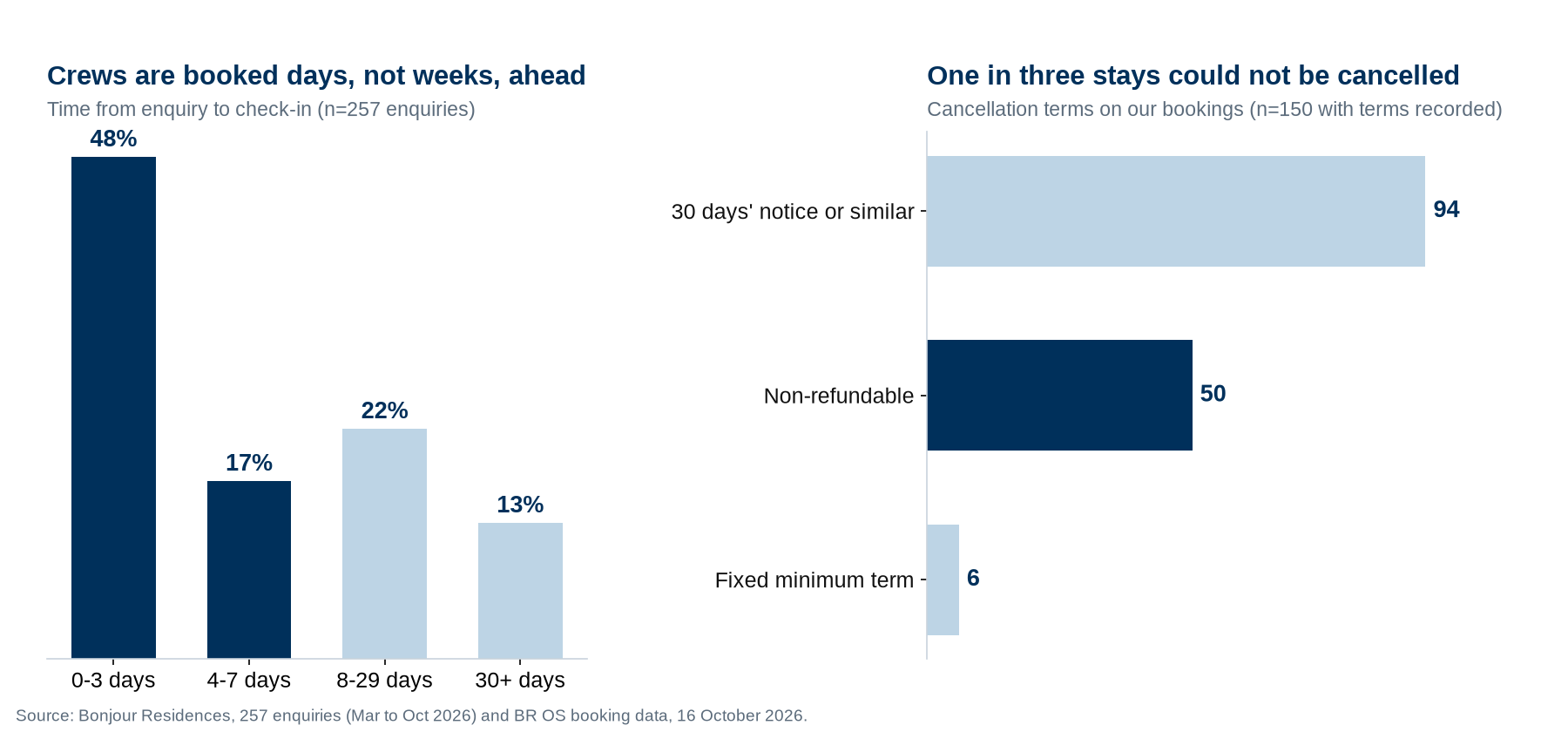
Waiting for the signed contract usually means booking crew accommodation in a panic: in Bonjour Residences data, the median time from enquiry to check-in is 4 days and only 13% of requests are planned 30 or more days ahead. Bookers should hold beds before signature, but only on terms they can walk away from, because a third of the cancellation terms on our bookings were non-refundable. The rule of thumb: secure the first weeks on flexible terms once the award is likely, and commit to the full stay once the contract is signed.
| 4 daysmedian time from enquiry to check-in in our data (n=257 enquiries) | 8 / 15working days a public contract must wait after award: UK standstill / Spain | 1 in 3of the cancellation terms on our bookings were non-refundable (50 of 150) | 7%of our bookings were cancelled before or during the stay (15 of 216) |
Every booker of crew accommodation knows the dilemma. The client says the award is coming "any day now". The crew has to be on site the week after signature. If you book now and the contract slips, you pay for empty beds. If you wait, you book in a hurry, into whatever is left.
Our answer: do book before signature, but book a different thing. A hold on flexible terms, not the stay.
Why does accommodation always get booked so late?
Because the accommodation request follows the signature, and the crew follows days later. Across 257 enquiries we handled between March and October 2026, the median time from enquiry to check-in was 4 days. 48% of requests needed beds within 3 days, and only 13% were planned 30 or more days ahead.
Contractors are told to start the moment the paper is signed. When Native Land appointed Bennett Construction on its 180-home St Mary's Wharf scheme in Guildford on 12 October, Bennett was to take over the site and start preparatory work immediately, with the main phase following in the coming weeks. On 15 October Webuild signed an EUR 803 million contract for Lot B of Genoa's undersea road tunnel. Signature is the starting gun, not the planning stage.
How long is the gap between "you've won" and the signed contract?
Longer than site teams expect, and on public work it is written into law. In the UK, the Procurement Act 2023 (section 51) bars the authority from entering into the contract until a standstill period of eight working days after the contract award notice. In Spain, a contract open to a special appeal cannot be formalised until fifteen working days after the award is notified (Public Sector Contracts Law, article 153), and if a bidder appeals the award, the procedure is suspended automatically (article 53).
That suspension is not theoretical. On 2 October the award for the first buildings of the Army Logistics Base in Córdoba, two lots worth around EUR 344 million, was frozen after a losing joint venture appealed, and the appeals court kept the suspension in place. Any crew booked for that start date is now waiting with everyone else.
Private work has its own grey zone: letters of intent and pre-construction services agreements. On 6 October Construction News reported that Kier will be reinstated on a pre-construction services agreement at the UK Health Security campus in Harlow, four years after the contract was suspended for funding reasons; main construction is not expected before late 2029. A pre-contract agreement can mean design and surveys, not a full crew.
What does it cost to get it wrong?
It depends almost entirely on the cancellation terms. Of the 150 bookings where we recorded them, 94 were notice-based, mostly 30 days, 50 were non-refundable and 6 had a fixed minimum term. 15 of our 216 bookings were cancelled, and 6 of the 13 with terms on file were non-refundable.
A non-refundable booking made a fortnight before an award that then slips is a full loss. A 30-day notice booking turns the same slip into, at worst, a month of rent. A hold with free cancellation up to a week before arrival costs nothing. The nightly rate matters less than the exit.
| Stage | What is certain | What to book | Terms to ask for |
|---|---|---|---|
| Bid submitted | Nothing | Nothing; map the market near the site | None, just availability and a quote |
| Preferred bidder or award notice | You will probably win, the date may move | A hold on the first 2 to 4 weeks | Free cancellation up to 7 to 14 days before arrival |
| Standstill, letter of intent or PCSA | Work can start, scope is still limited | Beds for the advance team only | Flexible start date, monthly notice |
| Contract signed | Scope and programme | The full first phase, by the month | 30 days' notice, extension option |
| Start on site | Real headcount | Top-ups as the crew grows | Same terms as the main booking |

What should bookers do differently?
- Start at preferred bidder, not at signature. Once the award is likely, map what is available near the site and put a hold on the first weeks.
- Never book non-refundable before signature. Ask for free cancellation up to 7 to 14 days before arrival, even at a slightly higher rate.
- Book the advance team, not the peak. During a letter of intent or PCSA, house the people actually working; add beds when the headcount is real.
- Build the standstill into the date. On public work, count at least the standstill period, and on appealable contracts, assume the date can move by weeks.
- Commit to the full stay once signed, by the month. Longer stays belong in apartments and monthly lets, not nightly rooms. Our clients have saved 20-30% by using the correct market for the length of stay.
- Get an extension option in writing, so a later slip at the other end does not leave the crew homeless.
Related: Our project slipped 6 weeks: what happens to the crew's accommodation?, our lead time data and what project managers need before mobilisation.
FAQ
Can I cancel crew accommodation if we lose the contract?
Only if the booking terms allow it. Notice-based terms limit the loss to the notice period; non-refundable terms do not. Agree the terms before you pay, not after the award.
How early should crew accommodation be booked?
Hold beds once the award is likely, then confirm the full stay at signature. In our data, most requests come only days before arrival, which leaves little choice.
Does a letter of intent justify booking the whole crew?
Usually not. Book for the work the letter actually covers, often a small advance team, and scale up when the contract is signed.
- Procurement Act 2023, section 51 (standstill periods on the award of contracts), legislation.gov.uk, read 16 October 2026.
- Ley 9/2017 de Contratos del Sector Público, articles 53 and 153, BOE consolidated text, read 16 October 2026.
- Actualidad eCommerce, The Army Logistics Base in Córdoba is in limbo after a joint venture appeals its decision, 2 October 2026.
- Construction News, Kier to return to GBP 3.5bn health campus project after four-year absence, 6 October 2026.
- Construction Enquirer, Bennett Construction to build GBP 132m Guildford scheme, 12 October 2026.
- Webuild Group, Genoa undersea road tunnel: Autostrade per l'Italia and Webuild sign EUR 803 million contract for Lot B, press note, 15 October 2026.
- Bonjour Residences, anonymised aggregate of 257 accommodation enquiries, March to October 2026, and BR OS booking data, 16 October 2026 (216 bookings; cancellation terms recorded on 150; 15 cancelled). No client names or rates.

Contact us today to discuss your next project